In Germany .. book publishing is a fluctuating industry!
By: Saleh Suliman
When the young girl Helga Weyhe started working in the family library in the small town of Salzwedel in the former East Germany, Hitler was still setting Europe on fire with wars... and after (73) years, the oldest bookstore owner in her country still practices her activity at the age of ninety-five.
This woman, descending from the Weyhe family, started working in 1944. She represents the third generation of the family passionate about literature in managing this library that opened its doors in 1840. The shelves date back to the eighties of the nineteenth century in the time of her grandfather, Chancellor "Otto von Bismarck." This interest, represented by Helga and her family, is nothing but an extension of the Germans' interest in books and the book for more than 500 years, that is, since the launch of the oldest book fair in the world, which is the Frankfurt Book Fair, and the continuation of this fair's holding and prosperity, along with the Leipzig Book Fair, both of which attract many visitors from inside and outside Germany.
Germans and the passion for reading
Germans are among the European people most passionate about reading; it is part of their daily habit that cannot be separated from their daily activity. These (industrial par excellence) people read different types of books, whether novels or detective or social stories, and they do not hesitate to invest their short leisure times that occur during their workday in reading. Reading for them has no specific time or place; they read in public and private transport.
In parks, in waiting times at doctors' clinics, and in stores. Also, a house of Germans and Europeans is rarely empty of a personal library.
Creative writing in Germany
Due to this passion for reading, and perhaps it is also one of its results, we find that the trend towards creative writing is a strong trend in Germany since time, whether in terms of the momentum of literary works or in terms of teaching the art of writing to others at the hands of many writers who hold educational courses in this art. Also, folk schools and other educational institutes raised the level of their educational materials, so that if you enter a large library, you sense a wide spread of works that guide to successful writing methods.
Among the prominent titles on that is the book "Taking New Writers by the Hand" and "How I Write a Book that Achieves Record Sales." At the same time, the media shows increasing interest in emerging writers, specifically those who enjoy real talent, enabling them to pursue the path of literary authorship with full success.
Germany is the country of writers, literati and poets, and the country of authorship. Every year, (100) thousand new books enter the publishing market, and library shelves are filled with a huge amount of books offered in Germany's libraries annually. This country is famous, as we mentioned, for the book fairs that are held on its land at different times of the year, most notably the Frankfurt Book Fair, which is held in October of each year, and the Leipzig Fair, which is held in March.
The Frankfurt Book Fair started its first steps in the fifteenth century, where it was an exhibition for the production of the German book printing pioneer, Johannes Gutenberg. In the middle of the sixteenth century, the Frankfurt Fair lost its importance and was surpassed by the Leipzig Fair for political and social reasons.
After the division of Germany following World War II, the fair returned to its glory and developed continuously for the number of books displayed to reach more than (400) thousand books. Its area became (172) thousand square meters distributed over five large display halls, each divided into (13) halls. The number of its visitors in the past year (2019 AD) reached (302,267) visitors, an increase of 5.5% compared to the year before (year 2018: 285,024), and the number of professional visitors this year exceeded (144) thousand.
Thus, this fair with the momentum of the number of its visitors, the number of countries and publishing houses participating in it, and the movement of buying and selling that takes place during its opening, gives us a general picture of the state of the book in Germany.
The publishing industry here is flourishing
Those in charge of book fairs in Germany confirm that the industry of publishing and selling books in Germany is flourishing and there are no indicators that it is experiencing a decline. During the last three years, a number of people established publishing houses in Germany. Therefore, this industry is renewing itself, and Germany has a diverse and effective system of publishing houses that meet the needs of the entire reading public, whether those passionate about knowledge or researchers as well as those who read for pleasure.
By looking at the German libraries directory, we find it includes about 15,000 companies for publishing books, some of which undertake book publishing occasionally. Generally, the economic situation for the publishing industry in Germany is considered healthy: as this industry has managed to raise its sales volume since 1992 by 53 percent. Preliminary estimates indicate a rise in the total volume of sales since 2010 to more than 5.4 billion euros.
Despite this boom in the publishing and book market, this did not prevent the existence of difficulties facing emerging authors who may not find publishing houses to undertake publishing their works, as publishers are keen on well-known writers and their works that can be marketed successfully according to the German (DW) website.
These houses have managed to reap as much profit as possible. But they show little interest in the works of unknown authors and their interest remains limited to young writers despite the presence of a large number of them who try to write and publish and send their texts to publishing houses, which receive a huge number of them, as says the text reviewer at Suhrkamp Publishing House, Charlotte Brumbach.
Libraries in Germany
The number of important German libraries is estimated at two thousand libraries varying between public and university libraries and libraries affiliated with churches, museums and schools and others belonging
to the states and big cities in addition to libraries specialized in sciences or letters, and libraries
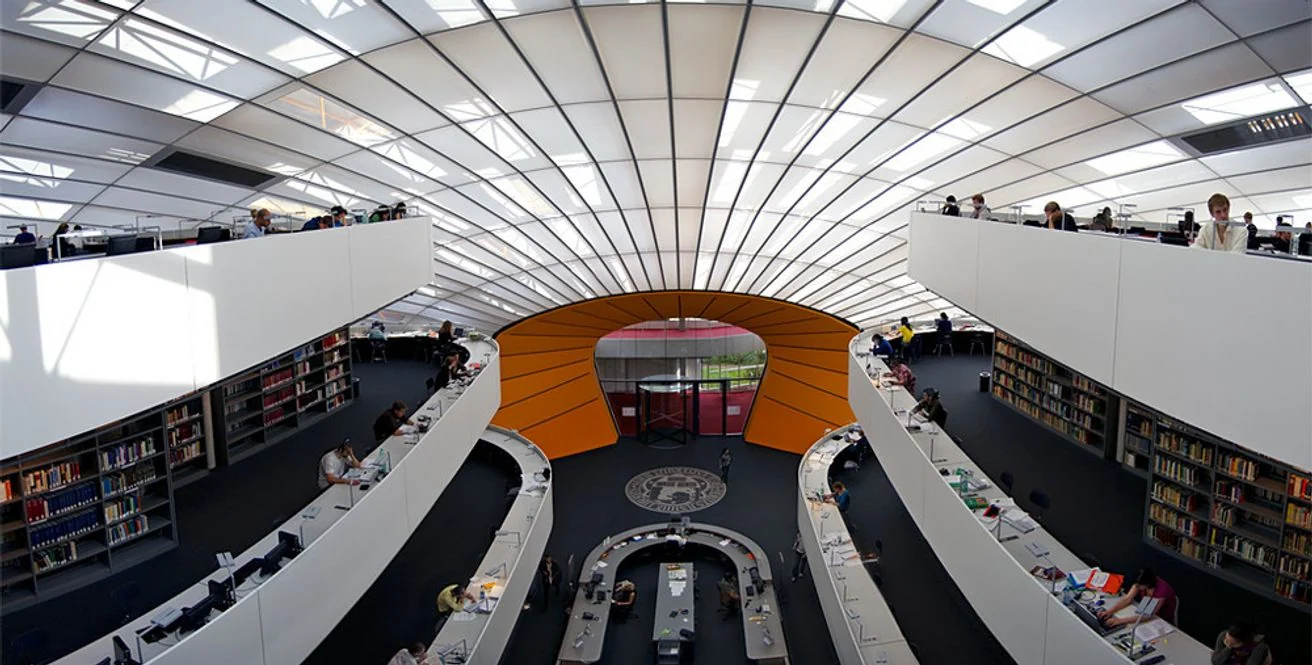
generally enjoy the admiration of all visitors based on their wonderful geometric design that mostly maintains its old architectural character, and also because of the system and service provided to visitors in light of what each library is rich with original books. Rather, perhaps this turnout is due to the extreme calm that overshadows the place, which helps concentration. German libraries are generally famous for the helpful climate; besides the system, the seats are plush, comfortable and healthy, helping greatly to sit for long periods so individuals do not tire of reading.
Also commercial bookstores spread in large German cities, and their floors multiply, and they are crowded with people all the time. They are greatly crowded in holiday seasons for people's turnout to buy gifts of books. The book for Germans is considered a precious gift. Although these stores seek profit through selling and trading in books, they allow the right of internal lending, and the visitor can read any of the books his hands reach for as long as he is inside.
Library Union
The libraries in Germany are gathered by a union called the German Library Association headquartered in Berlin. Among its most important functions is linking libraries to the German Parliament and relevant German ministries and international bodies concerned with culture. Despite all this interest in books and libraries and the attempt to improve them and provide them in society, the spokesperson for the Association of Books and Libraries recently stated that the image of libraries among the German people needs improvement, clarification and distinction based on the importance of their cultural and scientific role in German society.
The Library Union pays much care to children's and youth's books and works on improving them constantly. For this reason, the Union hurried to demand taking into account the inclinations of children and youth and linking old cultural means with modern ones as it sees that the book does not conflict with the internet. In many fields the book cannot be dispensed with just as the network cannot be dispensed with in some cases too.
Paper vs. Electronic
In January 2018, the private market research unit of the German Book Trade Association presented data indicating a remarkable drop among book buyers, a report that raised the concern of publishers and sellers alike. The figures showed that - except for textbooks and references, the number of German book buyers decreased by more than six million people in the period between 2012 and 2016 and this trend continued in 2017.
This development only caught people's attention very late given that the revenue figures issued by the industry remained very stable. The actual number of books sold only slightly declined, amidst a trend of fewer buyers buying more books generally and more expensive books.
And that causes not only an increasing gap in buying behavior: rather what is more disturbing for the book industry is that reading behavior is changing.
According to the "Allensbach" institute for opinion polls, a 2017 study showed that the number of Germans who bought at least one book once a week fell from 49 percent in 2012 to 42 percent last year.
Above all, this decline was recorded among younger readers (14 to 29 years) besides the middle generation (30 to 59 years).
At the same time, the trend towards reading fewer books also reached people of higher educational levels.
Fingers point to social media sites such as Facebook, "WhatsApp" and "Instagram" as potential causes, where they compete with books for attention and reading time.
At the same time, the electronic book, according to the latest studies, has not established itself, to a large extent, with a generation of youth who enjoy digital smartness, in another way, for even with best intentions, it is very difficult to read a book on a smartphone, which has now become the most important companion for humanity.
Studies show that it is still possible to motivate teenagers to read books. For years, the number of teenagers from 12 to 19 years, who read for pleasure, is still steady.
According to an academic study of youth and media for the year 2017, performed by a research institute in the German state of Baden-Württemberg, one girl out of every two and one boy out of every three reads books regularly.
Publishers in the face of electronic book numbers despite their lack of stability do not want to surrender and confirm their superiority in the industry of the book and its publishing because it is the main source of information and knowledge.
References
- Germany in Arabic website
- DW website (DW)
- Fekr Cultural Magazine
- Free Encyclopedia (Wikipedia)
- Dar Al-Fikr January 13, 2013
- Saudi Digital Library
- Al-Qafila Magazine January 2016
- Elaph Electronic newspaper March 2, 2010