The Kingdom topped the rate of its use Arabically and globally – Twitter space: creative, cultural and technical interaction that changed the forms of writing and delivery
The Saudi presence on the social networking site "Twitter" formed a case of great interaction that included various fields of writing, social and cultural communication, as well as news, daily, economic, social, heritage and cognitive in general.
Dr. Nawal bint Nasser Al-Suwailem points out in her book: "Brief Literary Forms in the Twitter Space" that Saudis are the most using the Twitter site in the Arab world at a rate of (38%) as the Kingdom also topped the countries of the world in the rate of active users for the Twitter site where it obtained a rate of (41%) according to a study conducted by the statistics department at the site "Business Insider" in late 2013 AD. That is, the turnout was early by Saudis since the founding of the Twitter site.
Intensity of effect:
And because this presence on Twitter required great energies of concentration given the publishing conditions on the site that do not exceed (280) characters, the writings in (Twitter) carry a degree of intensity, clarification of the vision, and clarification of the direct al from what exactly is written, and how to influence followers, especially by public figures whose numbers of followers reach millions.
Twitter icons and its terms began to spread a lot between: the tweet, hashtag, trend, and emotion, and between writing, images and transformations of discourse, until it became a main and official platform also for various bodies and institutions, vernmental or private.
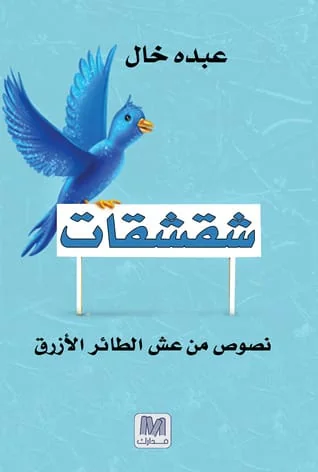
it is a major shift that required writers and followers to author in it, so the well-known novelist Abdo Khal published several books carrying his tweets that he published on the site, including: "Chirpings: Texts from the Nest of the Blue Bird"
Dr. Abdulrahman Al-Muhasini published a book titled: "Critical Optics: Chapters on the Intersection of Literature and Technology" and Dr. Lamia Baashan published: "Angles of the Circle"
And in the book of Dr. Nawal bint Nasser Al-Suwailem: "Brief Literary Forms in the Twitter Space" referred to previously, she seeks in it to study the reflections of modern technology on literature, and she believes that one of the most prominent striking manifestations in this effect is the attraction of the Twitter site for writers, poets and prose writers, who record brief literature technically called the tweet. The tweet is technically defined as: "Everything you write in the text box of shares, replies or re-posting of shares," and this means it is a template that accommodates several literary and non-literary contents.
The author believes that literary tweets are brief literary forms, different from the literary forms practiced in literature old and new, varying in their size without strict restrictions that limit the flow, and choking it in a number of words.
Media dominance
Dr. Nawal Al-Suwailem attributes the reasons for her study of this subject to the communications revolution and the increasing interest in modern technology in all fields of life, and the dominance of the new media and the Twitter site in attracting segments of society, and the tendency of writers to electronic literary publishing, and the need of the Arab library for applied studies that keep pace with development and conditions of the era, and the author provided her book with an entry about brief literary forms, then two chapters in which she addressed: the problem of genre classification, the discourse, the news, the poetry, the aesthetics of reception, the implicit reader, the one spoken to, and the digital reader.
Brief literary forms are a pattern of texts known since ancient times in old Arab literature and foreign literatures, and are not among the givens of modern literature nor a fruit from the fruits of the digital era and the communication revolution, and they are texts "characterized by their brevity" and in the definition of the brief, Nietzsche defines it with his saying: "The least in number of sounds and signs and the most energy," and depends on two properties: shortness and poeticism, through the realization of artistic and rhetorical features and expressive techniques.
Our Arab heritage is full of these forms of writing such as: wisdom, proverbs, aphorisms about writers, anecdotes, short wills, literary fragments, the art of signatures, and the poetic snippet, and all of them are mentioned in books of selections and literary heritage as in (Zahr al-Adab) by Al-Husari al-Qayrawani, and "Majma' al-Amthal" by Al-Nisaburi, and as in the Greek art of the epigram, and the book "Jannat al-Shawk" by Taha Hussein, and short prose and poetic pieces.
The author transfers a large collection of tweets for Saudi writers and poets to analyze them such as: Mohammed Al-Ratyan, Mohammed Al-Suhaimi, Eid Al-Hujaili, Ibrahim Zouli, Fawaz Al-Labboun, Munira Al-Qasim, Haifa Al-Hamdan, Zakia Al-Otaibi, Mufreh Al-Shaqiqi, Awadh Shaher, Jassim Al-Sahih, Taher Al-Zarei, and Abdulmohsen Al-S...