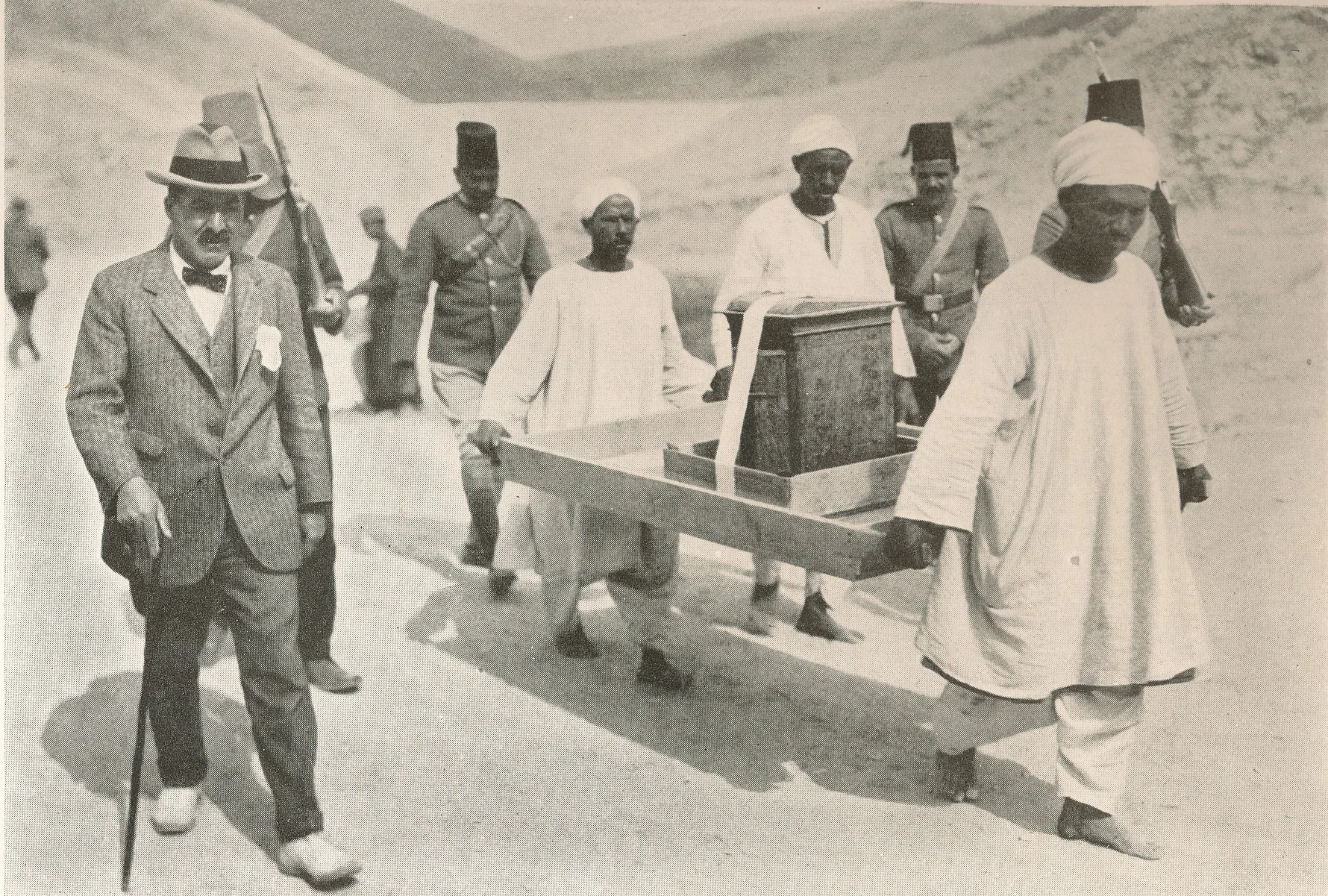
A book by the British Christina Riggs provides the first critical analysis of the photo archive.. the tomb and treasures of the lden Pharaoh Tutankhamun
Hajjaj Salama
In her book published in London under the title: "PHOTOGRAPHING TUTANKHAMUN: ARCHAEOLOGY, ANCIENT EGYPT, AND THE ARCHIVE", the English scholar Christina Riggs attempts to restore that archive of historical photographs documenting the moments of her British compatriot Howard Carter’s discovery of the tomb and treasures of the lden Pharaoh King Tutankhamun in the Valley of the Kings on the West Bank of the historic city of Luxor in Upper Egypt, in November 1922, 99 years a. She worked on studying and analyzing that rich archive over the ten years following the discovery, which is considered one of the most important archaeological discoveries in history. Those years witnessed the restoration of the collection of artifacts belonging to the lden Pharaoh, and the restoration of the tomb and its preparation to receive visitors. The book came as a comprehensive study of the photographic archive of Tutankhamun’s excavations, shedding light on the history of the discovery of that Pharaoh’s tomb and the various paths the tomb, its treasures, and its archive have taken since the 1920s until today.
Harry Burton
Christina Riggs’ book includes a study of the work of photographer "Harry Burton," who was one of the leading photographers of ancient Egyptian antiquities. He accompanied the British explorer Howard Carter and was present during all stages of the discovery of the tomb and treasures of King Tutankhamun. In her book, Christina Riggs focused on exploring the ways in which photography helped create the myths of King Tutankhamun’s tomb and the role photography played in shaping the archaeological methods and interpretations related to that discovery, which has attracted the world’s attention to this day.
The book provides a critical analysis of the photographic archive formed during the ten-year clearing of the tomb, thereby exploring the relationship between photography and archaeology at a pivotal time for both. Tutankhamun’s photography highlights photography as a physical, technical, and social process in early 20th-century archaeology.
The Most Famous Images
The book presents a collection of some of the most famous photographs ever in archaeology: "British explorer Howard Carter kneeling before the tombs of Tutankhamun, life-size statues of the boy king—who moved Egypt to the world and moved the world to Egypt—beside a tightly sealed entrance in his tomb, and a solid ld coffin still wrapped in cut flowers from more than 3,300 years a."
Perhaps the essence of Christina Riggs’ book lies in the call to return to the extensive archive of photographs taken by Harry Burton in Tutankhamun’s tomb between 1922 and 1933, which are now kept by the Griffith Institute in Oxford and the Metropolitan Museum in New York, and to read these archives carefully, observing the features of the relationship and connection between photography and archaeology, especially in the first decades of the twentieth century and beyond. These photographs represent a huge archive consisting of 3,400 images, along with a collection of documents associated with this massive group of photos documenting the details and diaries of the daily digging, excavation, and search for the tomb and treasures of Pharaoh Tutankhamun in the Valley of the Kings, until that discovery was reached, some of whose secrets may remain difficult to understand to this day. Christina Riggs is a British academic, a professor in the field of visual culture, and a researcher in the field of photography and archaeology. She has a special interest in the history of the North African region in general, and Ancient Egypt in particular, and the development that has occurred in archaeology and what is known as Egyptology during various historical eras.
Photographic Archives
Christina Riggs has expanded her research to include other photographic archives, whether those private collections owned by individuals or museum collections of photographs related to the history of art in Ancient Egypt. She is also interested in photography of historical routes. She began her scientific career training as an Egyptologist—a researcher in the history and archaeology of ancient Egypt—and started her professional career working on the visual culture of Roman Egypt and curating museum collections of Egyptian antiquities. Before joining the Department of History at Durham University, she spent twelve years in the Department of Art History and World Art Studies at the University of East Anglia, Norwich.
It is noteworthy that on Saturday, November 4, 1922, the world was witness to one of the greatest archaeological discoveries of the twentieth century. At ten o'clock that day, while British explorer Howard Carter was conducting a comprehensive survey of the Valley of the Kings archaeological area west of Luxor, sent by Lord Herbert, 5th Earl of Carnarvon (1866-1923), he found the first stone step through which he reached the tomb of the boy king Tutankhamun and its dazzling treasures. Howard Carter found Tutankhamun’s treasure in its entirety without thieves reaching it for over three thousand years. The hidden treasure contained sarcophagus shrines, statues of the young king, ld jewelry, magical and ordinary foundations, lden shrines, and ceramic vessels. The contents of the tomb gave archaeologists a unique opportunity to delve deeper into the nature of life in the era of the Eighteenth Dynasty (1550-1319 BC), which is considered a period of special importance in the history of Ancient Egypt. Howard Carter was a British explorer, born in London in 1874, and gained his fame thanks to his discovery of the tomb and treasures of King Tutankhamun in the Theban Necropolis—the capital of Ancient Egypt—located in the embrace of Mount Qurna on the West Bank of the historic city of Luxor in Upper Egypt.