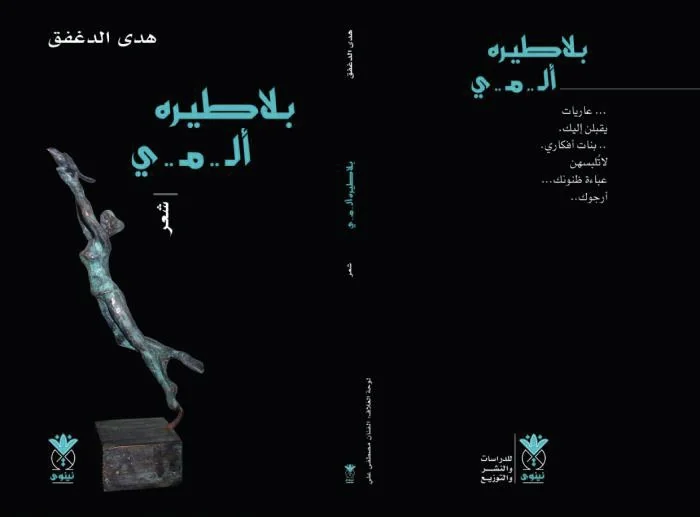
Focusing on dreams, writing and childhood.. Huda Al-Daghfag in her collection: "My Pain Without a Bird"
Abdullah Al-Samti
Does pain have a bird?
The feeling of loss, brokenness, and the recurrence of wounds on the self creates an overwhelming pain, in which the arrowheads break upon arrowheads, as the painful expression of Abu al-Tayyib al-Mutanabbi puts it. So, does pain fly?
Does it have wings? Where does it fly? And how? And if it flies and lands far away in the distances, can it be fortten, or does it return time after time?
Poetry – as an art that transcends logic and creates its own lives and prayers through language – is able to give pain a bird, and make it soar either in the heavens of the senses or the spaces of the soul. Pain has a bird. And the bird has its literature and metaphors in the Arab and Islamic religious, mythological, poetic, and prose heritage.
The bird has an inspiring presence, and in legends the phoenix rises after being burned, and in the Arab heritage the griffin (Anqa) rises from its ashes.
This is the logic of the bird, or this is the scene of its presence, and it is often compared to, borrowed from, or entered into a recurring symbolic state in poetry and prose.
It is more evident and widespread in folk heritage. In her collection: "My Pain Without a Bird," Nineveh House for Studies and Publishing, which includes (37) texts and is located in (72) medium-sized pages.
The poet denies the presence of the bird with pain, but it is a temporary denial. Pain pecks like a bird, and pain does not far, but rather renews itself. Pain is a title for the soul, and it is not necessarily a physical pain resulting from wounds that may heal, but it is the pain of the soul, the pain of writing, and the pain of the imagination.
With a letter and three words, the poet Huda Al-Daghfag begins her collection with a very brief text with an exciting title from a semantic point of view and its mythological dimension: "Transmigration." The choice of the title does not come by chance. Choosing the title is part of the text, and from here the poet, when she names this indicative word charged with its mythology, points to a large horizon, regardless of the brevity and intensity of the words. It is a poetic sentence distributed over four lines that says:
Tame
No...
...does it tire of me
...my alienation
The alienation here is tame, it has become familiar with the poetic self and inhabited it. The alienation is not satisfied with this familiarity, but rather transmigrates and reproduces, in a common act between the poetic self and alienation. Therefore, naming the text: "Transmigration" is a meaningful name if we recall the meaning of transmigration in some terrestrial mythological visions that make souls not disappear or away, or ascend to their Creator, but rather transmigrate from soul to soul, and from body to body. The two metaphorical bodies here that the poet presents as a poetic parable are: the poetic self and alienation.
Alienation has become more familiar and common, and it is not certainly the alienation of travel, but it is the alienation of place and time, the alienation of an era, the alienation of a soul, and the alienation of a word.
The poet's care for the word made her care for what is around the word, the typographic form of the page, the letter distribution of the words, punctuation marks, and the font size, as if the poet does not just sign the word in its acoustic and musical dimension, but also in its plastic dimension. The poet is one of those fascinated by music and visual arts, as told in her book: "I Rip the Burqa.. I See."