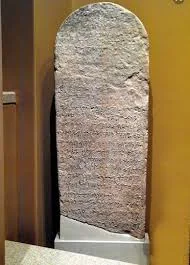
From Tulaihan Palace in Tayma to the Louvre Museum .. A Saudi obelisk transferred to France more than 139 years a. Will it be recovered?
On Sunday, February 17, 1884 AD, the German traveler Julius Euting (1839-1913) found an archaeological stone (the Tayma Obelisk) during his visit to Tayma accompanied by Charles Huber. They agreed to transfer it to Germany, but it was moved to France, where it became part of the collections of the Louvre Museum in Paris.
What is the story of this obelisk? What does it contain? And in what era was it carved and inscribed?
The Tayma Obelisk has a historical archaeological value. It is a sculpture made of limestone weighing 150 kg, 110 cm long, 43 cm wide, and 12 cm thick. It has an inscription in the Aramaic language consisting of twenty-three lines about the inauguration of (Salm Sharb) as a priest in the temple of (Salm Hajam) in Tayma. Archaeologists and historians have differed over the significance of this sculpture. Some said that the drawing in the upper part symbolizes the deity Salm Hajam, while others see that it represents one of the kings due to the lack of symbols and signs that usually appear with images and statues of deities. Even the conical helmet that is on the head of the standing person in the upper part of the obelisk resembles the helmets that used to appear on the heads of Assyrian warriors and Babylonian kings, meaning that it is among human clothing and not deities, which include the two-horned crown and pleated clothing. they also differed in the date of the obelisk; some say it is from the fifth century BC, and some say it is from the sixth century BC. Perhaps the latter opinion is correct when comparing the carving on the obelisk with the carvings on the two Harran obelisks that date back to the era of the Babylonian King Nabonidus (555-539 BC).
Story of Detection:
Julius Euting recounts in his book: "Journey Inside the Arabian Peninsula" that he passed by a large square-shaped palace with towers on the corners, and went to the palace of "Asmah Tulaihan". There he found the most precious treasure or booty in his journey to the Arabian Peninsula..
He saw at Tulaihan''s, to the right on the right post of the inner door, an upside-down stone on which were carved human shapes representing a deity or a king and a priest. This stone (the Tayma Stone), "when I saw an inscription written on it, drawn with an Aramaic pen, I could not hide my feelings of surprise. I copied it on paper, then gave the owner of the house some money with pleasure, and ordered Zaidan to bring it to me early the next morning. I went quickly and was tired and agitated to the house, to tell Huber about the new discovery, and that the importance of the inscription written on it lies in the fact that it is written with an Aramaic pen dating back to the sixth century BC.
Studies on the Obelisk:
A large group of studies have been written about this artifact, among them what Theodor Nöldeke published in July 1884, which is the first "original" documentation drawing of this obelisk with a detailed study of its text, based on the research of Julius Euting. Huber''s research regarding this stone was issued in 1891, with another documentation drawing prepared by the German Orientalist Enno Littmann. Between these two issues, the first photograph of the obelisk was published in 1889 in one of the volumes of the "Encyclopedia of Semitic Writings".
On the edge of the side frame of this obelisk, we find a protruding pictorial carving that combines two scenes. In the top scene, a priest stands wearing a high hat, carrying a long scepter. In the bottom scene, a bareheaded worshiper stands, raising his arms towards an altar. The Babylonian style that dates back to the sixth century BC predominates on the pictorial carving, but the Aramaic writing points to the fifth century BC, i.e., to the Persian era. The inscribed writing does not bear any royal name, but its opening refers to a reign that lasted twenty-two years, which refers to the reign of Darius I, or the reign of Arshir I. .
The name Tayma shone in conjunction with the emergence of its obelisk, and researchers and excavators flocked to this oasis to study its features. In the middle of the last century, the British Arabist John Philby continued this exploratory journey.
The Kingdom''s care for Tayma''s antiquities began more than fifty years a, and in recent years, the Kingdom has been seeking to recover its antiquities located abroad, including the Tayma Obelisk after nearly 140 years of its departure to France.