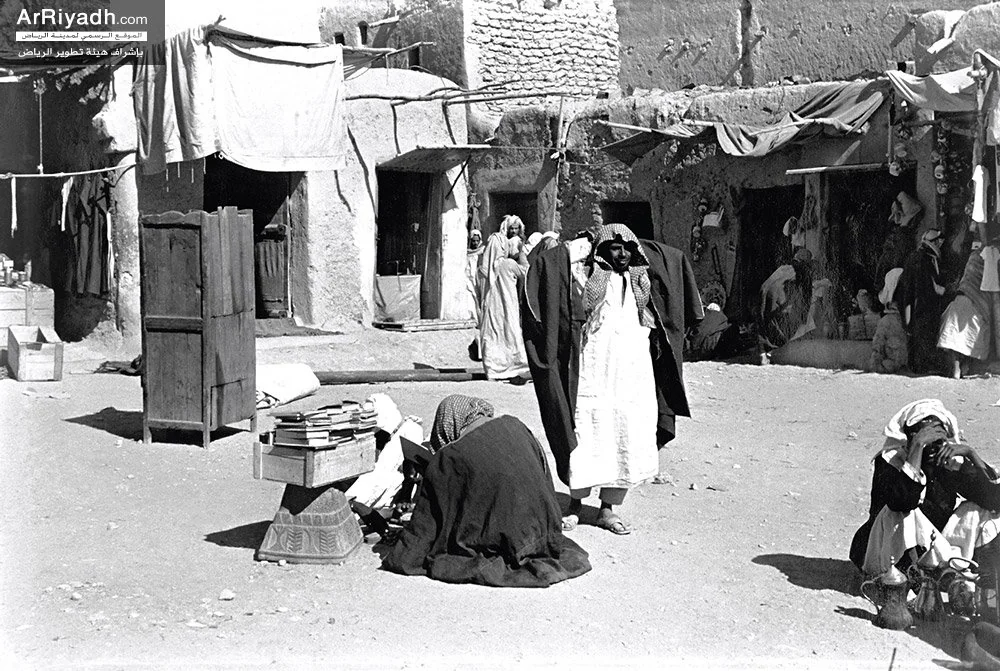
It was called: "Mawsem" and held around "Al-Safat" Square.. Old Riyadh Markets: A popular commercial heritage documented by history and traditions
There is a vast civilizational difference between the advanced civilizational features that the city of Riyadh is experiencing today in various fields of life, and what it was experiencing in the early stages of its founding. Riyadh, the capital of the Kingdom of Saudi Arabia, is a meeting point of diverse civilizations, and today it is an incubator for medical, scientific, cultural, economic and sports centers, as well as its new open-horizon buildings that have kept pace with the presence of malls, markets and commercial centers at the highest international levels.
But the memories of the place – in its heritage dimension – always appear and loom on the horizon of heritage and cultural restoration, perhaps so that the follower can learn about the features of a city that has evolved civilizationally to the furthest extent, like other global cities. There is something old that recurs in the customs, traditions and places in old Riyadh, whether at the level of buildings, professions and crafts, or markets.
The pattern of Riyadh markets was in the form of stores lined up in the squares and wide streets in the center of the town next to the palace and the mosque: the Justice Palace and the Grand Mosque, where there was space for shoppers and their ods and the draft animals that came to the market to transport ods or display them for sale. These commercial stores and their locations are called (Mawsem) (with a damma on the mim and a fatha on the sin), which is a local dialect meaning the place of buying and selling, and it does not mean temporary seasons for sale, but rather permanent shops filled with ods crowded with shoppers and passers-by. The season is located in a central place between neighborhoods in order to facilitate access to it from all places.
There are many places for buying and selling in old Riyadh, between squares and open land spaces in the city center, where (Al-Safat) or (Al-Baraha) is considered the most important square in old Riyadh because of its central location in the middle of the city, and because it is surrounded by the main market, in addition to the view of the Justice Palace and some other palaces from it. Horses, camels and weapons were sold in (Al-Safat), and Ardah dances were held there on occasions. In the northwest of the Justice Palace are the rest of the markets, then they head south to a large square called Al-Maqbara (Al-Maqbara Square).
Most famous ancient markets:
The markets in old Riyadh were many and varied, the most famous of which were the (Al-Hadam) market, which is for clothes, the (Al-Zal) market for rugs, (Al-Thumairi), the (Dakhna) market, and the Qaysariyah Aba Oud, located north of the Al-Hadam market and west of the Ibn Mudaimigh school, the (Tamer) market, the (Al-Kharrazin) market, the (Al-Alaf) market, and the (Al-Hasawiyah) market, which was named so because most of those who work in it are from the Al-Ahsa region. It is a market specialized in sewing clothes, and it is one of the branches descending from Al-Safat Square.
There was also the (Women's Market) which was located adjacent to the palace wall from the northern side, where women sold things related to their peers and what they needed of beauty tools and their own purposes.
Al-Safat Square, which embraces all these markets, is a large square located in front of the Grand Mosque, and was full of movement and people. Al-Safat witnessed popular festivals and Najdi (Saudi) Ardah dances in which King Abdulaziz – may d have mercy on him – participated with the residents, and the enthusiasm of these dances inspired the poet Fahid bin Dahim, which made people flock to this place from all over Riyadh. The poet Abdullah bin Khamis said, depicting the reality of life in Al-Safat:
Its crowds surge in Al-Safat Square.. and the messenger of the returners meets its alarm
Voices cry out in it, its bare horses neigh.. and its thirsty ones roar and its young camels bray
If Abdulaziz led it to a banner.. its naming would be terrifying and would change its deception
Various markets:
It is natural in the field of trade and selling that there are various and specialized markets, as there are markets that sell everything immediately by auction as in the auction market square, or Haraj bin Qasim which was called Haraj (Ibn Nafisah). Among these markets are (Money Changers) south of the auction, and the old (Al-Bazz) market, meaning fabrics, and (Qaysariyah Qureimish), which is one of the famous markets specialized in selling women's fabrics, and is located west of the Justice Palace, the slaughterhouse, the artisans, and the market south of the palace. The Bisht trade was one of the popular trades in the past, and all these markets and shops were in the (Al-Safat) area in central Riyadh.
In the (Al-Muraigib) neighborhood, there was the Al-Maqbara market, located south of Hillat Al-Qana'i. The market included selling animal feed, fruits, vegetables, fat, food, coffee, meat, and farming and carpentry tools.
References:
- Old Riyadh, High Commission for the Development of Riyadh, First Edition 2015
- Khalid bin Ahmed Al-Suliman Al-Anqari: Dictionary of the City of Riyadh, Third Edition 2012