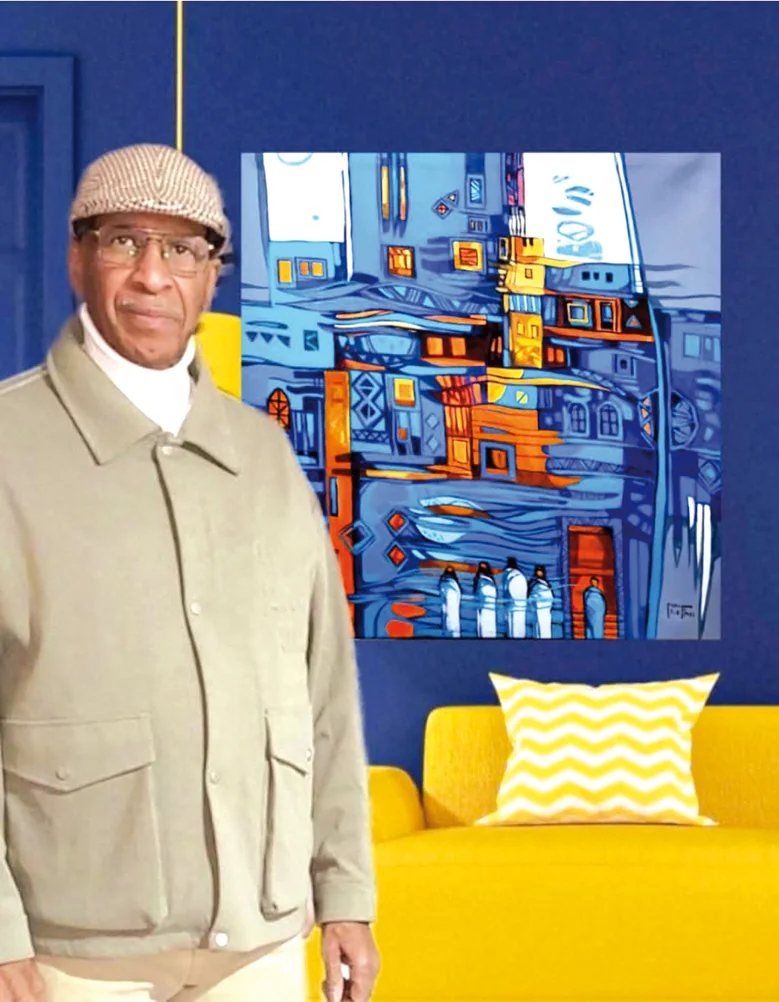
Al-Daham in his new book: Conscious approaches between art and literature
Abdel Hafeez Al-Shammari
Excellence and Structure: A Mark of Skillful Giving
Visual artist Samir Al-Daham has been known for four decades in his creative journey as one of the artists who follow the method of realistic composition that mixes aesthetics with abstraction, leading to a clear aesthetic understanding that achieves enjoyment and benefit from moments of contemplation of any work the artist presents to the viewer.
In this correlation between constant aesthetic visions, Al-Daham excels in the impact of art with its interesting inspirational dimensions... those that achieve for the viewer the pleasure of contemplation and the inquiry leading to an understanding of the truth of the essence of creativity and the contribution of a human armed with knowledge and awareness.
Although Al-Daham approached these artistic concepts and other aesthetic experiences, he is sincerely dedicated to deriving the od idea, summoning the appropriate color, and drawing clear lines so that the artistic work for him is not just experimentation, but rather is embodied in the form of a complete intellectual framework that determines the path of the visual experience for him and allows for clear communication between him and the viewer to create aesthetic trust that achieves the best for the taste.
Artist Samir Al-Daham drew from the spring of local heritage and derived human visions, so he formulated this integrated visual project, which has extended over four decades and continues.. he is always diligent in building the equation of (beauty and benefit).. in the first part of this equation, Al-Daham aspires to present astonishing aesthetics of artistic composition, and in the other part, he establishes the importance of the contemplator of his paintings coming out with a clear idea where no image can be confused or overlap with another.
Samir Al-Daham summons the image of the local environment, where he excels in drawing the image of the struggling human, such as the shepherd, the worker, the farmer, the artisan, the carpenter, and the handicraft maker. In these, the artist sees a huge energy of giving; they are, besides being characters in his works, in a permanent state of producing art that parallels the truth of pleasure and the effects of benefit, where they are an active part in the equation of success, distinction, and splendor in any painting the artist presents.
"Banat Afkari" between art lines and literature letters
Samir Marzouq Al-Daham presents through his new book "Banat Afkari" (My Brainchildren) a new and rare vision in its presence to the reader.. presenting us with artistic and literary approaches in the painting, showing everyone the expressive images that occurred to him with two close visions that can be read.
In every two pages of this book, we see on the right side a painting from his works, and on the other, a literary text that generates the written artistic image. However, before this contemplation, we realize that every text in the book comes to interpret the painting or composition, where the original is the visual art, and then the literary text comes to blend the visions and add a symbolic dimension to these works that Al-Daham presented with high craftsmanship, spreading a lot of realistic art that does not accept interpretation or pictorial flights of fancy.
Another thing we stand in parallel with regarding this new book by Al-Daham is represented in the time differences between the date of the painting and the moment of writing the text accompanying it. The artist relies on current writing about the visions and ideas that remained in his mind since he drew these paintings until his writing of these aesthetic texts that achieve their influential dimension on the taste in a distinguished inspirational way credited to Samir Al-Daham as a brilliant master for a whole generation of artists in the homeland.
The journey that brings together visual art and written literature is always wonderful and amazing, where the aesthetic dimension remains latent in the folds of this experience. In the journey of the book "Banat Afkari" specifically, we find color, lines, dimensions, images, and the flavor of the depicted scene. We also find in contrast the text crowded with the pleasure of creativity in words and the embodiment of aesthetic visions. In this marriage between art and literature, the reader comes out with a complete vision in which aesthetic images cooperate and crowd side by side with rushing human inputs in construction, distinction, and human presence.
In writing "Banat Afkari", Samir Al-Daham colors a huge space of the homeland's horizon to see him excelling in drawing the image of the real human who seeks to build his beautiful glory and his realistic contemplation of life that does not accept excessive imagination. If imagination comes in Al-Daham's experience, it remains a stimulating imagination for an inquiry into some inert objects that the artist cannot present in their current state, such as his depiction of buildings, stones, mud, and tools that have been affected by wear and stagnation. However, Al-Daham's ability continued in building this artistic truth to embody for us the real human dimension, even if through these imaginative images that rely on the idea of imagining reality out of a desire to represent it in a true and clear way that achieves enjoyment and benefit.
In the book "Banat Afkari", there is a harmonious duality that aims to inquiry the human image of the lived reality, such as his opening with the painting "The Village" which he supported with a textual vision titled "Who has no past...". He is the one who establishes in the painting the image of the past as the original identity, while narrating his realistic vision that necessitates a repeated reading of all the details of life that formed the past for us in the form of a heritage we must communicate with.
While Al-Daham sees that the present will be provisions for the future, he makes from history a true sequence in the form of a wave pushing another, to form with time this human momentum that some store with awareness, while others squander it.
Vision of Beauty.. A Digression in Drawing "Was"
Artist Samir Al-Daham aims in this book "Banat Afkari" to reveal one truth for these multiple visions, as his main idea lies in digging through the piles of consecutive life for a human to search for aesthetic images touched by decay or wear. Nothing other than authentic art and beautiful writing is what restores their luster to see him sincerely deriving the images of beautiful life in the past.
He remained proud, boastful, and jubilant about that beautiful past that dwells in yesterday and resides in those halls full of the dense presence of the past, like the painting "Joys" and the text "Missed Call". In this mixture between painting and text, we are returned to the past and brought closer to it through language codes that began explaining the contemporary and new in a distinguished style.
While the aesthetics of the past remain in that joy and stormy aesthetic color in those moments, there is beautiful joy that stores whiteness and colors of delight in the waves of these tunes for an old wedding where melodious voices attract these rushing rhythms of the tambourines, as if we are before a moment of joy that is still falling now on the ears of this time, which has become more dissonance in the piece of life panting behind a persistent life.
Samir Al-Daham prepares in drawing the details of his writing about the past in a group of motivators where the idea is the basis, while language inquires the lines of the setting moment to record its presence in the self, especially when the painting is coming from the womb of the past. He is here with us, attracting the reader towards watching the painting and then reading the corresponding text so that this cooperation leads to drawing the comparison image between the past (Was) as beautiful, and the present (Now) as persistent endurance in summoning what is more beautiful than these modern developments from which we are usually only saved by representing the beautiful past.
From here we can conclude the fact that the visual artist Al-Daham cared for the reader's matter and did not want to burden him in representing some paintings, so he provided a bundle of his color expertise, even if they came in the folds of this book uncolored; they reflect an inquiry vision of the idea of the painting and its meaning described by the accompanying title, and the writing he showers on us that refers us to stand in parallel with a human scene worth watching and reading together. This is what he excelled in when he depicted the last step of a human in his constant run with modern life, while trying in a beautiful style to remind us that the train of life will stop at any station and carry with it new faces, while leaving behind those who were outlived by time.. None of them was worth reaching an ideal al.