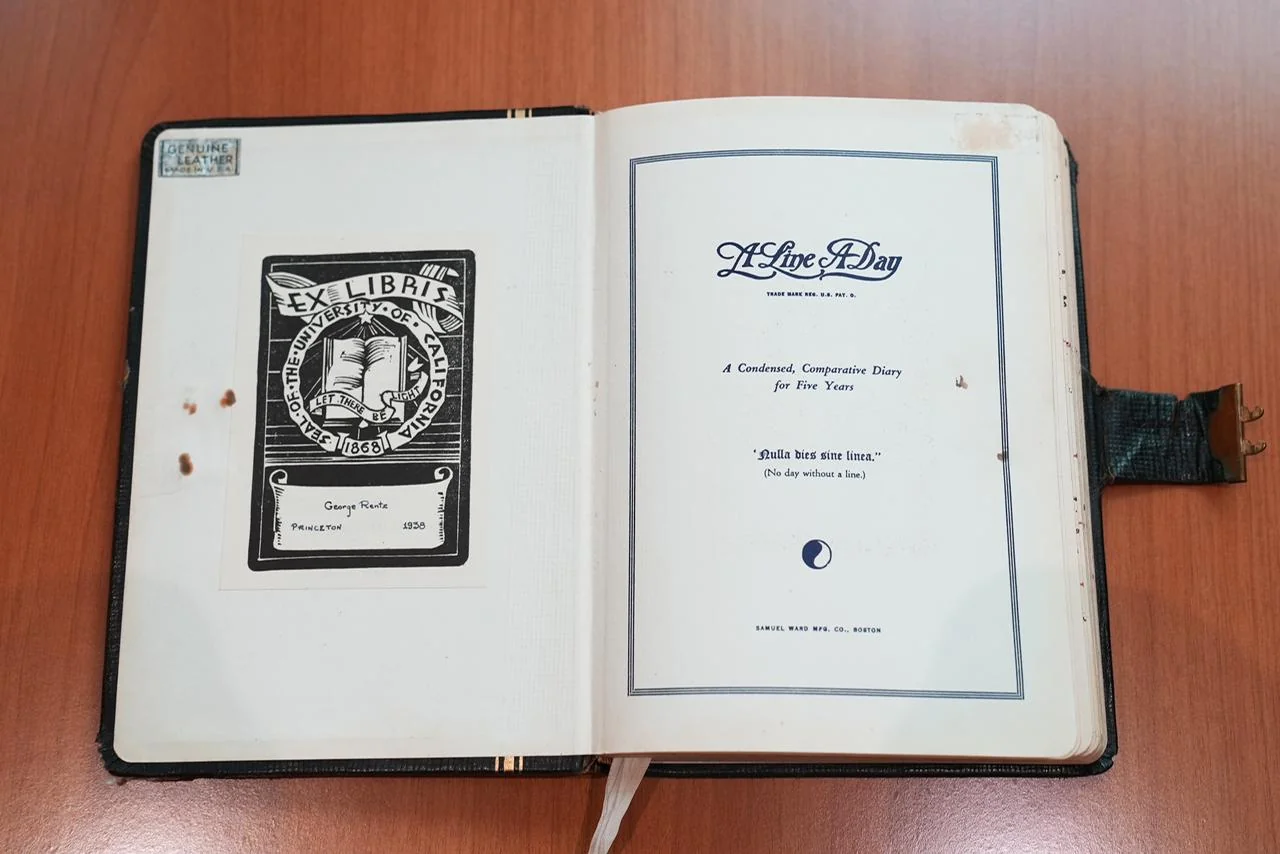
He changed his ambitions from the military to scientific research. George Rentz, the American orientalist, records Saudi history after World War II
Perhaps it was fortunate that the US Navy did not accept "George S. Rentz" into its naval military cadre because of a minor hearing impairment. The well-known American orientalist George Rentz wanted to join the US Navy to become a naval military commander like his father, but he was unable to do so. Therefore, he abandoned his war ambition to become a fighter in another more humane and bright field, deeper in civilization, which is the scientific, research, cultural and orientalist field that manifested in a set of high-level scientific and research works that he wrote while working as a translator and researcher at the Arabian American Oil Company (Aramco), where he provided a distinct cognitive production in reading and monitoring contemporary Saudi history during his period of work between 1946-1963 and he is the founder of the Research and Translation Department in the vernment Relations Department at Aramco.
George Rentz was born in Welsh Run, Pennsylvania, on April 10, 1912. He was the eldest of four sons to his father, George S. Rentz Sr., a well-known naval commander. In 1928, Rentz graduated from Pensacola High School in Florida and studied engineering at Georgia Tech. Then he moved to the Philippines, where his father''s services were transferred, where he lived there between 1930-1932, during which he completed studying mathematics at the University of the Philippines. Then he worked in Syria for 3 years as a teacher, then returned to the United States in 1935 and joined the University of Berkeley and obtained a Bachelor''s degree in European History in 1937, then a Master''s in 1938 in the history of Egypt in the fourteenth century. He also studied Arabic there under the American orientalist William Popper.
He worked in Cairo in 1942 as head of the Research and Translation Department, and married the Egyptian Copt Sophia Basili in 1944 and had three daughters: Maureen, Tania and Janine. He was appointed as a translator at Aramco after the end of World War II for 17 years, and was appointed in 1946 as director of the Research and Translation Department in the vernment Relations Department. He became very influential in Aramco''s path and during his work documented the oral history of Bedouin tribes and published a series of Aramco booklets and obtained a PhD in a thesis on Sheikh Mohammed bin Abdul Wahhab from the University of California, and completed two studies: The Eastern Tributaries of the Al-Ahsa Region, and Oman and the Southern Coast of the Gulf. Rentz retired from Aramco in 1963 and joined Stanford University where he became curator of the Middle East section at the Hoover Institution and worked on expanding the Arabic, Turkish and Persian collections in the library. In addition, he gave lectures on Islam, Saudi-Russian relations, the role of oil in Middle East politics, and the modern Arab world. In 1976, he became a member of the Woodrow Wilson International Center for Scholars in Washington and then a resident scholar at Johns Hopkins University. He died on December 22, 1987 in California.
A pivotal stage: The period George Rentz spent in the Kingdom of Saudi Arabia, which lasted for (17) years as a researcher and translator at Aramco, formed a pivotal stage in his life. George Rentz, who worked as a teacher for three years in the Syrian city of Aleppo, wanted to integrate completely into Arab life, which is what happened during his stay in the Kingdom of Saudi Arabia, where he experienced life in the Kingdom focusing on the research and scientific role, recording some oral narratives from Saudi history, and forming cultural relationships with the most prominent Saudi writers and researchers such as Sheikh: Hamad Al-Jasser, Sheikh Khamis bin Rimthan and other researchers. His private collection, acquired by the King Abdulaziz Public Library, which is one of the most important private Western libraries, reveals the existence of a large number of manuscripts, documents and photos, in addition to containing 3,200 books (in English, French and Arabic) focusing mostly on reading Saudi history during the period between 1930-1960. George Rentz was head of the Research and Translation Center at Aramco, and one of the most interested in research and scientific activities, and had very wide relationships with many segments of society, its institutions and intellectuals, internally and externally, and had a special and distinct interest in all affairs of the Arabian Peninsula. He was a university professor, and had many publications and participations in writing subjects in encyclopedias, especially the Islamic Encyclopedia. He also witnessed important events, whether in Syria or Egypt, before settling in the Arabian Peninsula. He was fluent in Arabic, speaking and writing, and was treated as a consultant, expert and scientific examiner for the affairs of the Arabian Peninsula by his country, American publishing houses, and researchers interested in this region at that time, as indicated by the documents in his possession.
The George Rentz document collection includes a massive range of personal and official documents, studies, research, articles and press clippings, memoirs and reports, most of which are closely related to the history of the Kingdom of Saudi Arabia and the Arabian Gulf in particular, and the Middle East and Islam in general. The documents vary in importance, as some are rare and confidential. The dominant feature of most of those documents is their scientific and historical value, including for example: documents of the sayings of Arabic and English Egyptian newspapers about King Abdulaziz''s visit to Egypt. Documents of the sayings of American newspapers about King Saud''s visit to the United States of America. Documents about oil agreements between the Kingdom and some American companies. The library also includes a large number of books in foreign languages, monitoring the most important political events and historical facts in the Kingdom and the Arabian Gulf region. The manuscripts and rare books also include a large number of sciences, cultures, history and general culture books. The George Rentz library is a cognitive storehouse for researchers and historians because of its rare books and documents, and the personal impressions of this orientalist as he was a contemporary of the beginnings of the unification of the Kingdom, the emergence of oil in it, and the demarcation of borders with neighboring countries, as he used to acquire maps, personal correspondences and memoirs.