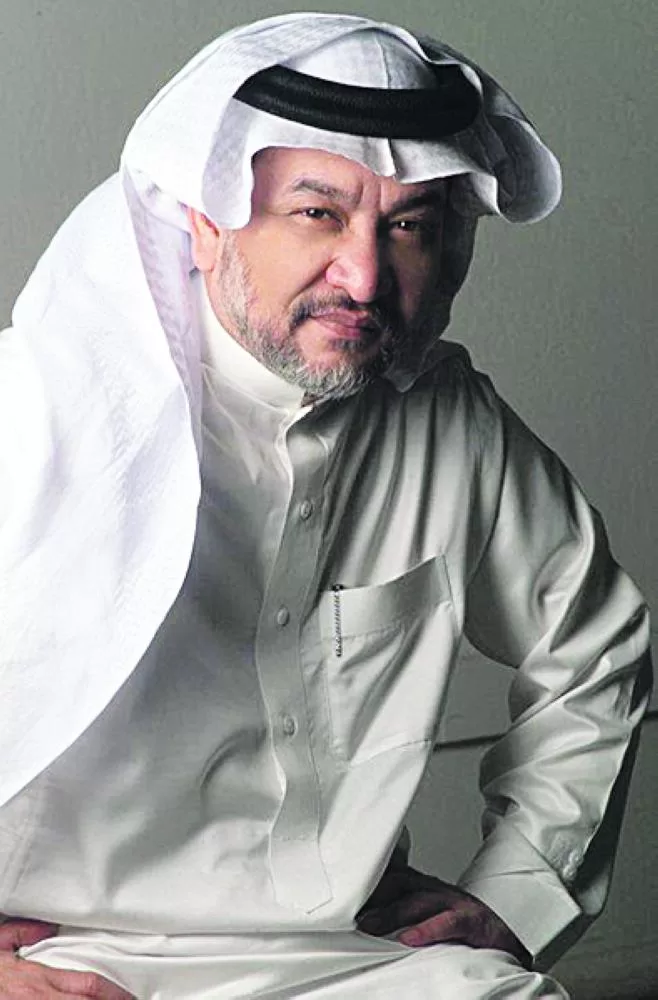
Saudi artist Youssef Ibrahim: Art is a human requirement and not a secondary matter!
Interview by / Radhi Jouda
A few years ago he was not known, at least to me, and his presence on the art scene was not sudden as we see, or overnight, at a time when we hear about names and exhibitions for attempts that I think their owners were somewhat hasty in presenting themselves, especially in private and individual exhibitions. One of the advantages of participation is to reduce the focus of the critic's eye, and perhaps even sympathy with young experiences and overlooking their lapses, but the artist Youssef Ibrahim, our guest here, (engineered) his presence for us with a winged lettering that belongs to creativity alone, and only reveals its secrets to form and color. It also does not wear the cloak of wisdom and preaching, only a genre of creativity and formation with the Arabic letter with a wonderful color blend dominated by the color of dates in their ripeness and sweetness, brown and gold, and you have to complete the rest of the colors, but what actually happened.
The artist Youssef Ibrahim has won many Saudi and Arab awards and held many art exhibitions inside and outside the Kingdom, reaching 285 exhibitions, and judged more than one international, domestic and local art competition, and held more than 42 workshops in various countries of the world. He has lectures in more than one forum and festival.
I contacted the artist Youssef Ibrahim, just like that, without any occasion, and via telephone, and we continued the conversation via means of communication, so the result was this dialogue about art.
In the beginning, sports clubs were the first incubators of fine art. In your opinion, is art still incomplete and needs incubators?
In my belief, Saudi fine art in particular has moved beyond the incubator stage to some extent, or rather, there have begun to be rapid flashes and omens that suggest a near and dazzling future. Associations and groups have appeared in their shy state but they have started, and we also notice the interest of some businessmen interested in art and artists, and this is a great support through acquisitions and investments in this field in one way or another. I also notice the insertion of art in a strong way sometimes and sometimes in a shy way within events that are not artistic in the first place. Also, the media has started to shed some faint and sometimes shaky light on some aspects of art and the artistic scene, although the scene needs from the media to consolidate the idea that art is a human need and not a secondary matter in our lives and just a color, a brush and a painting that decorates the corners of our councils only. All these factors and others from the spread of good art galleries, and the interest of the artist himself in his artistic culture and his spiritual, visual and cognitive nourishment as well as the current controversy, discussions and arguments also, all these factors influenced the beginning of emerging from the cloak of the old and single incubator, which is sports clubs, and launching in a more distinct, brilliant and sophisticated way.
Do you see that some judging committees are not fair enough for the artist to feel comfortable with them and accept their decisions?
Every competition and every event has its own circumstances, capabilities and conditions, and judging committees are often not completely independent and sometimes not even independent or stable temperamentally, artistically or even administratively. This is the participating artist as well. Therefore, how can an unstable person be satisfied by an unstable person and a non-independent person by a non-independent person. But from my experience in this field and based on the standards available in judging competitions, I see that the percentage of satisfaction with the results of many judging works is greater than dissatisfaction and I think that satisfaction or dissatisfaction is a relative matter to a large extent and cannot be measured accurately because there are no clear and accurate measurement indicators in this aspect.
Tell me about the dream painting hidden in your memory that your tools have not revealed to create its presence and reveal its secret.
I dreamed of a flower that cannot be plucked and a star that has not risen. Search is my constant obsession and my old dream is the search for the perfection of my artistic work, and this search in itself is beauty and sailing in the world of thought, beauty and wonder, and this sailing takes from me all of me and some of me. It pleases me at times and at other times it terrifies me. Yes, my sailing in the world of letters took me to infinite worlds of magic and sad music that I almost certain at times that it refined my humanity and trimmed the impurities of confusion in me. The pleasure of sailing in the world and depths of letters and their secrets is a pleasure that has no equal, and the feeling of imperfection and deficiency and the struggle in trying to reach a mythic feeling mixed with longing, eagerness, anticipation, waiting and attempt. Yes, the pleasure of deficiency is in the search for perfection.
Do you have a work team that supports the success of the Flower Festival? And some of your ideas, especially the big ones?
The Garden and Flower Festival is a huge festival that has reached international levels and achieved record numbers in more than one event. The fine arts event, which is one of the festival's events, had achieved wonderful successes in its previous two editions thanks to God and then the concerted efforts and support of officials. The work team that worked with me in the arts event in the first and second editions consisted of five young men and one young woman, but each of them was worth ten people in terms of effort, initiative, sincerity and love. We achieved all those successes thanks to God and then the love of the team. I do not forget the support of the officials who had the most beautiful impact and support in achieving those successes, all of which are credited to the Royal Commission for Yanbu Industrial City.
When do you start your daily work? And which materials do you find closest in conveying the idea of the work?
Perhaps I would be exaggerating if I said that I do not know a specific time I work in my studio, because I sometimes lose sense of time when I am possessed by the desire to work on a painting or an artistic work. The idea is not something I hunt, but in most cases it is the one that hunts me, so it then possesses me and possesses the time as well. As for the materials, I have tried many materials and colors until I reached the point where the idea of the work and its content are what determine the type of material and the quality of colors required for the work, but mostly I found that acrylic colors, paper materials and pastes are the dominant ones in my works, although I sometimes add other materials to them such as fabric, sand, cardboard, wood or metals according to the idea and content and in a way that helps the work and performs what is required of it and serves it.
Do the values of the artistic work differ with the seasons of the year or the type of participations?
The artistic work I have stems from thought, feeling, accumulations and inventory. I do not remember that I did any work based on an occasion, event or activity unless this event had a strong impact on me. To be honest, I am a prisoner of my thought and feeling to a large extent, although I see that some of them paint for each occasion a special work for them. I do not know if it is a mastery of feelings or a mastery of feeling or what.
But I enter into the artistic work as I said, a prisoner of an idea that possessed me or a feeling that contained me. It is very rare that I work based on an occasion, activity or event unless it affected me with the impact that captures me and moves me.
In your opinion, what are the incentives for continuing fine art activity and does the art scene really suffer from imitation and reproduction?
I believe that the first incentive for the artist is *provocation*. Yes, it is the first spark for any state of creativity. A negative or positive provocation can attract and focus all the artist's senses for creativity. I do not see that the state of calm and tranquility is a good state for any creativity because the senses in the state of calm or tranquility are dormant and cannot show any creativity while in that state. This state, and I mean provocation, must be realized by the artist because it is a wonderful state of mental, emotional and sensory arousal leading to a state of attraction and presence that the conscious artist benefits from. As for cases of imitation and reproduction in which arousal, presence, feeling and thought are disabled, they exist, although they are among some climbers and intruders, but they are like bubbles that soon vanish. The strange thing is that everyone on the scene knows those bubbles, but the bubbles alone do not realize that they are bubbles.
Do you agree with those who imagine that there is a psychological gap between the fine arts creator and the critic? And why do some artists imagine that the critic is lurking to catch his mistakes if they exist?
The critic is the highest mediator between the artist, the artistic work and the recipient. I mean by the critic here the critic who possesses his tools, his thought, his vision and his insight. Here he is the ideal mediator, and the genuine artist may need him more than others because I see that he opens a door or larger, wider and more sophisticated doors for the work, the artist and the recipient.