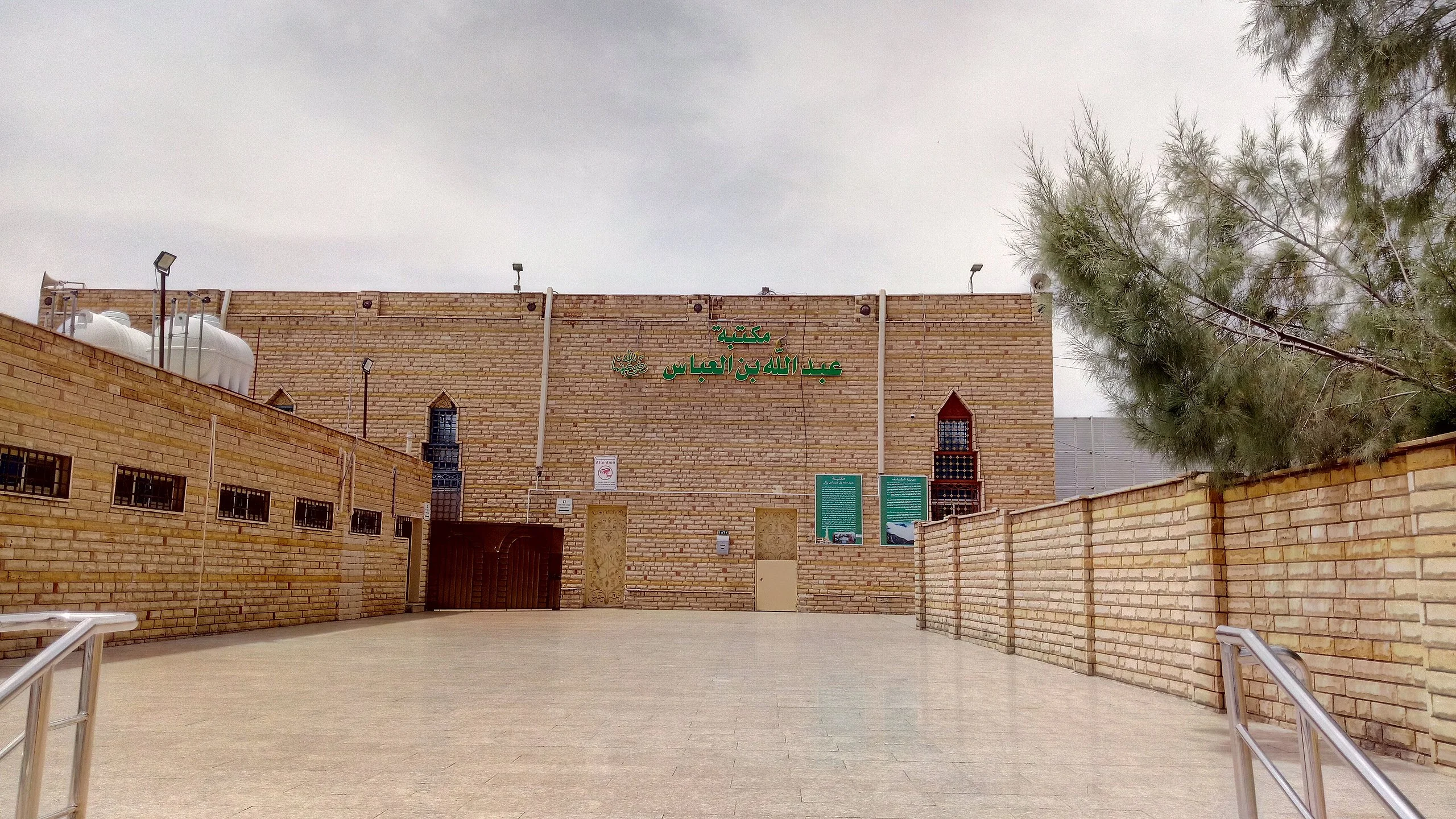
Ibn Abbas Library in Taif .. a cultural radiation center rich in rare manuscripts
Report: Muhammad Al-Qahtani
The Abdullah bin Al-Abbas Library in Taif is one of the oldest libraries specialized in the field of jurisprudence and its foundations in the Islamic and Arab worlds. It includes among its corners a collection of rare Islamic works, books, and manuscripts, as well as artifacts and stone inscriptions dating back more than 900 years.
The library, according to the Saudi Press Agency (1), was established concurrently with the establishment of the Mosque of the Nation's Scholar, the Companion Abdullah bin Al-Abbas, may d be pleased with them, which was built by Thaqif on the site where the Messenger, peace and blessings be upon him, prayed during his siege of the people of Taif in the eighth year of migration. The Prophet, peace be upon him, ordered Othman bin Abi Al-Aas, may d be pleased with him, to lead the people of Taif in prayer there. This was followed by the Rightly Guided Caliphs and the Umayyads caring for the mosque until it was rebuilt during the time of the Abbasid Caliphate in the year (592 AH).
The library of the Ibn Abbas Mosque, may d be pleased with them both, remained an endowment for students of knowledge and scholars inside the mosque, until the vernor of Hijaz in the Ottoman era, Muhammad Rushdie Pasha Al-Sharwani, between the years (1250 AH – 1270 AH), established a library independent of the mosque consisting of two corridors on the western side of the mosque. He allocated a separate entrance for it from the southern side, known to this day as the Door of (Muhammad Rushdie Pasha), as part of a project to establish annex libraries for large mosques and mosques or what was known at that time as (Kutubkhana). This is the building that includes the cabinets of books and manuscripts present and scattered inside the mosques and mosques, with the aim of preserving them and facilitating the process of benefiting from them and facilitating the access of students of knowledge, researchers, and the general public of those who love to view and read.
The Library in the Saudi Era
The library received the attention of the Saudi state, where King Saud bin Abdulaziz Al Saud - may d have mercy on him - ordered in 1378 AH the complete reconstruction of the Abdullah bin Abbas Mosque and the reconstruction of its minaret, doors, and all its annexes, including the library. In the era of King Faisal bin Abdulaziz Al Saud - may d have mercy on him - the library was reopened in 1384 AH, and the Ministry of Hajj and Endowments "at that time" delegated more than one specialized employee to register, index, and number the books, until it was annexed to the Ministry of Islamic Affairs, Endowments, Call, and Guidance, which supervises it and provides it with books and scientific journals and provides it with preservation shelves, library cabinets, and electronic devices to continue its scientific mission.
An Ancient Heritage Model
The library is an ancient heritage model in the field of culture and Sharia given what it contains of scientific books and rare manuscripts, as the number of books has reached ten thousand printed volumes, including no less than seven thousand titles. As for the manuscripts, their number is four hundred and fifty titles in various arts. Dr. Othman Al-Sini indexed and evaluated them in 1402 AH, and printed a special book for the library called (Indexing the Manuscripts of the Abdullah bin Abbas Library). The oldest of them is written in the handwriting of Abd al-Rahman bin Ahmad al-Harazi in Ramadan in the year 702 AH, entitled (Al-Kafi in the Science of inheritance) by al-Surdafi Ishaq bin Yusuf bin Yaqub Abd al-Samad, who died in the year 500 AH. It is in a masterful handwriting of 380 leaves. Many of the library's manuscripts were written at the beginning and end of the seventh and eighth centuries (2), as well as the manuscript "Clarification of Secrets and Wonders and Refinement of Gems and Benefits" in the Quran and Tajweed, the manuscript "Lights of Revelation and Secrets of Interpretation in Exegesis," and the manuscript "The Thirst-Quenching Spring in the Terminology of the Prophet's Hadith" (3). Dr. Othman Al-Sini considers that the Ibn Abbas Library is one of the most important Arab book treasures and libraries that were neglected and fortten for a long time until it was reopened in 1384 AH during the reign of King Faisal - may d have mercy on him - and what could be saved was saved from the manuscripts found in boxes and bags that were present in it.
Dr. Al-Sini mentioned: Many of the manuscripts in the Ibn Abbas Library were completely lost despite being referred to in some manuscripts present in the library, or parts of them were lost, or were affected by moisture, wetness, and termites. He pointed out that the library has many manuscripts of Sheikh Abdul Hafeez bin Othman bin Muhammad bin Othman Al-Qari Al-Fitni Al-Idrisi Al-Hanafi who lived in the year 1319 AH, and he has a treatise of his named "An Excerpt from the News of Taif" preserved at the King Abdulaziz Foundation (Darah).
The Abdullah bin Abbas Library includes several scientific departments: the Quran and its sciences, the Hadith and its sciences, the Hadith and its sciences, the principles of jurisprudence, creed, contemporary religions and sects, letters, language, grammar and morphology, history, biographies and translations, geography, politics and economy, the Prophet's biography, Islamic culture, eloquence, prosody, literature, history and biographies, medicine, animals, algebra and arithmetic, astronomy, and scientific magazines and journals.
Computer Indexing
According to Mr. Talal Al-Harthi, the library official, most of the books are indexed in the computer. There is an internet service in the library, and all the library's manuscripts have been placed on the internet, where the researcher can read any manuscript page by page with excellent technology. The researcher will notice the accuracy of photographing the manuscript pages with the possibility of enlarging the page and reducing it on the screen, and with the possibility of printing the page he wants in color.
ـــــــــــــــــــــــــــــــــــــــــــ
(1), Saudi Press Agency SPA
(2) Love of Islam website 08/13/2009
(3) Al-Jazirah Newspaper 04/15/1422