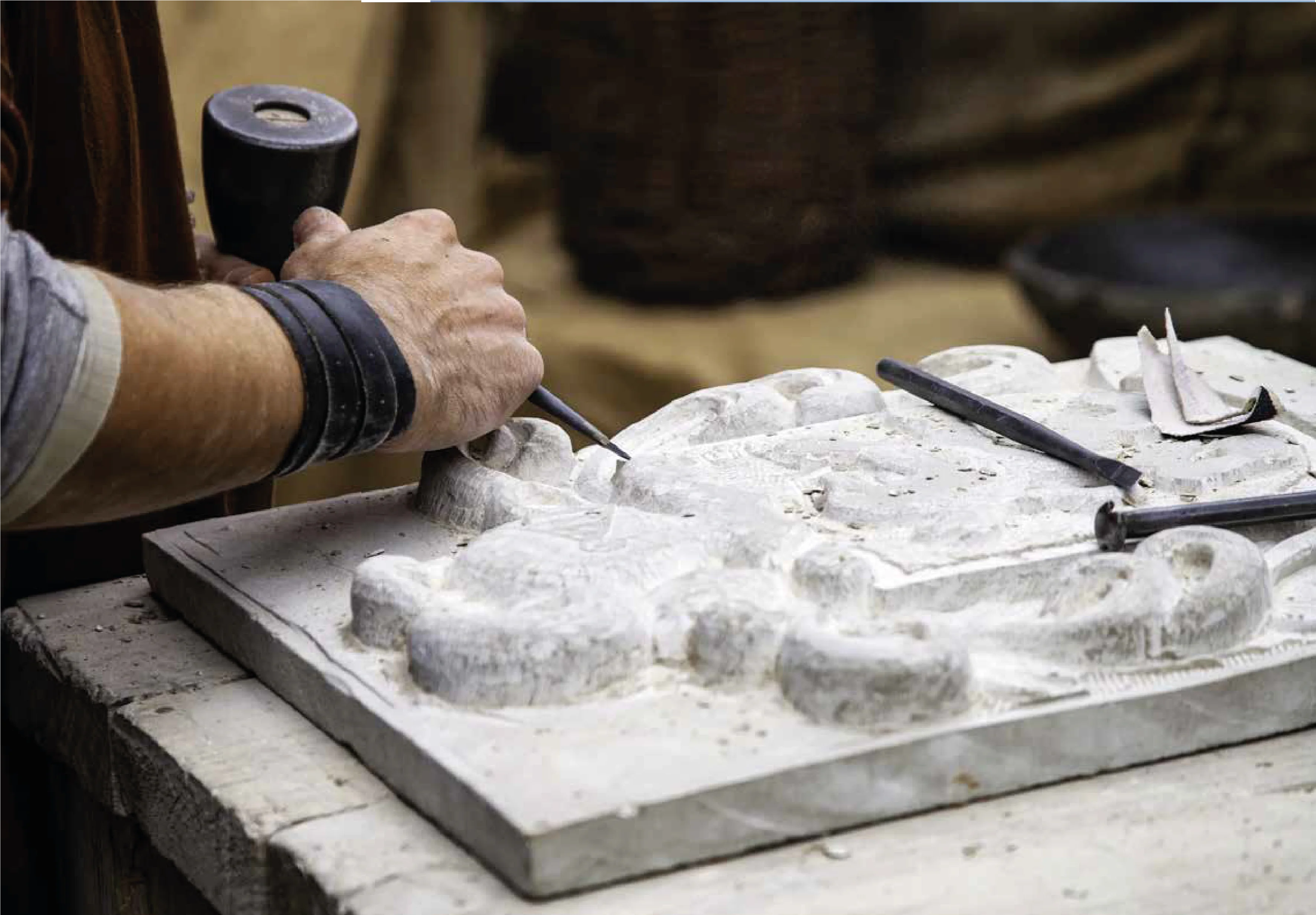
The Art of Sculpture: The Intimate Relationship Between Stone and Humans ,,
Al-Anoud Muhammad
Sculpture is considered a branch of the visual arts, and it is one of the oldest and most difficult fine arts. Its al is to embody ideas in the form of three-dimensional figures, in which a group of ideas can be presented in a single sculpture that often relies on expression and movement in humans and animals.
The history of sculpture dates back to prehistoric times, as simple sculptures dating back to the Old and New Stone Ages were found, and many of those valuable monuments were found in the Nile Valley and Mesopotamia. Those monuments appeared similar to the object, indicating the similarity of early human cultures.
Sculpture is described by critics as explicit art, and it is classified by them as an art of necessity, not an art of luxury, as it is easy for viewers of the sculpture to understand it or approach its meaning. Just as the necessity and innate need of humans are what established its appearance, and sculpture can be practiced by an experienced artist or a skilled professional, even if the method of execution and accuracy standards differ between the two. Sculpture is closely linked to other arts, as it resorts to drawing to place the lines of the final shape of the figure and uses geometry to measure the three-dimensional dimensions of the subject and needs the art of photography in order to predict the shape and pictorial character of the work.
The history of sculpture dates back to prehistoric times, as simple sculptures dating back to the Old and New Stone Ages were found, and many of those valuable monuments were found in the Nile Valley and Mesopotamia. Those monuments appeared similar to each other...
...indicating the similarity of early human cultures, the way of social life, and the prevailing conditions at that time. It is certain that sculpture is older than the arts of drawing and photography. Humanity has known it in all parts of the earth, so civilizations and kingdoms were distinguished by it, and it came primitive and simple to others. Man in ancient times used this art to carve mountains and rocks to make homes and shelters and carve his weapons and life necessities. Many ancient civilizations throughout human history have been famous for it.
Sculpture was distinguished in many ancient Roman and Byzantine monuments, and in monuments of Eastern civilizations and ancient Asian kingdoms and even in ancient Indian monuments.
Sculpture was also distinguished in many ancient Roman and Byzantine monuments and in monuments of Eastern civilizations and ancient Asian kingdoms and even in ancient Indian monuments, which we find standing and cohesive until today. Some of their sculptures were completed to express religious beliefs and social rituals and to date wars and disasters.
The Pharaonic civilization is the one that left giant monuments and sculptures, as the ancient Egyptians carved many figures and statues for their kings, their buildings, their temples, their tombs, their jewelry, their clothes, their vessels, and their daily life tools.
Perhaps the Pharaonic civilization is the one that left giant monuments and sculptures, as the ancient Egyptians carved many figures and statues for their kings and carved their buildings, their temples, their tombs, figures of their boats and animals of their kingdom and their jewelry, their clothes, their vessels, and their daily life tools.
The types of sculpture, its forms, and its effects differ according to many standards. There are colored sculptures that carry the natural color of the material from which they were carved or the component materials such as rocks, minerals, pottery, ceramics, iron, ivory, ebony, wax, plaster, and other materials capable of being carved and transformed into figures. The difference in its types also comes from its being a sculptural or structural art.
The most common forms of sculpture in ancient civilizations are high relief, figure, sunken relief, and flattened sculpture.
The most common forms of sculpture in ancient civilizations were high relief, figure, sunken relief, and flattened sculpture. The artist relies in high relief on wood and it can also be applied to stone.
As for flattened sculpture, it involves shaping, embodying, and engraving on the surface of the raw material from which it is carved without separation from it, so the surface remains as the background on which the sculpture rests. It is not necessary for the surface to be flat; it may be curved, concave, or convex.