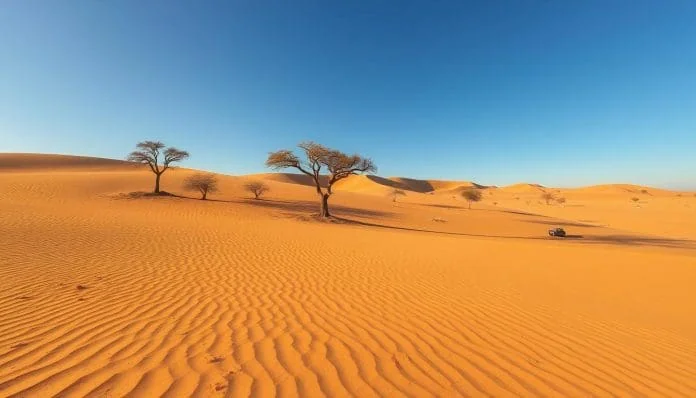
The desert and its verbal commonalities: an anxious poetic discourse and cautious optimism in contemporary Saudi poetry..
By: Dr. Emad Al-Khatib
The desert is lonely with all its elements, and civilization has turned it into an exciting civilization, and despite the development in it, it remained causing anxiety as it indicates the approach of death, and optimism remained walking side by side with it, being the companion with whom the Saudi poet coexisted wherever he was..
So how was the poetics of the desert drawn? And how did its poetics oscillate between being anxious and optimistic together? This is what the Saudi poet depicted and drew his painting. We read the poet Muhammad al-Fahd al-Issa depicting the desert in an anxious negative feeling that does not harmonize with its bright tomorrow, saying:
Between the rocks I see nothing but graves
Between the hills and the land is a barren wasteland
The language of the Saudi poet meets on indicative words and common connotations most of which suggest the significance of (the desert) between the two ends of anxiety and optimism. We find a poetic lexicon dominated by a common discourse language, and anxious vocabulary that can be mediated by (the desert) and wrap around it some of its verbal commonalities that suggest direct connotations heading towards it, including the wasteland, the burning sand, separation, doubt, anxiety, sacrifice, the sun, hardship, fatigue, thirst, the companion, the sands, the noon, desertification, hardship, thirst, despair, the mask, whiteness...
The poet Salah bin Hindi did the same in his collection (Shyly) when he created participatory relationships between (the desert) and what is measured by its word from indicators such as: (the heat of the sun, the wasteland, the distance) and likewise came at the poet Hassan al-Sulhabi, in his collection (Betrayal of Resemblance) when the vocabulary of the collection lexicon participated with the assassination of the void by heat and the feeling of absence and void after every sad silence that pains with its blackness and sends sterility in everyone in it and suffocation with dust that only wanted to be sad too..
Positive and negative self-feelings mix in the Saudi poet in a mixture during which the Saudi poet possesses psychological influences that form a special feeling for him. He when expressing his philosophy towards (the desert) couples that philosophy with his emotions and feelings, and uses his artistic tools that he wants to succeed in forming his poetic experience which can be the truest artistic standard.. In the desert is an expression of the suffering of the Saudi poet, his concerns, hopes, pains, dreams, anxiety, and alienation, among other conflicting feelings that strike him according to the circumstances of his life and its fluctuations.
The poet's handling of these feelings in the long run leads to the formation of his psychological mood or what is known as (the psychological state) through the permanent influence from the psychological scope. For this, common words are repeated that can form in the language of criticism (the poetic lexicon). The repetition of specific words by the poet contains an indication of the private poetic identity and contains a performance style that forms a uniqueness for the Saudi poet and differs from one poet to another, because the soul is distinguished from others by the mixing of feelings with what surrounds it. Read this amazing mixture in the image of the poetess Zainab Ghasib, as she says:
Move in the blaze of the desert, O my hope
Move in the ice of time
So the poetess calls her hope for movement in the blaze of the desert. What hope will move in the blaze, and the hot blaze follows the ice of time in an antithesis image reflecting her psychological state that does not stabilize and returns for her hope to (move) as if she needs it to move, and as if it is close to movement, except that there is something preventing it from movement: it is (the blaze of the desert), and it is (the ice of time). Words participate at the poetess that were only meant to participate in her words, then she calls her hope for patience and breaking the stature of laziness. Is there any doubt that what causes the flame is indeed the desert, and is there any doubt that what causes laziness is her feeling of the stagnation of time (time = ice) and is there any doubt that hope exists but the desert suffocates it! It is her saying:
And derive heat from the flame of patience
And break the stature of laziness
On the same path went the poem of the poet Abdullah al-Washmi, combining dreamy romanticism by invoking the lady of the desert, and sincere hope by invoking all that points to that lady of cloak, love and infatuation, for the poet to draw a picture of union between him, his country and that lady through his opening:
I am ..
The lady of the desert
Then the poet follows the indicators of that lady and makes her in the camels, the poetry and the water, and attaches them to her in a picture of merger expressing the same dream for which the poet and that lady live, saying:
Coming out of my black cloak
It is a picture of belonging to the symbol of the cloak, for the lady of the desert is known for her cloak.. and merged with the desert; as the camels are in the desert and the lady of the desert, out of her cloak come the camels, and the hair of the lady of the desert is wrapped by her cloak and all this takes place in the desert space. As for the union of the poet's self with the lady and the desert, it came through his hope in the fire that he wants not to out, and remains lighting the night, which will grant the poet safety, he says:
The ash of the fire is still in its burning
Lit by the night ,
And in its sleep I grant it safety
Then the poet moved to the picture of the lady of the desert in love with her desert and its traditions,
saying about her and him:
An infatuated female lover and male lover
As for the poet Eid al-Khamisi, he depicts the desert more than once. In the first picture he seems alone, walking with a sun that does not follow him, so he says:
Yesterday I walked alone in a desert
And there was a sun ... not following me
In the second picture the poet maintains the presence of the sun but does not mention it
explicitly, but rather points to it saying:
Desert noon
Then he dismantles the image of his anxiety about what is around him in words that participate with the desert at noon, and you know what is the shape of noon in the desert, it is a picture of exposure, silence and the narrow room, and what resembles it and what may appear in your imagination and what you cannot imagine.. all of that is capable of being imagined in the desert noon. Then he maintains a deserved hope and optimism with the presence of the bird that crosses your head wanting for you to continue in steadfastness and challenge the impossible to reach the desired al.
The presence of the general psychological feeling (of anxiety) in Saudi poetry accompanying the desert, and since poetry depicts a case of suffering, anxiety is a psychological phenomenon accompanied by participation between the poetic self and the desert that represents it, and anxiety has become a remarkable purpose for Arab poets; because of the crises surrounding them and the Saudi poet is one of these poets. Despite prosperity, poets insist on highlighting the dark side and this is from the extreme sensitivity of the creator, for he is affected by everything that happens contrary to what he desires even if it was small.
The contemplator of linking the causes of anxiety in Saudi poetry with the depiction of the desert finds that the desert has transformed from just a (space/place) into a symbolic image to depict the opposing relationship between all that is new and old,.
When we link what we said with the desert and its participatory words we find synonyms which are: the harsh, the deprivation, .. and others further away from pessimism but walking in the line of anxiety such as: nostalgia, the unknown and nostalgia for the future that does not
know what is in it, nostalgia, isolation and others.