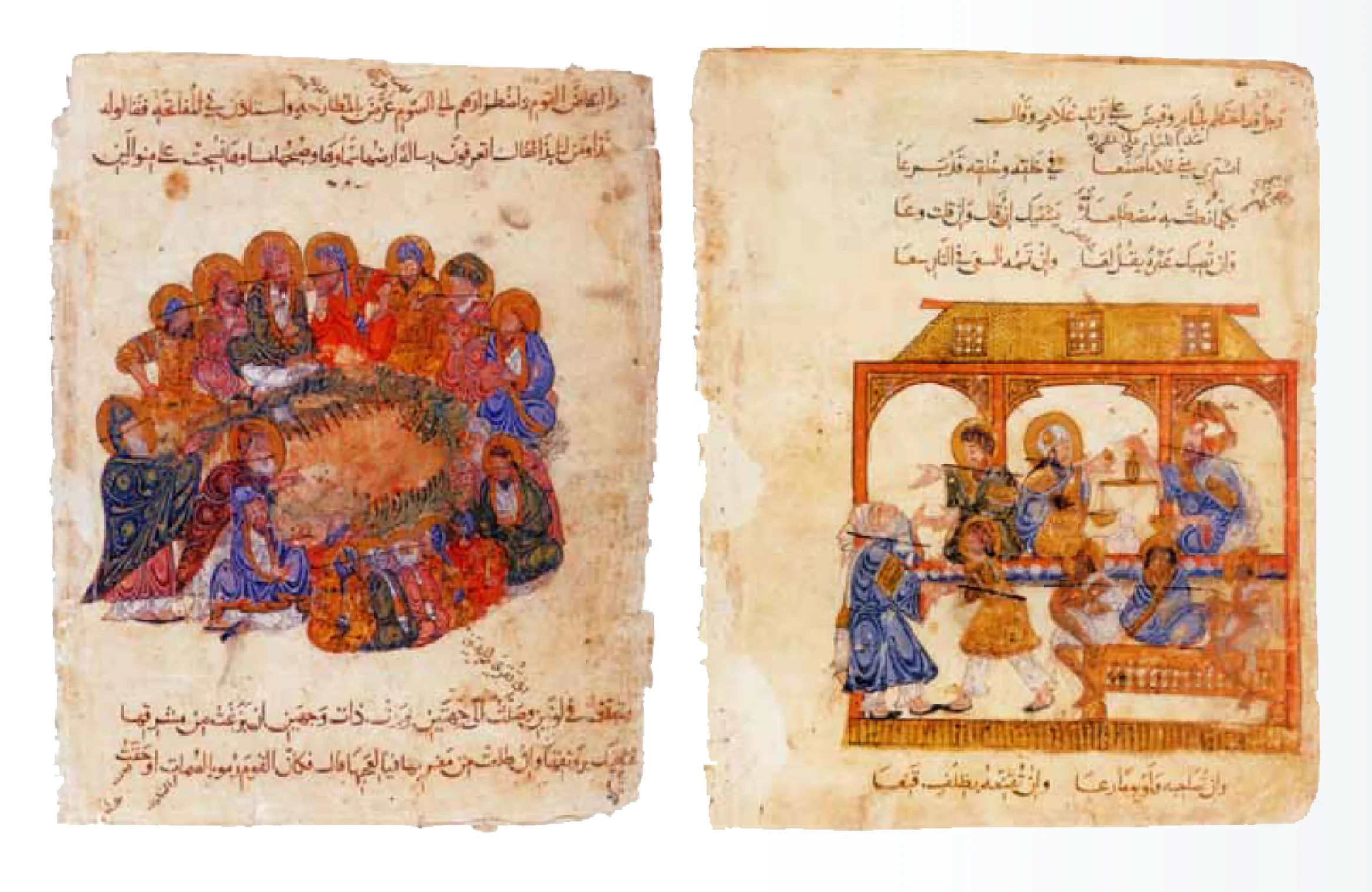
Maqamat al-Hariri and the painter Al-Wasiti
Dr. Abdulkarim Ibrahim Al-Samak
Dr. Tharwat Okasha is considered one of the leading academics in the art of painting, as he excels in reading images. He traveled to Paris to examine the only original manuscript of Hariri's Maqamat illustrated by Al-Wasiti, which Paris possesses under the number (5847). He studied it and read all of its illustrations, which exceed one hundred and fifty, between the covers of the Maqamat by Hariri. He elaborated on the reading of each image from its sister, and his reading came to present to those who missed the opportunity to stand on this manuscript and see its images. He presents to them and to the Arabic library this creative artistic exploration that he examined in Al-Wasiti's illustrations of Hariri's Maqamat. The book covers all the images of the Maqamat book by Hariri with an informed reading of them, being the reading of an illustrator along with an introductory presentation of the Maqama to which each image belongs. Sincere thanks to him for this precious work.
What is a Maqama?
The word Maqama is pluralized as Maqamat. In the pre-Islamic era, the word Maqama indicated the tribe's gathering place, meaning the group. The first person to establish this type of writing was Badi' al-Zaman al-Hamadhani, although some say the credit for this es to Ibn Duraid.
The Maqamat rely primarily on fictional and fabricated tales dealing with many aspects from literary to religious to scientific to social. They also contain a great deal of irony, criticism, and trickery, while explaining and defining the customs of the society to which they are attributed, especially the Mukaddun, meaning the beggars mentioned in the Maqama, showing them to be hypocritical liars. An individual among them is supposed to be intelligent and alert, and possess a command of literature, the science of poetry, and rhetoric, and have presence in every Maqama. A narrator like him should speak on his behalf to relate his news in every Maqama and reveal his secrets. The Maqamat rely on the solidity of the language, the elegance of the phrase, metaphor, rhymed prose, poems, proverbs, verses, and Prophetic traditions.
Al-Hariri opened his Maqamat with the following: "I have established fifty Maqamas containing the serious and the light, the delicate and the grand word, the jewels and pearls of eloquence, and the anecdotes and rarities of literature, in addition to what I have adorned them with of verses and beautiful writings, and set in them of Arab proverbs, literary subtleties, grammatical riddles, linguistic fatwas, innovative letters, puzzling sermons, and weeping exhortations, all of which I dictated on the tongue of Abu Zayd al-Saruji and assigned its narration to Al-Harith bin Hammam Al-Basri."
Al-Hariri paid attention to the narrator whom he named: Al-Harith bin Hammam, which he took from the Prophet's saying (peace be upon him): "Every one of you is a Harith and every one of you is a Hammam." Al-Harith is the earner, and Al-Hammam is the one who cares much. Abu Zayd al-Saruji is Al-Mutahhar bin Sallar and was from the people of Basra and from the people of language and grammar. He accompanied Al-Hariri and narrated from him his Malhamat al-I'rab, stating that he heard it from him. The character of Sahl bin Abbad, created by Nassif al-Yaziji in "Majma' al-Bahrayn," the container of his Maqamat, as well as the hero of these Maqamat, "Maymun bin Khuzam," should not be fortten.
As for Badi' al-Zaman al-Hamadhani, who is Sheikh Abu al-Fadl Ahmad bin al-Husayn bin Yahya bin Sa'id al-Hamadhani, he made the narrator of his Maqamat Isa bin Hisham.
Al-Hariri in his birth and death:
He is Abu Muhammad al-Qasim bin Ali bin Muhammad bin Othman al-Hariri al-Basri al-Harami al-Shafi'i. He was one of the imams of his era in the highness of his rank and his knowledge in the craft of the Maqama. Banu Haram is a sub-tribe of the Arabs that lived in this alley outside Basra attributed to them. Al-Hariri's name is attributed to silk (harir) and working in it or selling it. Al-Mashan is a small town after Basra with many palms, and it is a small agricultural town whose people were of Al-Hariri's family. It is said that Al-Hariri was among the wealthy and had eighteen thousand palm trees there. Al-Hariri was born in 446 AH (1054-1122 AD) and died in 510 or 515 AH in Basra and was buried in the alley of Banu Haram, leaving behind two sons who were among the scholars of the art of Maqamat. Al-Jawaliqi said: I was authorized in the Maqamat by Najm al-Din Abdullah and the Chief Judge of Basra Diya al-Din Abdullah from their father, its creator.
Al-Hariri is one of the most famous writers of the Maqamat...