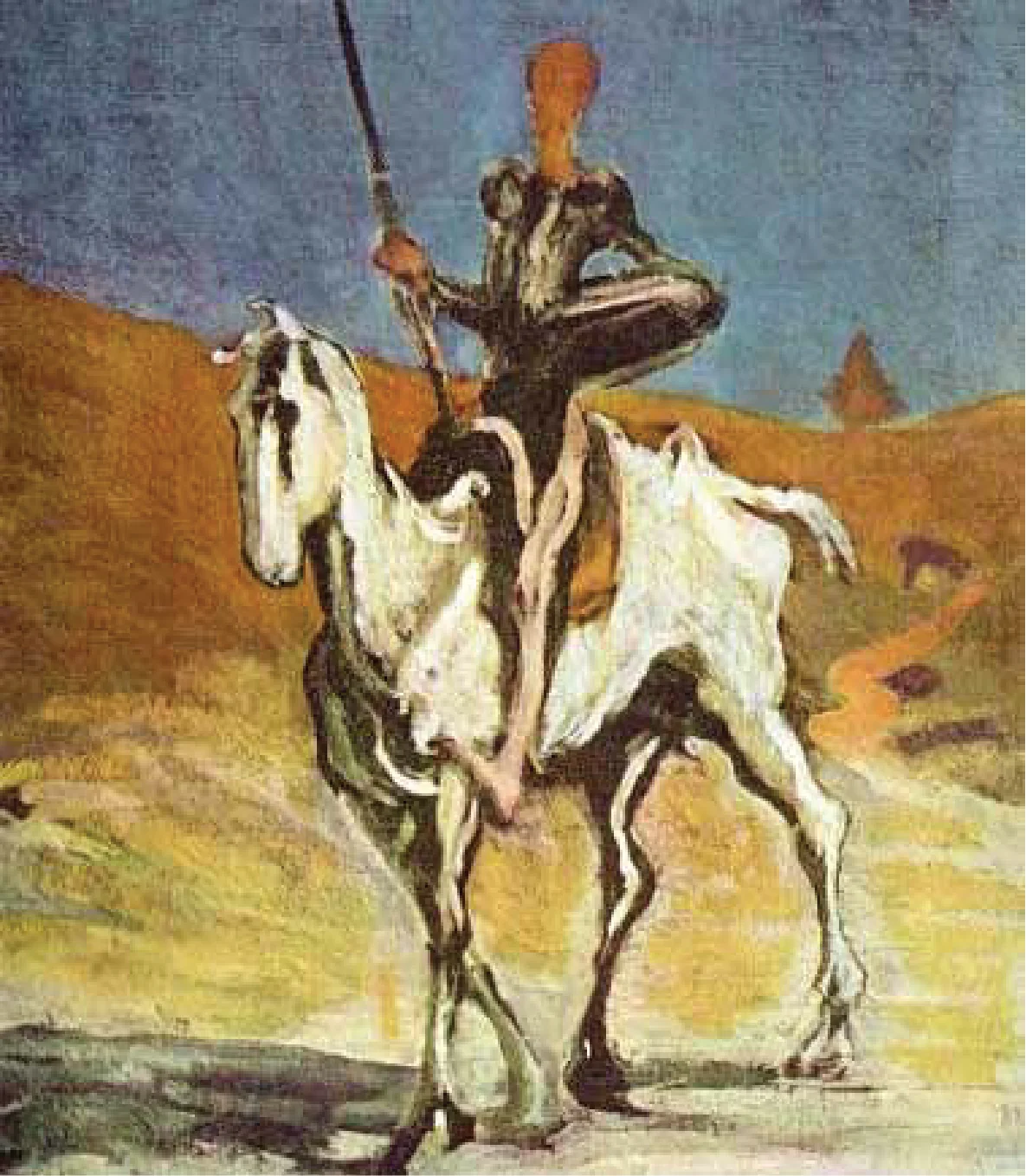
Don Quixote Fighting Windmills
Rashoud Al-Tamimi
About the Author and the Novel: The author of the novel Don Quixote, Miguel de Cervantes, was born in 1547 AD, when Spain was at the height of its power. The Spanish King Charles I (reigned 1516-1556) was the most powerful man in Europe at that time, and his ambitions knew no bounds; he aimed to unite all of Europe under his banner. The author was a soldier in the Spanish army, always unlucky despite his struggle and diligence. He lived until he witnessed the crumbling of the Spanish era under the weight of economic inflation. His family was considered noble, yet they suffered severely from extreme poverty. His father worked as a surgeon - and the surgeon in those days had a fairly od social status, ranked between a doctor and a barber. But that family often resorted to escaping and moving away from the eyes of some (customers) who were not satisfied with that father's surgical service, fearing pursuit. The author was unable to obtain basic education when he was young due to the financial difficulties his family suffered from, yet he read a lot depending on himself, with hope that he would one day be one of the great poets pointed at, but he died and that wish was not fulfilled after a life full of suffering in April 1616 AD, which is the same year - and month - in which his contemporary Shakespeare died. The novel Don Quixote can be classified - sometimes pronounced "Don Quijote" - as one of the long novels, yet its basic plot is relatively simple.
Main events of the novel: The young man (Alonso Quixano) is engrossed in reading the heroic stories of medieval knights, and gets so immersed in them that it occurs to him that he is one of them. He imagines a romantic relationship with a princess he calls (Dulcinea) - following the custom of the knights of those times. This Dulcinea is a poor girl from his town who never paid attention to him. He then changes his name to (Don Quixote), takes up old rusty armor he found, and es out in search of heroic adventures. On the road he sees an inn and thinks it's a castle, so he orders the guard of that inn to call one of the knights from inside to duel him. The guard agrees, overcome with laughter. Then after a while some merchants pass by the place, so he thinks they are knights and raises the flag of challenge before them, but some of them stand up to him, so the circle turns on him and they beat him up. A passer-by from the residents of the neighborhood saves him then takes him to his house. The notables of the neighborhood then exert all their effort in trying to convince him and distance him from his illusions, and they set fire to his books before him hoping to return him to reason, but to no avail. They find no way to return him to his house except by putting him in a cage and moving him in that cage to his house. They convince him to enter this cage by saying that they only want to test his courage, so he believes them and they achieve what they wanted. Here the first part ends. In the second part of the novel, we find that six weeks of rest in his house were not enough to cure him of his madness, so he es out with (Sancho) for more adventures. It happens in the meantime that a student at a Spanish university, named (Samson), had read the first part of the novel Don Quixote, so he decided to see him in person. Samson's al was to treat the poor (Don Quixote) from his madness, but at the same time he holds envy for the literary fame he won from publishing the novel. Accordingly, he challenges (Don Quixote) to a duel on the condition that one of them leaves the life of chivalry once and for all if he is defeated in that decisive duel. The two agree, but our hero (Don Quixote) wins by sheer coincidence. His adventures continue with (Sancho). His madness reaches its peak when he suffers from complete confusion and disturbance in thinking, so he thinks that windmills are evil giant demons, so he rushes to them drawing his sword for battle, and this scene is considered the most famous scene in that novel. He continues in those performances and (heroic) adventures to the end of the novel. The novel ends with his return to his house after reaching old age announcing that he was cured of madness, then he dies after that a short time later.
Character of (Don Quixote): During the context of the story, the character of (Don Quixote), who is the main character, changes several times. He is first (Alonso Quixano), a kind-hearted young man overcome by idiocy. But when he is hit by madness, he believes he is another person who is (Don Quixote), the brave knight and noble hero who will take on the task of straightening every tilt in this world.
For this reason, the character of (Don Quixote) in truth is only from the mind of (Alonso Quixano) - if we stay within the scope of the novel. In the second part, the characters play with (Don Quixote) and deceive him, revealing the huge gap between truth and illusions. His condition is reinforced and gets worse at this point when he is called the "Knight of the Lions" (The Knight of the Lions), and this title comes from the scene in which he meets the lion to fight it at the king; the lion here is a real fact, but (Don Quixote) doesn't want to lie to himself, and when the lion refrains from fighting, (Don Quixote)'s belief in himself is entrenched, and he becomes a victim of this strange reality believing that the lion doesn't dare to face him. Quixotism is one of the most important ideas in this novel, and a person is considered Quixotic if he falls under the control of a hard idealism. Thus, (Don Quixote)'s runaway imagination creates giant knights from windmills. His illusions often land him in ridiculous and funny situations, and although he sympathizes a lot with the weak, he is a tragic character at some times. His devotion to his principles, no matter how idealistic, doesn't stir in us admiration for his character. The creativity in this novel lies in that (Don Quixote) is a stereotypical character of many whom we know in our reality. We may notice that immersion in reading heroic stories and the glories of knights and concentration on that, as in the case of the hero of this novel, generates ideas that soon take control of their owner and consume him, after they were mere abstract thoughts, driving him first to belong to those heroic characters then adopting and imitating them. But when reality is not prepared - for one reason or another - for this character to represent its heroes, it results in an internal conflict that may result in yielding to this Quixotic tendency, and then the conflict turns into an external conflict with the environment, and this may be accompanied by an overlap between reality and dreams, and here such a Quixotic tendency appears clearly defined. Perhaps one of the features of this character is impulsiveness and lack of concern resulting from excess self-esteem as heroic knights do! It may be noticed its preoccupation with creating enemies even if they were not so, and then challenge and arrogance with obvious weakness and inability. Weakness and the sense of deficiency create a fertile environment for such a tendency as compensatory behavior. Also, the Quixotic traits are inevitably - as felt - applied to the speech of the extreme revolutionary character, and this speech characterized by Quixotism may soon spread among simple people like a contagious disease. Examples are many of such a stereotypical character who lives and thrives in different societies with varying cultural levels, and all of that es according to the compensation principle. The novel also provides a caricature portrayal of chivalry in that era, and it is considered by many readers as one of the humorous novels characterized by simplicity and clarity. Its author claimed that he wrote it to stir fun and mock the heroic novels widespread at that time, which tell of the heroic adventures of knights. The impressions of most contemporary readers agree with this direction; they see that the novel was written to be read as a comedy work, and that any other reading of it is not considered a correct reading. Some also see that this novel is an expression of the conflict between idealism and realism. (Don Quixote)'s idealism may stir admiration in us, but it is doomed to perish for no purpose because it doesn't touch the world in which it lives. It is known that our als, no matter how noble, may give unpleasant results if we do not take the correct practical context of our actions into account, and interact with our reality as our heroes interacted with their reality. You may also find in it a portrayal of the dialectic of illusion and truth, as there are multiple levels of illusion and truth in this novel; the greatest immersion in illusion is the case of (Don Quixote) himself, then followed by his friends when they deceive him to enable him to exit his whirlpool, unaware that they are playing a major role in entrenching his illusions, and here lies the irony. At any rate, the dividing line between illusion and truth for the reader seems clearer at the beginning of the novel than at its end.
The interesting thing in this subject is that (Don Quixote) and his friend (Sancho) realize in the second part of the novel that they are mere characters in a literary book. Also interesting is the overlap of characters between the world of the novel and the outside world, the exchange of roles between them, and each of them being affected by the other.