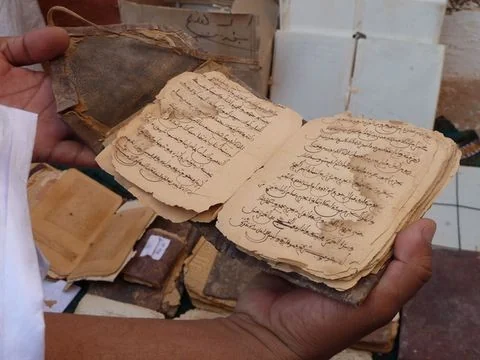
Chinguetti Manuscripts.. A cultural and Islamic heritage in the middle of the desert
The Mauritanian city of Chinguetti is rich with its precious manuscripts that many of its scientific institutions and private libraries store. For centuries, the city remained a scientific and cultural beacon not only in the African continent but in the entire Islamic world. Due to this high scientific status, unremitting efforts were made in order to preserve its cultural heritage and rare manuscripts, which led it to become part of the UNESCO World Heritage list, which increased its status and the care for its manuscripts and libraries that include the major books and unique references and made it a tourist destination for lovers of manuscripts and Islamic heritage.
Damage and Theft
What calls for sadness is that much of the Chinguetti heritage was dissipated for various reasons, most notably damage and theft of manuscripts that were popular in West Africa. Only a few of the rare manuscripts escaped this neglect from loss, most notably "Al-Ishara fi Tadbir al-Imara" in the fifth century AH, and "Mawhub al-Jalil bisharh Mukhtasar Khalil" in the tenth century AH.
80,000 Manuscripts
Mauritania is one of the Islamic countries that includes a treasure of manuscripts. Although there are no accurate statistics on the number of these manuscripts, whose numbers vary according to the announced figures, some statistics say that they are 30,000 manuscripts at the lowest estimate, while other statistics estimate them at about 80,000 manuscripts dating back to the first Hijri centuries since the spread of science began at the hands of the first generation of scholars, especially in the cities that became famous for science, which are four cities, at the forefront of which are (Chinguetti, Ouadane, Tichitt, Oualata) and they are the four cities registered on the World Heritage List.
Country of Chinguetti
Historical accounts indicate that the city of Chinguetti was built during the sixth century AH (thirteenth century AD), and its reputation spread in the countries of the Arab Mashreq, so Mauritania became famous as the country of Chinguetti. The importance of the city of Chinguetti was increased by the fact that it was a starting point for pilgrim caravans.
Chinguetti Libraries
The beginnings of founding libraries in Chinguetti back to the fifth century AH. During this period, the founding of libraries or Mahadhir (plural of Mahdhara) began, which is the scientific school or university in the old Chinguetti society, through which various sciences were taught, at the forefront of which were Arabic Islamic sciences. This extreme interest in science was accompanied by the emergence of the formation of manuscript libraries, which are scientific institutions established by scholars and senior sheikhs to become research and scientific references. Unfortunately, these libraries were subjected over centuries to much damage which led to the loss or destruction of large quantities of those manuscripts.
Naming of Chinguetti
There was disagreement over the origin of the name Chinguetti. It was said that it is a Berber word meaning "the wells of horses", and it was said: an eloquent Arabic word whose origin is (Sin Qit) meaning the edge of Mount (Qit) adjacent to the city, and a third opinion went to that it is an Arabic word meaning Al-Shanqit, which is a type of ceramic vessel that was circulating in the region.