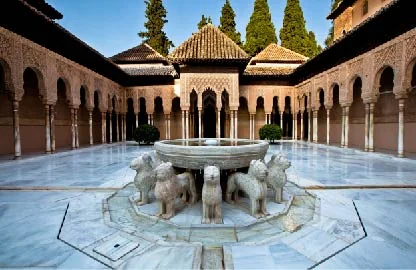
Arab Andalusia .. Islam of Civilization and Culture of Tolerance
Author: Maria Rosa Menocal (*)
Review and Reading by Najib Muhammad Al-Jabari (**)
It es without saying that Andalusia has received, during the last two decades of the last century, great interest and remarkable attention from a large number of scholars and university researchers in many Arab and foreign countries in the form of articles or independent works, representing the outcome of their efforts. These are diverse methodological trends and varying perceptions about that distant part of the Islamic West, and about aspects of Andalusian life that remained mysterious and obscure for long periods.
Interest in the Arab and Islamic heritage was initially focused on the East as a result of the establishment of the major Arab and Islamic state there, and its clear influence on all parts of the Islamic world, East and West. However, these modern scholars realized the importance of turning to the western parts that played an effective role in the course of history and Arab-Islamic civilization. This civilization directly influenced human civilization as a whole through its friction with the West and gave it a push forward.
The task of tracking, searching and revealing the secrets of Andalusia and its authentic role in rooting human civilization in general was undertaken by some Hispanists and Orientalists, foremost among them the researcher Miguel Lafuente Alcántara in his book "History of Granada", and Francisco Javier Simonet in his book "History of Malaga" (1), the works of Luis Robles and Juan Torres Fontes, and the works of the late researcher Luis Seco de Lucena Paredes, who dedicated all his efforts to Granada in the eighth and ninth centuries AH, contributing more than fifty articles, in addition to his two works "Granada in the Fifteenth Century" and "Muhammad IX Sultan of Granada" (2), and the works of the French researcher Rachel Arié, especially her thesis on "Muslim Spain during the Nasrid era".
We do not forget in this article some English research concerning the history and description of Andalusia, such as: "The Influence of Arab-Islamic Civilization on Portugal" (3). Then the book "Islamic and Christian Spain in the Early Middle Ages" by Thomas Glick (4), and the valuable study carried out by Dr. Dominique Urvoy on "The World of Andalusian Scholars from the 5th Century AH to the 6th Century AH", which is a search into the urban, cultural and civilizational world of scholars in the first place, as this study reflects a modern social stratum.
These brief models only indicate the extent of increasing interest and recurring desire to see the contributions and achievements of the "other". This indeed happened immediately after the fall of Granada on January 2, 1492 AD, although not all Islamic traces disappeared with it. On the contrary, it remained - and perhaps until the current moment - visible in the features of faces, the color of eyes, and the fragrance of heritage and Arab-Islamic culture.
The valuable book prepared by the university professor and Cuban researcher, Maria Rosa Menocal, "The Ornament of the World: How Muslims, Jews, and Christians Created a Culture of Tolerance in Medieval Spain" comes to crown this thriving movement about the lost paradise where the Arab-Islamic presence lasted for about eight centuries.
The English edition of Maria Rosa's book first appeared in the United States in 2002. Then it was translated into French under the title "L'Andalousie arabe: une culture de la tolérance, VIIIe-XVe siècle" in Paris, consisting of 247 pages (5). Its Arabic translation was published in Morocco in 2006 under the title "Arab Andalusia: The Islam of Civilization and the Culture of Tolerance" (6), in a beautiful edition decorated with an image of a portico from the Alhambra Palace in Granada, which represents one of the most important civilizational and architectural monuments carved by Arabs and Muslims in the memory of Andalusia.
This book is part of the author's enthusiastic project to study the Arab-Islamic experience in Andalusia in the Middle Ages, which she inaugurated with her book on "The Arabic Role in Medieval Literary History" (7), as well as her contribution to the book "The Literature of Al-Andalus" published in the Cambridge History of Arabic Literature series. In all her works and university lectures, she focuses on the great role of Andalusia in shaping European modernity and civilization, due to the coexistence of the three monotheistic religions under the banner of Islam that fluttered over the lands of Andalusia for a long time.
The book "Arab Andalusia" is not just a book or a history book in the traditional sense, but rather a deep and serious attempt to interpret the history of the Iberian Peninsula during the Middle Ages, and an observation of the history of Arab Andalusia from a point of view that differs from what other historical approaches have practiced regarding Andalusia, its Islam, Arabism, culture, languages, and various traditions and customs that coexisted on its land.
Andalusia.. Home of Tolerance and Meeting Point of Coexistence
The researcher (Menocal) determines since the introduction of her book that she deals with tolerance as a relative concept and an operational term to overcome the prevailing vision that was formed about the "Dark Middle Ages", and that what most researchers believe - that the peaceful coexistence between the three religions is an old myth - is a bright truth with no dust on it. A culture of tolerance, hybridization, and peaceful coexistence between contradictions was formed in Andalusia, based on dialogue, communication, and peace that overcame the conflicting belonging to diverse ethnic groups. Since the early ages of Andalusia, unique religious relations were established; the Jewish university awoke and was liberated from the swamp in which the thic rule had drowned it, to the point that a Jew became a minister in foreign affairs in the tenth century AH (8). Social affairs in Andalusia were also characterized by establishing marriages between clans of diverse cultures and by high-level cultural dialogues with the protected people (Dhimmis). History also confirms that a number of rulers in Castile used to surround themselves with Muslim scholars and use Muslim engineers. King Alfonso the Wise of Toledo is a glaring example and a od model of the distinction between politics and science; his care for translating the books of Averroes and other Muslim philosophers, and his support for publishing the "Libros del saber" with the aim of making Islamic knowledge available in the Castilian language (9) is only conclusive evidence of his love for Islamic heritage.
This cultural, civilizational, and social exchange between various components of Andalusian society could not have happened without the freedom of thought that prevailed then, as well as the tolerance that characterized Andalusian society. This was confirmed by an orientalist researcher: (When the West was an ordinary phenomenon in Spain like the Mozarabic Christians, civilization was strong thanks to cultural exchange between different components of society. When Granada fell, the link was broken and the Catholic reaction came with its Inquisition, which began to persecute the remnants of the Arabs and force people to convert to Christianity, leading to their resentment. The expulsion process began, and with its completion, Spain bled its blood, but the shadow of Arab civilization remained before the eyes of wise men in Spain even in that era of the country's history...) (10).
Some reports and memoirs written by Christian pilgrims spoke in fair accounts of the methods they worked with in Andalusia. For example: the saying of "Bernard the Wise" in his memoirs: (Peace prevailed between Christians and Muslims), so that if I went on a trip and my camel or donkey that carried my luggage died and I was forced to leave everything unguarded and went to the neighboring city to get another animal, I would find all my property as it was, untouched by anyone when I returned (11),.
Andalusia: The Bright Ornament of the World
In the first part of the book, which includes pages 21 to 45 in the Arabic translation, the author calls for a re-reading of Andalusian history, starting from the hypothesis that the Umayyad settlement in Andalusia is a decisive event that founded modern Europe. With the fall of the Umayyad Caliphate in the East in 132 AH and the escape of Abd al-Rahman al-Dakhil and his establishment of the Umayyad Emirate in Andalusia, which would be an unparalleled civilizational and political model, the actual presence of Arabs and Muslims begins along with the cultural radiation that reached even into the Latin world that was living in a stage of total darkness. On the contrary, Andalusia was brilliant intellectually, culturally, and materially, which made it the "Ornament of the World" (12).
The second part (p. 47 to 204) forms the basis and pillar of the book. it is divided into sixteen studies revolving around "prominent motifs" or known faces of troubadour poets, intellectual philosophers, men of science and politics, palaces, libraries, gardens, mosques and churches... etc. They are examples and models derived from language, literature, art and architecture. The Great Mosque of Cordoba, built at the end of the 8th century AD, formed a cultural and civilizational identity as a center of a new authority. At the same time, Madinat al-Zahra represents a purely Andalusian cultural, architectural and civilizational achievement. The Andalusia of the Taifas in the eleventh century remained a fertile cultural soil that witnessed a great demand for Arabic culture and language by non-Arab minorities who mastered the Arabic language, wore Arab dress, and took to Arab arts of architecture, poetry and singing. Samuel ibn Naghrillah, the Jewish minister in the Granadan court, composed poetry in Arabic. As for the Normans who seized Barbastro in 1064, they took with them the singing girls of the Arab elite and transferred poetic and artistic sensitivity to the Latin world.
The book "Arab Andalusia" on the other hand provides a strong lesson about the role that translation played in the melting of cultures and the destruction of boundaries between languages, where Toledo became during the 12th century "a capital of translation and a bringer of intellectual and cultural competition, especially in the fields of science and philosophy" (13).
Many translations first went through the stage of translation from Arabic to Hebrew before moving to Latin. The most famous sources of translation came into existence in Toledo immediately after its conquest in 1085, when Archbishop Raymond established a translation center in his court. Since Alfonso VI seized Toledo in 1085 and made it the capital of Castile, it turned into a center from which Arabic culture spread to the rest of Christian Spain and indeed to the entire European continent. Bishop Raymond was a patron of a large-scale translation movement known as the "Toledo School of Translators". Prominent scholars came to this institution, such as Gerard of Cremona (1114-1187), who was more productive and famous in the West. Despite his mastery of Arabic, he was assisted by a team of Spanish Jews and Christians to translate some Arabic books into Latin. This movement resulted in a list of about eighty-seven books in philosophy, medicine, mathematics, astronomy, and chemistry. Toledo was the international translation institute, the destination of those searching for the treasures of Arabic, and a symbol of intellectual rationality and modernity at that time, alongside Seville, Granada, Sicily and Paris.
On this stage, cultures converged, languages blended, and diverse races connected, establishing a culture of civilizational tolerance and peaceful coexistence that did not fade until the emergence of ideological conflicts and political fanatcisim, the rise of religious extremism and the emergence of the Black Plague represented in the concept of ethnic or cultural purity. The brutal destruction that Madinat al-Zahra suffered in 1009 immediately after the outbreak of the civil war marked the beginning of the end of political peace in the Islamic province in the middle of Europe. It is enough to recall the descriptions given to the luxurious palatial city on the outskirts of Cordoba, which embodied, in Menocal's view, one of the wonders of architecture in the Islamic world.
Arab Andalusia and the Tax of Brilliance and Success
The author believes that the Caliphate in Cordoba was in a sense a victim of its prosperity, brilliance, and success. Contrary to what is common, Andalusian history cannot be reduced to a religious struggle or a crusade between infidelity and faith or between one civilization and another. While Al-Mansur carried out destructive raids against Christian strongholds in the North around 900 AD, such raids were not the direct cause of the collapse of the central authority of the Caliphate. Rather, violent civil wars between competing Muslim factions and barbaric strikes from within the House of Islam tore the entity of the Caliphate. Also, the steadfastness shown by Abd al-Rahman III by declaring the Andalusian Caliphate raised opponents and competitors for leadership. This happened specifically at the time when other powerful Islamic emirates hostile to Umayyad uniqueness began to appear in North Africa. Dr. Abd al-Wahhab Khallaf follows the same view when he says: (The fifth century AH / eleventh century AD was characterized socially by the dissolution of the elements from which Andalusian society was generally and Cordovan society specifically composed, which the Umayyad Caliphate had managed to make into one cohesive mass) (14). The author believes that the Reconquista wars that broke out following the capture of Toledo in 1085 AD exposed Andalusian culture to regression and weakness, and the contributions of Jews and Muslims to European culture were cut off, and Islamic civilization was extinguished with the fall of its last stronghold, wounded Granada, in 1492 AD.
Final Word
It concludes by saying: Maria Rosa's book "Arab Andalusia" is a book worth reading, not just because it presents a completely different view of Andalusian history - which is an debatable view - but because it is an objective and fair reading of a delicate and decisive stage of the Islamic presence in Europe: literary, cultural, social, and civilizational. The book is a loud cry in the face of the contemporary barbaric world wrapped in monism and fundamentalisms of every kind, and shrouded in tiring and rigid dogmatic ideas.
Footnotes
(*) A researcher and university professor in the USA, of Cuban origin. A famous writer on the Middle Ages. She is the director of the Whitney Humanities Center at Yale and a professor of Spanish and Portuguese.
(**) Researcher Professor, Tangier – Morocco
1. Printed in 1843 AD.
2. The first book printed in 1975 and the second in 1978.
3. Published in Afaq Arabiya Magazine, Year 6, Issue 4, Baghdad 1980 AD, originally by F. J. Velozo.
4. Printed in 1970 AD.
5. Menocal, Maria Rosa, The Ornament of the World, 2002.
6. Translation: Abdel-Majid Jahfa and Mustafa Jabbari, Toubkal Publishing, Casablanca, 2006.
7. Arabic translation by Salih bin Maeed al-Ghamdi, King Saud University Press, 1999.
8. Al-Maqqari al-Tilmisani, Nafh al-Tib, Part 1, pp. 280-281.
9. The book was compiled in 1377 AD.
10. Krachkovsky, Arab Civilization in Spain, Moscow, 1965.
11. Influence of Arabs and Islam on European Renaissance, Cairo, 1987.
12. Arab Andalusia, p. 34.
13. Ibid, p. 42.
14. Islamic Cordoba in the 11th Century, Tunis 1984, p. 234.