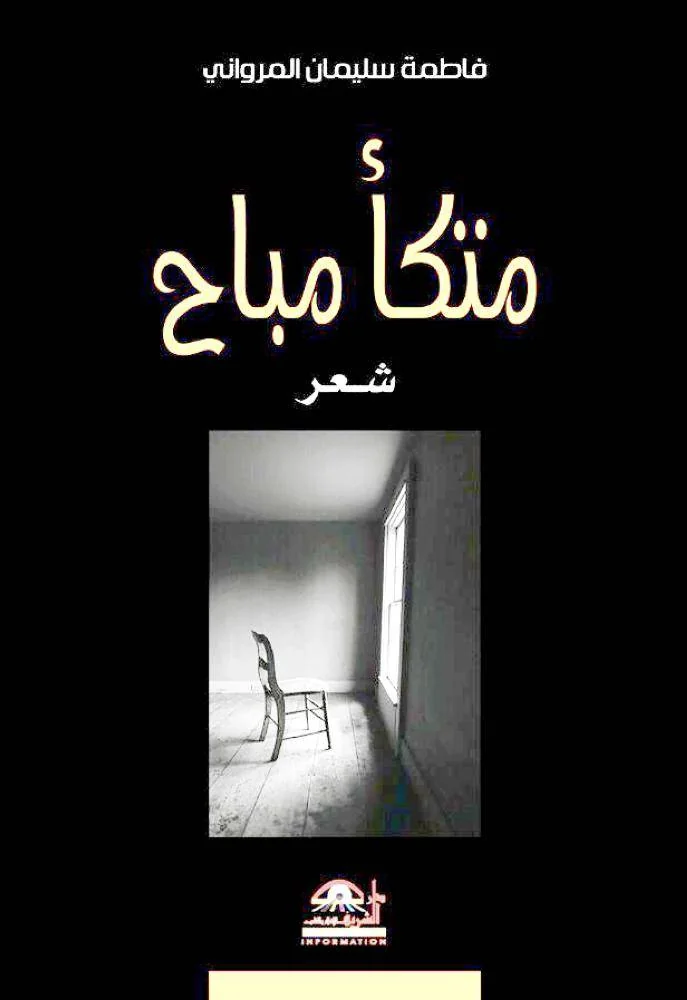
A fine thread between speech and revelation.. A reading in the diwan of the poet Fatima Al-Marwani
Abdullah Al-Samti
The Saudi poet Fatima Sulaiman Al-Marwani aspires in weaving her poem to reconcile between the act of speech, revelation and expression on one hand, and the mechanism of presenting the poetic sentence that includes this act on the other hand. It is for certain the al of every poetic vision: how can we reconcile between the saying and the technique, between revealing and shaping in the poetic text?
Here an important question comes up: Do poetic techniques limit the act of revelation and saying in the poem?
Prose poetry may have broken this problem to a far extent, as the space of revelation and expression is not completely restricted except by what the poetic sentences excite of new scenes, images and meanings that realize their innovation and uniqueness or aspire to that.
In light of this awareness we are facing a semantically directed poetic vision from the poet in her diwan: "Muttaka'' Mubah" (Author. Jeddah, First Edition 2019) where the poet directs the revelation of her texts to three areas, which increase or decrease from a textual quantitative point of view, but she focuses on: the E, the Other, and the contemplative descriptive abstraction.
From the beginning, the poet begins by directing the discourse to the other with a text: "Raheb" (Monk) in which the poetic lines follow directed to an interlocutor through assigning the words to the letter ''kaf'' of the addressee, and here these words become attached to what the other establishes of imagined or metaphorical meanings. The other will impose its dominance in its presence in the text, although the one addressing it is the poetic e.
Here the poet presents us with the details of the implicit presence of the other through the sentences of the short text, and enters into the scope of the sequence that slides in monitoring the other and its emotional descriptions:
He laughs and does not stop his sadness
In his depths a sad wound, your face
A mixture of insomnia and pain that exhausted you
Feelings wrapped in your mystery
Dreams of your thoughts and the surprise of your reality
All of them accompany you like a monk in the sanctuary of your madness. / p. 7
These are frequencies between multiple positions of insomnia, pain, mystery, dream, reality and madness, and they are as we see direct descriptions, for the poet does not seek here to construct complex or ambiguous images, but she names and describes directly, and these direct descriptions enhance the approach to the general reader who does not look much for technique as much as he looks for clear clarity and direct reception.
The poet continues in these direct descriptions in the text until she reaches the presentation of sentences beginning with imperative verbs of both the supplicatory and mandatory types, in a repetitive sequence that implicitly suggests summoning the future considering that the command has not been achieved yet:
Stretch out the palm of your sun, break your fear
Weave your love with the warmth of the pulse
Open your eyes to the rain and wash your dust
Human your sperm is light and pure water inside you
Sullaf of my last night waiting for you
I am a lady dancing to the voice of your madness singing
Like my confused evening without you
Forgetfulness is a missing word with you. / pp. 7-8
She remembers everything apparently, this self concerned with the emotional other, so after the consecutive imperative verbs, she illuminates a side of herself, and defines why she commands or hopes or asks so, explaining that in two phrases:
- I am a lady dancing to the voice of your madness singing
- Forgetfulness is a missing word with you.
These two sentences formulate the poetic vision here, for the poetic self defines through the pronoun ''I'' that she is connected to this singing and this madness that overflows from the emotional other, imagined or real realistic, but there is an overwhelming presence for it, there are poetic messages sent to it through various signifiers, there is a dreamy vision filled with longing, and filled with expressions of request and hope, and this vision is the one through which the poet, or rather the poetic self inside the text, seeks its achievement by searching for true love.
And in the second sentence there is an allusion to remembering everything, for with it nothing is fortten, everything is present, realized and described. And the diwan "Muttaka'' Mubah" is based on an implicit dialogue between the E that formulates itself as the poet inside the texts, and the Other to whom the E directs most of the textual discourses in the diwan through two pronouns:
- The pronoun of the addressee.
- The pronoun of absence.