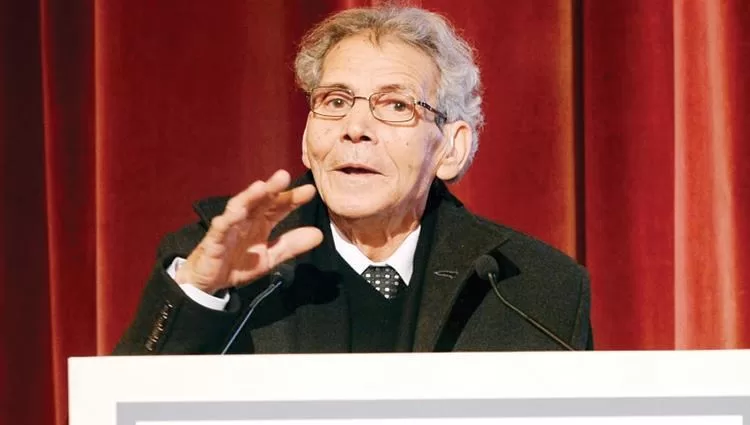
He emphasized that poetry moves forward .. Muhammad Al-Shahawy: Meaning is no longer in the poet's belly and connoisseurs evaluate us!
Interview conducted by: Mahmoud Abdel Moneim Salam
The great poet Muhammad Muhammad Al-Shahawy talks abstractly about himself, saying: Al-Shahawy is an Egyptian citizen born on the twenty-fifth of 1940 AD. He adds in an interview with Ahwal Al-Ma'rifa that he began his education in the Kuttab of Sheikh Muhammad Al-Shafi'i Al-Wakeel, where he memorized the Holy Quran completely and with Tajweed. He then joined the first primary year at Desouk Religious Institute in 1954 AD. Since my youth, I have been attracted by an innate love for the poetic anthems that were prescribed for school students then. In the first primary year, fate allowed me to buy the book (The Selected from Arabic Literature) in its four parts, and I read the whole book, as it contained symbols of Arabic poetry starting from Imru' al-Qais until Shawqi and Hafiz. After that, days allowed me to read many publications, either through acquisition or by borrowing some from friends who appreciated me, especially the late poet Abdel Fattah Ibrahim Shata, author of the collection (Echoes of Freedom). Al-Shahawy's interview addresses the concerns of writing, emphasizing that poetry moves forward, stressing the importance of reading, pointing to his influence by the Holy Quran in his poetic writing, and emphasizing the importance of life experiences for developing the poetic work of any poet. How was Al-Shahawy's poetic beginning? My relationship with poetry was a relationship of a lover enamored with that type of creativity. I used to read and memorize without it crossing my mind that those readings would lead me one day to become one of those who write poetry. Suddenly in 1956 AD during the Tripartite Aggression against Egypt, they gave us an open holiday like all educational houses in Egypt and everyone returned to where their families lived. Meanwhile, I found myself holding paper and pen to write things whose type or value I didn't know; they were just thoughts triggered inside me by the events. After the war ended, we returned to study and I showed those papers to the late poet Ibrahim Shata. He asked me where I got them from? I answered they were mine, but he didn't believe me until I swore to him. He said these poems are of a multi-foot meter that only an expert writes in, and you are not an expert and know nothing about poetry meters. He said it's a wonder there isn't a single linguistic error, so I told him I wrote what you see and you are the first person I show what I wrote to. He told me this is real poetry and from that day I have been taken by myself to poetry.. I won't tell you about the volume of joy I lived and still live every time I write a poem. There is a big difference between giving poetry everything you owe it from yourself and intentionality in writing it. I tell you that I live in a state of permanent and sacred bond with poetry without ever falling into the traps of intentionality.. for poetry is states and heavenly rewards bestowed by heaven upon those who took the reasons and took poetry as a beloved and sweetheart. Did your culture affect your choice of poetic direction? My culture is the sum of my readings, knowledge and experience, and because every person is a natural product of the sum of what I mentioned, and because a person is a mixture of influence and being influenced, and because there is no creative who is a spontaneous growth, I admit that I am very keen not to be an echo of another voice or an image of a poet no matter how great that poet is..... I am always keen not to be anyone but myself and I believe there is no contradiction between my recognition and benefit from all my experiences and being unique in my writings. I also emphasize that reading is the necessity and it is the greatest of necessities for those who wish not to grow old and rigid. I mean by reading serious and comprehensive reading that organizes all that the human mind has created, not only the Arab. How was the image of the poetic context at the beginning of writing? I told you that I didn't try to write at first and therefore there was no specific image, but rather a passion that reaches the limit of madness with the charm of poetry aesthetics specifically and creativity in general. All I know is that the first pages I wrote were known after writing them as Khalilite poetry, meaning poetry committed to the laws and techniques of our old Arabic poetry. For your information, my poetic life is still a mixture of Tafi'li (free verse) and Amudi (traditional). Every poem is born choosing its frame without any intervention from me in its choices of form or rhythm. How do you balance in your poetic experience between the position of poetry and the position of the poet? I always try not to say except what I live and not to contradict myself and I always try for my poetry to be unified and I will continue trying. Is the meaning in the poet's belly according to the famous saying? Meaning always starts from the poet's belly, i.e., from secrets and ghosts waving through the sides and limbs of the poet. But when meanings come out to life embodied in words and letters, I believe the meaning is no longer in the poet's belly but has become presented before the eyes of others for reading and evaluation. Always the judgment is for the reader, for he is the one prepared to have an opinion on the secrets and hidden aspects of the poem. We must not confuse the saying (The meaning is in the poet's belly) and artistically unjustified ambiguity. As the Sheikh of Egyptian poets: how do you describe festival poets? Festivals in themselves are something very beautiful and when festivals celebrate those who deserve from among the poets, this is also a beautiful thing. But what is not beautiful is for someone to link his poetic life and poetic existence to festivals and conferences, especially if there is someone who writes poetry in response to what is dictated to him of writings in specific subjects. Because as I said, poetry is states and manifestations. Do awards constitute a kind of distraction for the poet from his poetic mission? If there is someone who writes for awards only, he is undoubtedly distracted by awards from the truth of the poet within him. But when awards are given or granted as appreciation and recognition, that is considered a commendable matter because it is of the door (Is the reward for excellence anything but excellence?) and the poet's excellence means perfection and not a favor. Did experimentation negatively affect the Arabic poem? Poetry was and will always be the son of adventure and difference, and if it weren't for experimentation, Arabic poetry and all poetry would have lived in a closed circle. But the important thing is that no one experiments except those who are worthy of experimentation, meaning the creative human who proved his worth and eligibility and his creative history to be. There is a vast difference between experimentation and chaos. Is Arabic poetry advancing forward or returning backward? The whole world is moving forward and poetry is part of that world, so how can progress include everything except poetry. It is also in permanent process, therefore it is moving forward. You dedicated your life to poetry, so did it give you as much as you gave it? Not all gifts are limited to material embodiments. Gifts are types and I was satisfied with those gifts of flashes of joy and spiritual and psychological illumination along with what I live of pleasures, enjoyment and cosmic joy while I live the states of the poem. All I hope for is to remain in a state of communication with the states of writing; for man does not live by bread alone. Yes, bread is a necessary thing but it is necessary for me only to the extent of necessity and that's it. Does Al-Shahawy feel that he was critically wronged? I don't like complaining even in my poetry, and I have selections of Arabic poetry titled (Al-Mustafayat) in which I did not select a single verse of complaint poetry for any poet. The important thing is not what is written about the creative but what the creative wrote of creativity, and whoever is wronged today will be vindicated tomorrow as long as he truly deserves vindication. You are an Azhari, so to what extent did Azhari studies contribute to the structure and content of the rhetorical sense in your poem? I am the son of everything I lived in life of experiences, readings and dialogues with the phenomena and secrets of existence. But the Holy Quran remains with its loftiness and strong influence in my poetic experience. Yes, if I weren't an Azhari, I would have wished to be one. How do you think about the poetic text? And is there a balance between the moment of separation and the moment of performance? I told you that I wrote poetry in the beginning without knowing what I wrote, and when I write poetry, the writing is for emotional reasons, impulses and interactions between the ego and the cosmic. I don't remember that one day I lived types of preparation to enter the writing arena. Therefore, the absence of intentionality is something that accompanies me in all my writing states. I am intoxicated by illumination, not by wine, and I live by presence, not by absence, and I remain in the company of sincerity and perseverance. If the stray gazelle appears, I rush in attempts to catch it, to remain in my pursuits realizing that catching it is an impossible dream to achieve. Finally, how do you read the Arab poetic scene today? I read it as I read the poetic scene in every time.. a great cosmic arena waving with a thing and its opposite, with the real and the unreal, the authentic and the fake, repeating the saying of Allah Almighty (As for the foam, it vanishes, being cast off; while as for that which benefits the people, it remains on the earth).