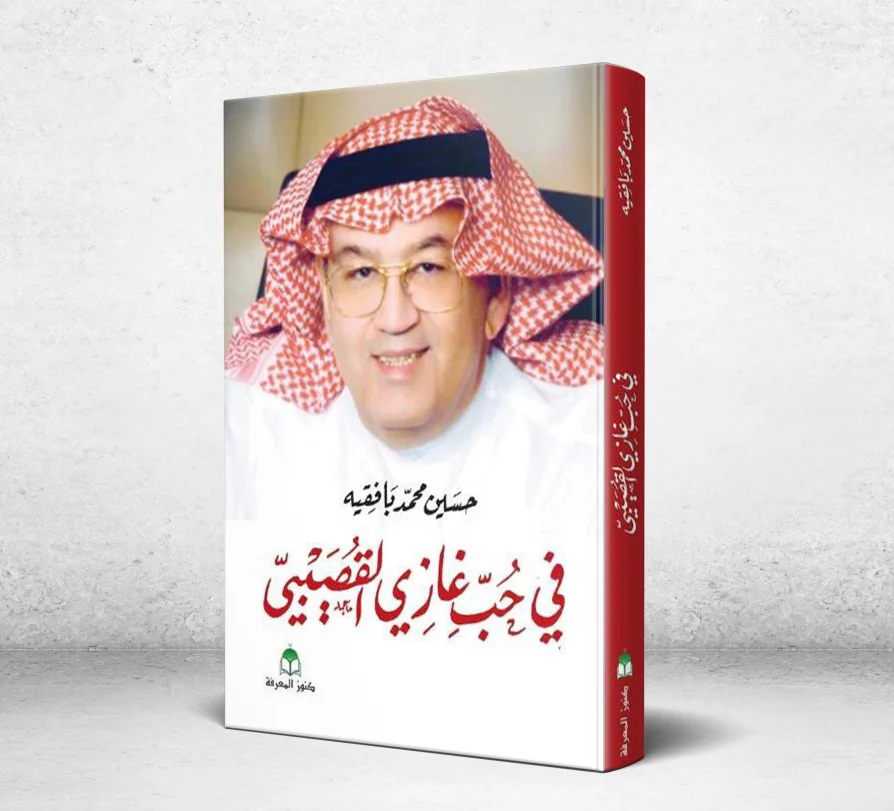
Mixing the Personal with the Critical and Living the Texts Closely .. What Did Hussein Ba-Faqih Write in Love for Ghazi Al-saibi?
Writings that are very close to literary works - outside the theoretical frameworks and their concepts and terminologies that may create methodological walls between the reader and the text - constitute a distinctive pattern of visionary critical writing patterns, which approach the texts and their owners, and read with ease what is between the lines and words, and offer an experience of living with the texts, and perhaps with their authors.
This is what we find represented in Hussein Mohamed Ba-Faqih's new book: "In Love for Ghazi Al-saibi" (Kunuz al-Ma'rifa, Jeddah, First Edition 2022 AD) in which he linked his personal vision in the literature of Al-saibi, and his influence by him in the beginnings of his reading literary biography, until he became attached to his poetic and fictional writings .
Ba-Faqih steps forward to read Dr. Ghazi Al-saibi from close range, without theoretical walls, or conceptual veils, as if he is transacting his own personal biography with Al-saibi's writings. For this reason, the language of the book (which is 195 pages) came very close, focusing on the cross-cultural interaction of the discourse textually, socially and expressively, as it also focuses on the impact and value that Al-saibi's writings brought about.
On page (19) Ba-Faqih says: "Literature and writing were the legacy of Ghazi Al-saibi, and that legacy, which is copious and precious, is what remains of him for history"
The book was built on initial pointers quoted (from the remnants of Ghazi Al-saibi) then the preamble of the book in which Ba-Faqih referred to Al-saibi's works in a condensed way under the title: "What remains of Al-saibi for history?" then (12) diverse articles about Al-saibi and his literary biography.
Al-saibi and History:
Ba-Faqih points out in the preamble of the book to the way he reads Al-saibi's works, saying: "These chapters we can consider as from literary criticism, and they do not deny that, and we can see them as a form of research, and they adopt that, but they all emanated from the heart of a reader who loved Ghazi Al-saibi's literature at the beginning of his acquaintance with reading and literature, and from his mind when he learned something of criticism and research so he inclined towards his poet on a day when poetry was most of his crafts, then he went on reading what he wrote, which is copious in the novel, literary criticism, the article, religious thought, development, and culture. The writer of these chapters realized that the days over their succession did not wear out that astonishment that stayed with him, nor that admiration that entered him, since he repeated in his solitude and during his study verses for Ghazi Al-saibi so he found in what he produces pleasure, beauty, purpose and moderation " .
Ba-Faqih proceeds in a gradual way in reading Al-saibi, referring first to his poetry in a chapter titled: "In Love for Ghazi Al-saibi" and stands with his poem about the King Fahd Causeway between the Kingdom and Bahrain:
A type of passion not a path of stone
This which flew with the oases to the islands
And stands with his collections, or the gems of his poems like : "You Are Riyadh" and "Returning to Old Places" .
Then come the titles of the following chapters: A Bahraini Memory, The Story of a Poem, A Type of Passion, The Apartment between Hamed Damanhouri and Ghazi Al-saibi, Do Al-saibi's Buds Bring Back the Beautiful Time, The Core of the Verse, A Biography for Death.. A Biography for Life, News of Death, Ghazi's Desert and Osama's Desert, Al-saibi of Bahrain and Shirawi of Saudi Arabia, Youssef Al-Shirawi After Forgetting Everything.
Thus came the chapters of the book, in which Ba-Faqih addressed multiple scenes from Al-saibi's cultural biography, but he did not move far from his diverse works and writings.
Writing the Memory:
Hussein Ba-Faqih reviews Al-saibi's beginnings and his upbringing in Bahrain where Ghazi Al-saibi was born in Hofuf in the year 1359 AH (1940 AD) and when he reached five years of age he migrated with his family to Bahrain, so he grew up, was raised and came of age in it, and went to its schools and mixed with its people, and familiarity, love and friendship were contracted between him and a group of them"
The writer continues to monitor Al-saibi's biography and his poetic beginnings and his love for Bahrain in which he wrote his poem: (The Pearl Islands), touching on his relationships with Bahraini writers especially Ibrahim Al-Arrayedh and Abdulrahman Rafeea, then his university studies in Cairo which were the base for his novel: "Freedom Apartment" then his return to his homeland, the Kingdom of Saudi Arabia, in the year 1964 after obtaining a master's degree in international relations from an American university.
The pointers in the book to Ghazi Al-saibi's poetry do not stop, as it is the initial al to which the book's visions set out, with the collection: "Drops of Thirst" and the collection: "Battle Without a Banner" and "Poems from the Pearl Islands" until the collection: "Sunset Garden" .
In an important gesture from Hussein Ba-Faqih, he compares two apartments or two fictional works that took (the apartment) as a field for the novel, in a title: "The Apartment between Hamed Damanhouri and Ghazi Al-saibi" through the novels: "The Price of Sacrifice" for Damanhouri, and "Freedom Apartment" for Al-saibi, pointing to the development of Al-saibi's novel by virtue of experience and temporal transformation.
The book constitutes important highlights in Al-saibi's works and his biography, and addresses them from other angles in which the personal blends with the biographical with the critical, which stimulates reading Al-saibi from multiple perspectives, especially since his writings are echoes of the poet, the administrator, the novelist, the playwright, the biographer, the translator and the thinker.