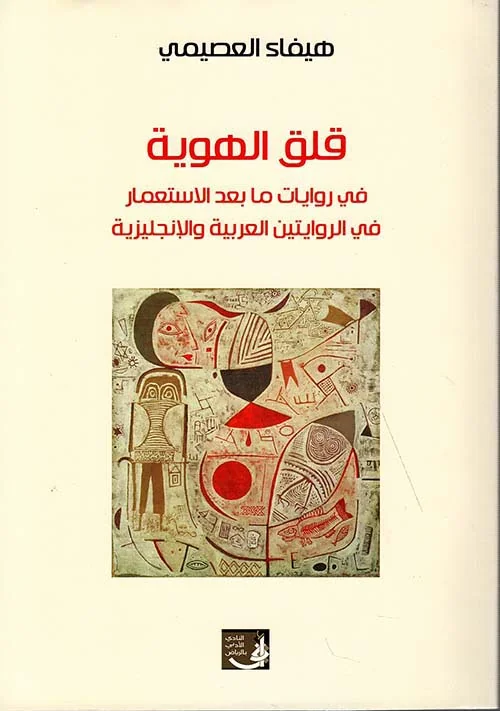
Identity anxiety in post-colonial novels in Arabic and English novels
Ahwal Al-Ma''rifa – Special
Saudi researcher Haifa Al-Osaimi selected two prominent novels through which she monitors the results of post-colonialism on the individual and society: the novel "The Dervish''s Longing" by Sudanese novelist Hammour Ziada, and the novel The Kite Runner by Afghan novelist Khaled Hosseini, a novel written in English.
The researcher started from the following questioning problem: How can anxiety be represented in post-colonial novels? Does it result in a realistic or imaginary historical narrative identity? And how do the effects of identity anxiety reflect on the narrative work at all levels?
The core idea on which Haifa Al-Osaimi''s book, titled: "Identity Anxiety in Post-Colonial Novels in Arabic and English Novels" (published by the Literary Club in Riyadh, 294 pages), is based is the study of the colonial influence on identity in countries that were colonized by the West, and the role of the Other in distorting identity, referring to Edward Said''s vision in his book Orientalism, in which he called for freeing the Arab and Western mind from the illusion of distorted images. And to the writings of Spivak, Homi Bhabha, and Aijaz Ahmad.
The researcher believes that when talking about literature in its relationship with colonialism, we find that the human topics addressed by literature "are nothing but an attempt to reveal the human self and its concerns, problems, and contradictions, and this is due to the urgent human need to know oneself."
Haifa Al-Osaimi shows that those belonging to "post-colonial" literature are not necessarily residents of countries that were colonized, as minority peoples in the West, and some peoples of the Third World, share a history of colonial exploitation, which constantly raises the crisis of cultural identity in creativity. Language is an important component of identity, but it is not the primary component in all cases.
Key Themes:
The author begins in the introduction by presenting the colonial state dominating the East in two axes. The first: Colonialism/Post-colonialism and the problem of terminology, in which she explained the concept of the word colonialism and coloniality. The second: Identity in narrative discourse approach, where modern Western human studies contributed to forming coherent philosophical, psychological, social, and cultural theories of identity, attempting to develop its own conception of the meaning of identity and its interconnections and formations. These studies also proved that the individual self is a collection of multiple identities and not one identity.
Citing the views of Peter Brook and Paul Ricoeur on the self, consciousness, and identity, she believes that if the European colonizer took the Eastern colonized as an imaginary counterpart to build his self and understand his contradictions, then the duty of the colonized is not to rely on distorted images of the Other to build his self, but rather to find himself in his history and heritage relying on self-comparison to reveal his weaknesses today.
Identity Anxiety
Through three chapters titled: Anxiety and the components of narrative identity, Anxiety its causes and narrative effects, and Identity anxiety and the Other, the researcher addressed a number of topics about identity and social networks, communication mechanisms, the emergence of binary oppositions, monologue, dialogue, spatial classification, temporal change and identity anxiety, national identities and communication failure, ethnic conflict in ethnic societies, and national identity and popular culture by applying them to the two studied novels.
The author concluded with the research results where the study attempted to investigate the anxiety of identities in a Sudanese novel model and an Afghan one, by observing tangible identity elements and subjective identity elements, and their progression in stability, change, and transformation. She found that pronouns and dialogues are affected by the positioning of the character in the text, and the strength of its identity presence, thus revealing cases of losing some of its identity features, and that the relationship of identity to dialogue is a reciprocal reflective one. She argued that one cannot focus on the state of anxiety in itself when monitoring temporal-spatial elements, because that could affect the structure of narrative and stop the sequence of events, thus moving out of the field of literature and its criticism into the psychological field interested in conscious states and explaining their symptoms. She revealed that the impact of national identity by the colonial phase and beyond and the disintegration of its elements led to the emergence of new elements carrying features of hatred and destructive racism for the entity of the nation itself. Writing about the self in another national language contributed to revealing new aspects in identity and developing it.
The researcher called for focusing on the fields of cultural studies and cultural criticism and attempting to employ them in studying the new colonial formation in all fields.