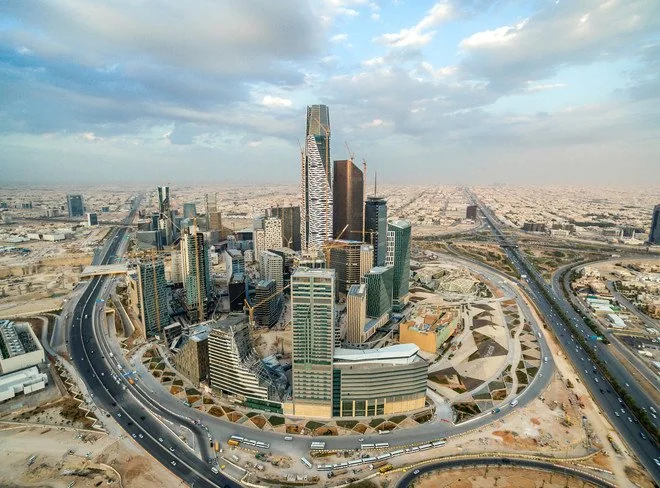
Historical and civilized leaps after the founding of the Kingdom.. Between old Riyadh and the Riyadh of Vision 2030, reality embroiders its buildings
In the moments between moments, history wanders, changes and is changed, and writes its realistic narratives with embroidered evidence of thought and human creativity. This is how we learn from the eras that man invents, where he turns ruins into a memory, memory into a documented witness, and the witness into a tangible physical style that stands tall to speak its aesthetic words.
This is how cities are, and Riyadh is one of the ancient cities. In fact, it is one of the oldest cities in the Arabian Peninsula. It is the stone of Najd, it is Al-Yamamah, it is Wadi Hanifa, it is Manfuha Al-Asha, and then it is the incubator of the Saudi state in its various stages and transformations. It is the desert book open to events, memories, poems, and epics.
Ancient Styles:
Old neighborhoods are spread in Riyadh, especially in southern Riyadh, where the first beginnings of urbanization and the appearance of mud houses that remained in their natural state for long decades, and were inhabited by the first Saudis. King Abdulaziz Al Saud - may d have mercy on him - launched the first building outside the ancient wall of the city, which is: Al-Murabba Palace, where the city intertwined with modernization in 1938, as Abdullah Al-Zazan explains, when King Abdulaziz ordered the construction of Al-Murabba Palace outside the walls of old Riyadh. After that, specifically in 1956, modern architectural systems intertwined with the city's ancient architectural heritage, blending the old with the new, and the past with the present in a race with the manifestations of modernization.
The High Commission for the Development of Riyadh launched a program to preserve heritage buildings, which included old residential palaces, vernment buildings, and others. A survey was conducted of those buildings, which often consist of two floors and were built of mud, stone, wood, and tree branches. Data was recorded in the field and the buildings were photographed and placed in a database, and historical studies were conducted on those neighborhoods, archaeological buildings, their residents, and the lifestyle in them.
The program registered more than 15,000 buildings distributed in 33 neighborhoods of Riyadh, the most prominent of which are Al-Shumaisi, Al-Oud, Ad-Dirah, Manfuha, Al-Aridja, Al-Marqab and other neighborhoods of the capital. The most important architectural elements in these buildings were also identified, including the "Al-Haqaf", which is a longitudinal hollow line in the middle of the wall, and "Al-Hadayer", prominent and inverted triangles, and "Al-Dahliz", which is the entrance to the house, and "Al-Turmah", the protrusion above the door of the house with a height of 60 cm that allows seeing the person knocking, and "Al-Majbab", a hall for the owner of the house and his guests in the summer, and "Al-Khalwa", which is a decorated hall special for guests, and "Al-Kamar", which is a warehouse with plaster shelves, and "Al-Wajar", where wood and charcoal are placed.
Riyadh houses were distinguished in the past by their fixed engravings on the plaster in distinctive locations of the Najdi house, from the facade and balconies, where the white walls are topped with engravings from the local environment and triangular openings. This method continued for three centuries, especially in neighborhoods such as the Turaif neighborhood in Diriyah.
The development of the city of Riyadh - in Al-Zazan's words - came with the commitment of the Custodian of the Two Holy Mosques King Salman bin Abdulaziz to civilized reform, a qualitative leap in modern Saudi time, aiming to place the Saudi person in the ranks of the finest human societies. Therefore, it is very difficult for the pen to capture a single act to shed light on, as every act deserves to be paused at. King Salman bin Abdulaziz is one of the most prominent international figures who recorded a prominent presence at all levels: social, economic, cultural, civilized, humanitarian, and structural.
The city recorded the largest developmental development process known to the world. Construction was following at a rapid pace, and Salman bin Abdulaziz wanted this city to enter the civilization of the age through the wide door. Therefore, what happened and is happening to Riyadh today would be almost impossible without the presence of the personality of Salman bin Abdulaziz.
One look at this city confirms the extent of the massive expansion. What has happened now is by all standards beyond imagination. King Salman - may d protect him - inaugurated Riyadh's major projects amounting to 921 projects at a cost of 52.3 billion riyals, and projects for which he laid the foundation stone amounting to 360 projects at a cost of 29.8 billion riyals.
Riyadh has become one of the major global cities, living an unprecedented civilized renaissance in its ancient and modern history together.
Scenes and Transformations:
Whoever reads the books of European travelers about the city of Riyadh more than a hundred years a, such as the book of William Facey or other travelers, and their observations about the city, its buildings, and its social and economic conditions and compares its status with Riyadh today will be completely amazed by the rapid pace of modern and civilized transformations. Whoever looks at the objectives and strategy of the Kingdom's Vision 2030 will be proud of this realistic development through construction and sustainable development that makes Riyadh one of the widest and most spacious modern cities shaped by technological work techniques and these buildings with open horizons.
References:
https://www.wafyapp.com/ar/article/old-riyadh-houses-are-a-testament-to-the-ancestral-lifestyle
https://www.alriyadh.com/1739456