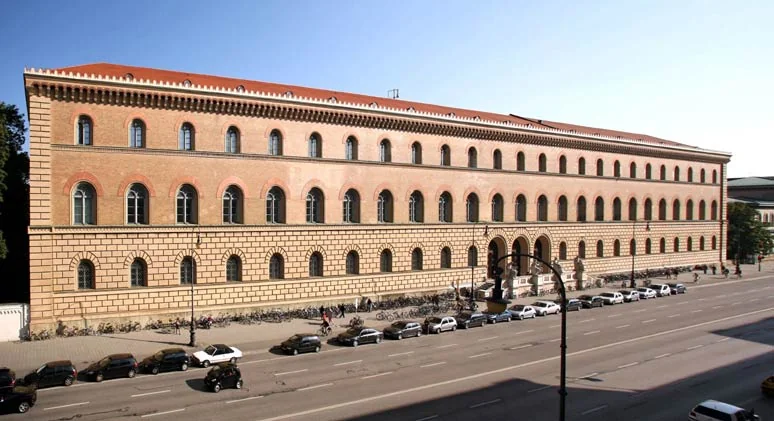
The Bavarian State Library... History at the forefront of its responsibilities!
State of Knowledge: Special
Munich is the third largest city in Germany and the capital of the state of Bavaria. The city is located in southern Germany on the Isar River, about an hour's drive from the Alps. Its population living within the city limits is about 1.31 million. Its unique location in central Europe has made it throughout history an important stop and center on the continent. It is also an important center for fashion, culture and literature in Germany, as it is home to a number of television and radio stations and includes about 300 publishing houses.
This International Library
This economic and cultural city (Munich) includes one of the most famous libraries and research centers in the world, the Bavarian State Library, founded by the ruler of Bavaria, Albrecht V, in 1558. This library derives its importance from being an international center for research, and due to its valuable and rare acquisitions throughout the ages and from various civilizations, as it includes 10 million books, 59,700 periodicals and newspapers, 1.1 million e-books, 93,800 manuscripts, and 20 thousand books printed in the early stages of the art of printing (1), in addition to 96 thousand rare historical manuscripts. The library introduced a numbering service for a million items of its acquisitions of books and manuscripts, making it the largest digital library among German libraries. During the Second World War, the Bavarian State Library lost more than 500 thousand volumes. After the end of the war, the building was restored and the new eastern wing was built behind the historical walls of the building, bringing the total surface area to 17 thousand square meters, with a volume of 84 thousand cubic meters. The southern wing was opened after its restoration, which was the final stage in 1970. As for the warehouse for preserving books, it was completed in 1988.
260 thousand volumes in Arabic and Oriental languages
The library's collection in the Oriental and East Asian department includes 260 thousand volumes in Arabic, Armenian, Georgian, Hebrew, Yiddish, Persian, Hindi and Tibetan. The East Asian collection includes more than 310 thousand volumes in Chinese, Japanese, Korean, Thai and Vietnamese. The Bavarian State Library considered "history" in general at the forefront of its responsibilities, starting from 1949, from prehistory and ancient history, including ancient Latin works from the Byzantine era in Germany, Austria, Switzerland, France and Italy. In 1998, the library focused in its modern collection on "history" too, which included approximately 690 thousand books and 19,300 periodicals, including 4,300 that are still being published until now. Thus, the percentage of historical publications is 10% of the total contents of the library (2).
Islamic culture in the hands of Germans
The Bavarian Library is proud of its important collection consisting of precious parts and pages of the Holy Quran and other Arabic manuscripts. Many of these copies have been in the Bavarian library for many centuries and were collected either by the princes of Bavaria or the monks of the monasteries for two reasons; the first was driven by curiosity and the love of knowing their content and about the Islamic religion, and the second for their artistic value; as the kings of Bavaria loved fine art and this appears in the palaces in the state of Bavaria. Among those who collected Islamic manuscripts was the German orientalist Johann Albrecht Widmanstetter (1506 – 1557 AD) in the Renaissance era, and he was more open to new ideas and the cultures of others. His proficiency in the Arabic language facilitated the study of manuscripts with the utmost care, and he later wrote a book about the Holy Quran. After his death, the ownership of his library passed to Duke Albrecht V, Duke of Bavaria, for his library to turn into a core for the establishment of the current Bavarian State Library. Through repeated purchase operations from different countries and places, the library was able to possess the greatest cultural and civilizational human wealth, and the largest deal was in 1858 when the administration bought from the French orientalist Etienne Quatremère 1250 Islamic manuscripts written by hand and many oriental and Islamic publications, followed in the nineteenth century by its purchase of collections of orientalists including Marcus Joseph Müller and Martin Haug and the Italian Giuseppe Caprotti, who was known for his tours in Yemen (3). Due to the rarity of what this library possesses, its administration periodically holds exhibitions to display them, attended by visitors from all over the world, especially those interested in oriental affairs, Islamic arts and the Islamic religion, who also participate in lectures and seminars held in the library. Among the Islamic exhibits considered rare are 130 copies of the Quran written by hand dating back to the period between the ninth and nineteenth centuries, when the printing press replaced writing by hand, leading the library management to believe that the manuscripts and copies of the Holy Quran it has are among the most important collections outside the Islamic world. There are copies of the Quran that still preserve their beauty, some written in liquid ld and originated in Iran and completed in the eleventh century AD, in addition to the cover of a manuscript from the late eighteenth century decorated with flower-shaped ornaments drawn in India or Iran. In a copy of the Holy Quran, the first decorated page carries an Andalusian model from the twelfth and thirteenth centuries showing the accuracy of the drawings and the beauty of the colors chosen with great care. There is also the cover of one of the Qurans in a small size and written by hand in 1870 and decorated with flowers and plants. Andalusian Qurans are among the rare copies too, as most of the Qurans completed and written in Islamic Spain were destroyed after the Christians recovered Spain at the end of the fifteenth century, and Muslims were able to smuggle some of them. They are distinguished by the special decoration of the first and last pages, and their unusual size that reaches a square. Among the artistically decorated Qurans are those written in the Iberian Peninsula in the fourteenth and fifteenth centuries, and are considered distinct for their extraordinary accurate decoration (4).
The library buys new manuscripts
The Munich library recently expanded its rare collection of Islamic and oriental manuscripts by acquiring a number of precious pages of the Holy Quran written in ld dating back to the ninth century AD/third century AH. Those in charge of the library emphasized that the Quranic pages it bought for 51 thousand euros enrich and complete its precious collection of Qurans and parts of the Holy Quran and rare Islamic manuscripts, which it began collecting since the mid-sixteenth century AD. This collection of Qurans and Islamic and oriental manuscripts completes what was collected of manuscripts and with which the ruler of Bavaria Albrecht V founded the library when he bought the complete set of oriental acquisitions from the orientalist Johann Widmanstetter. During the last fifty years, the library expanded its acquisitions by buying a number of Qurans and precious parts of the Holy Quran from ancient historical stages, including a Quran written in ld dating back to the eleventh century AD, and Qurans and parts of the Holy Quran dating back to the period between the ninth and nineteenth centuries AD. The number of acquisitions of the Bavarian State Library of oriental manuscripts currently reached 17 thousand pieces, including 4400 Islamic manuscripts, comprising 175 rare Qurans and precious parts and pages of the Holy Quran (5).