Date Palms.. From Protection Against Hunger and Travel Provisions to Competitive Acquisition
Talking about palms in general is the task of botanists and scientific encyclopedias concerned with the orders, families, types, and genera of palms in a detailed manner. The date palm in the Arabian Peninsula has occupied a wide space in the life of the Arab since ancient times; its fruit was his protection from hunger and his provision in travel, just as it was the accessible raw material that he used in building his home and furnishing it, and in producing many useful products, tools, and vessels.
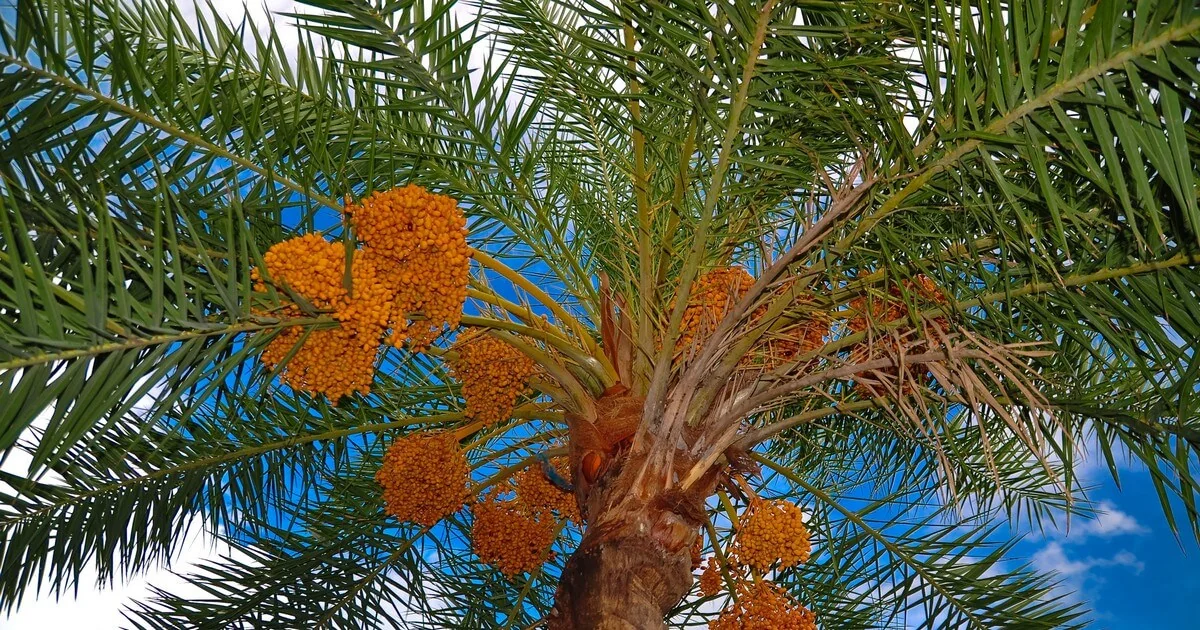
The date palm in its complete form at the time of fruiting consists of five main parts: the roots, the trunk, the fronds, the heart of the palm (the growing tip), and the bunches carrying the racemes and fruit. Among the types of dates are:
Al-Barhi
The origin of the Barhi tree is from Iraq, and the first to bring it from Iraq were the people of Unayzah half a century a. It has a great status for them and for the people of Al-Qassim in general. The tree size is huge, its fronds are long, its channels are long and strong, and it is generous in giving as the average production of a single palm annually reaches (250) kilograms, and it is modest in pollination.
The Barhi fruit is medium in size, its shape is short cylindrical tending to spherical, slightly thick, its color is apricot yellow turning in the rutab stage to amber or transparent honey and the date tends to light brown. It is eaten in the Zahw, Rutab, and Tamr stages. Its ripening is late.
Ajwa of Medina
The Ajwa of Medina tree is ancient and famous in Medina. Its size is medium, its numbers are few because the success rate of planting it does not exceed 30%. It only gives a few offsets, which raises its price. Its fruit output is low, and its desire for pollination is moderate. If pollination increases, the fruit accumulates, its size decreases and it becomes parched (hashaf). If pollination is insufficient, the fruit turns into a non-edible state. Its color is black, relatively oblong, and marked from its base with white lines. The fruit is eaten as a date. People may confuse the original Ajwa with another traditional spherical-shaped Ajwa, while the original is oblong in shape.
Al-Safawi
Its origin is from Wadi al-Safra. Strong, its size is huge, its fronds are long, and it is large in number. Farmers accept planting it because it is generous in giving, as its annual production reaches (300) kilograms. It is modest in pollination and its fruit ripens late. Its taste is delicious, it is eaten as a date and its color is oblong black. it is marketed to pilgrims and visitors and is common in Medina and Al-Qassim region.
Al-Sukkari
The cultivation of the Sukkari palm is widespread in Al-Qassim region. The tree size is medium, fast growing and rising, and highly productive as its annual production reaches (150-200) kilograms. It has a moderate desire for pollination.
Among the excellent varieties, its size is medium, elliptical in the growth stage, its color is yellow. The Sukkari fruit is eaten as rutab and tamr with a delicious taste, and it can be preserved by freezing. It is late in ripening.
Al-Sagai
The Sagai palm is from the Al-Aarid region and its cultivation is frequent around the city of Riyadh. The Sagai tree size is huge, fast in growth and height, its output is moderate, and it is greedy for pollination. It has a thick cylindrical shape with a prominent yellowish top with a flat reddish edge. Its color is light yellow, turning to a tan brown color when it becomes a date. It ripens in the middle of the season, its price is high, and it is eaten as rutab and tamr.
Al-Khalas
The cultivation of the Khalas palm flourishes and spreads in the Eastern Province of the Kingdom and specifically in Al-Ahsa. Medium in size, modest in pollination, its output is od. The Khalas fruit is oval in shape, medium size, its color is apricot yellow turning in the stage of completed growth to light amber when ripening, then to reddish amber. It ripens in the middle of the season, has few fibers, and Khalas fruits can be consumed in all stages of ripening.
Al-Rothana
The Rothana tree is planted in Medina and Yanbu Al-Nakhl. It grows tall quickly, is medium in size, moderate in output, and moderate in the desire for pollination. The Rothana fruit is medium in size with an oval shape, wide. The color of the unripe date (busr) is yellow. In the rutab stage, its taste is sweet and palatable in the busr, rutab, and tamr stages. Its rutab is beautiful and it ripens early. The fruit retains its shape for a long time without being damaged.
Nabtat Ali
It is planted in the Central Region and specifically in Al-Qassim. The average production of the tree annually is (95) kilograms, and it is attributed to the first one who cultivated it, who is (Ali).
The size of the fruit varies from medium to large, with an oval-oblong shape, with a drawn top. The color of the fruit in the busr stage is yellow and in the rutab it is dark amber. It is soft with few fibers, but its rutab is sweet and delicious in taste.
Al-Barni
The Barni palm is ancient and well-known in Medina and Al-Ula region. Its cultivation also spreads in Wadi Turabah and Wadi Bisha. The tree trunk is long, fast growing, od in output, and modest in pollination.
The fruit shape is oval-oblong, large in size, tapered from its top, thick from its base. It is used as a treatment for wounds, resists decay, late in ripening, and used in manufacturing.
Al-Khudari
This tree is famous and widespread in some central regions, and in Al-Ahsa and Qatif, and needs care when pollinating. Its output is low. Its fruit has a cylindrical-oblong shape with a conical top, large size, its color is blood red in the stage of completed growth, turning to dark brown in the tamr stage. It is characterized by few fibers, and is one of the most important od and commercial varieties.