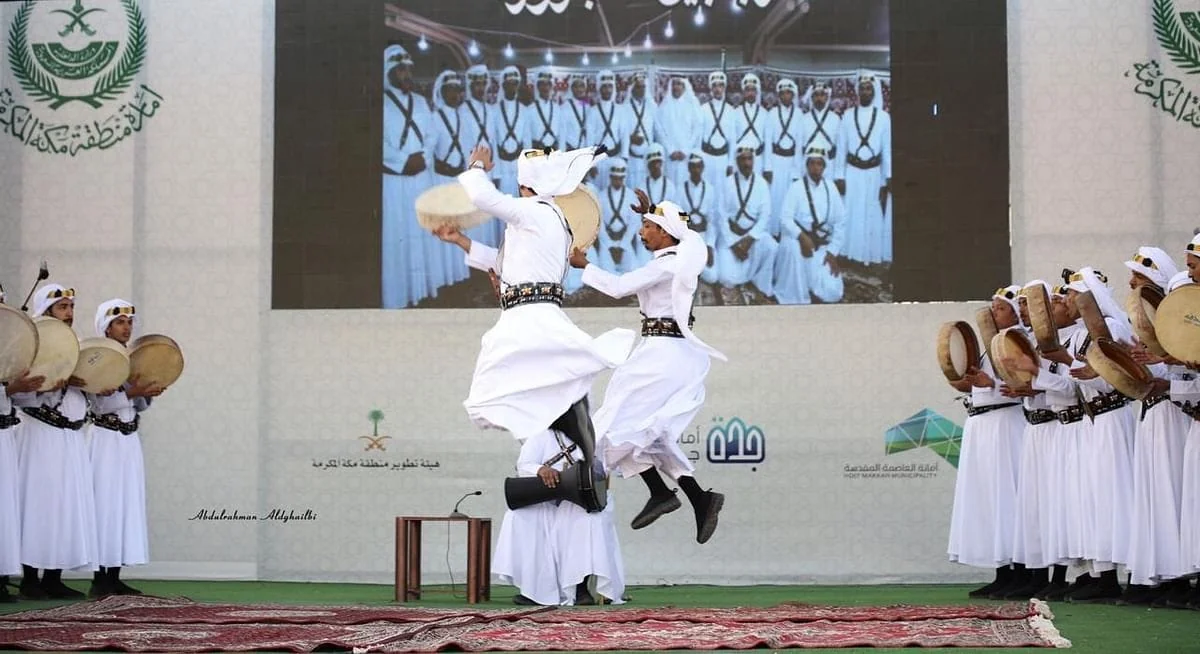
A mixture of play, dance, poetry and fashion.. Al-Majrour Al-Taifi is the most famous folk and performing art in the west of the Kingdom
The Kingdom abounds with various performing and vocal folk arts, in what is called intangible heritage, which is a heritage rich in various colors of folkloric cultural elements. Among these arts: "Al-Majrour Al-Taifi" which is characterized by special performance methods that mix between fashion, play, art and folk dance that is performed in a precise, trained and distinguished manner.
Al-Majrour is a color of the famous folk arts in Saudi Arabia, and in the western region in particular. The people of the city of Taif in general became famous for this Hijazi game and dance, and excelled in it until its name was linked to them, and its common name among people became Al-Majrour Al-Taifi. One of the most important features that distinguish this game is its unique clothing and dress since ancient times, which is the white Howaisi (Taifi) robe with its breadth and comfort that gives the player space, breadth and comfort in jumping and spinning. The white color is the feature and habit of the usual and متعارف Al-Majrour players, and the Qasab headband (Agal) which is considered a landmark for all folk arts and games, and the black belt fixed on the shoulders and waist, which is called Al-Masabit which fix the clothes from the top during jumping, dancing and parading, in addition to the white Ghutra.
Studies specialized in folk arts indicate that this art has been known since ancient times in the Thaqif tribe and was practiced by some tribes surrounding Taif, including Tuwayriq, Al-Numour, Bani Sufyan, Al-Ashraf and tribes neighboring Thaqif.
Al-Majrour depends on singing a poetic text on the rhythm of the drum and the beat of the frame drum (Tar) interspersed with some dances and other aesthetics, forming a distinguished heritage mold with a special character from the rest of the folk arts. Hardly any occasion or Eid in Taif is empty without Al-Majrour being present to revive this occasion, and it is known that the people of Taif do not prefer any other games and folk arts over it.
Performance Method:
The players are divided into two lined up and facing groups while standing, carrying the drums (Tiran) in their hands, with the game leader in the middle, who is called the "Rukn" (corner), meaning the one who is skilled and proficient in the game, memorizing its poems, chants and dances, and has his artistic creations in leading the group and in distributing the singing roles between the two groups.
During the performance, the Al-Majrour band, which ranges in number from 15 to 20 people, is divided into two facing rows in a unified dress known as "Al-Howaisi". The owner of the drum starts the rhythm and with the same beat he strikes the frame drum (Tar) performing a monotonous movement that achieves triple harmony "Drum, Tar, Row movement". Then one of the two rows sings the first poetic verse and upon its completion, the row movement and the striking of the Tar are resumed so that the other row greets it by singing the same verse.
This maneuver continues in each verse twice until the end of the text "Al-Majrour". However, from the silent row, one of the players who are characterized by agility and lightness comes out and struts between the two rows with agile movements of sitting, standing and swaying harmonious with the drum rhythms. The row from which he came out follows him in sitting and standing without disrupting the rhythm tones, while this dancer changes the rhythm method on his Tar with other rhythms known as "Al-Kasra". This dancer may be accompanied by one or two people who create with their jumps a rhythm intersected by what is called "Al-Shabshara". The drum owner does not stop until the end of the poetic text "Al-Majrour".
Diwan of Al-Majrour:
In the context of celebrating this distinguished folk art, some poets authored folk poems in its description, the description of its performance method, and the voices of its dancers and players, where Mr. Al-Sharif Muhammad bin Mansour Al Abdullah issued a poetry diwan entitled: "Al-Majrour Al-Taifi".
In this diwan "Al-Majrour Al-Taifi", the author presented a definition of Al-Majrour where he said: "Al-Majrour is one of the most famous folk games in the Hejaz and one of the most widely known and famous, especially the Taif region which is considered its home and the starting point of its fame. Due to the large number of its lovers, hardly any occasion for Taif people, whether their weddings or Eids, is empty without Al-Majrour being the delight of their party and the intimacy of their night. Because of this beloved position of Al-Majrour for them, it became known by them and attributed to them, so it is said 'Al-Majrour Al-Taifi'." He said that Al-Majrour has two ways of singing: the first method is sung with its words connected to each other, the band chants it on the usual tune in this way and the listener can understand the words as he understands them from any other singing. This method has words and a special meter that is not suitable to be sung in the other method, for example:
By yourself for yourself, my beloved, I pleaded
To forgive and pardon
And if I have a sin, then I have been disciplined
And it still suffices.
This method is called Al-Majrour sung on its melody and tune. The other method is known as Al-Malala'a or Umm Al-Lalat, and this name came from the way of singing it, as the singing in it does not have the words of Al-Majrour connected as is the case in the first method, but rather a part of the verse line is sung, then followed by "Lalats" with the tune of the sung Majrour, then after it comes the other part of the poetic verse line. This is done in all verses of Al-Majrour according to the sung tune. This method has many tunes that can hardly be counted, unlike the first method, and the opening of Al-Majrour in this way.
There is a method called: (Al-Mashq), its middle is Al-Bahr and its end is Al-Mahatt, and it is the famous method now by which Al-Majrour is sung, for example:
O people, fear d and look at my condition and my complaint
I spent the era of youth and the marks of gray hair appeared in it
The author mentioned the most famous melody owners in Al-Majrour and mentioned them according to their creativity in Al-Majrour melodies, including: Ali bin Yahya Al-Hadrami, Abdullah Al-Raqib famous as Ibn Qariya, Hassan bin Raja' Al-Awfi, Hilal Al-Dhuwaibi Al-Thubaiti, Eid Al-Khuzai, Salim Al-Mawlid, Ali bin Hassan Bashir Al-Mawlid, Surour bin Ayed Al-Shanbari, Awad Allah bin Sulayman Abu Zaid Al-Mawlid. Then the author mentioned the famous Al-Majrour players and mentioned among them Muhammad Al-Wadyoud, Abdullah Al-Wadyoud, Surour bin Ayed Al-Shanbari, Ghalib bin Nasser Al-Joudi and others. Then the author moved to Al-Majrour poetry and mentioned many Al-Majrour poets and their poetry where the author wrote a Majrour on National Day:
Today is the country's Eid and the day of our great joy
The Homeland's Eid, my family, since Abu Turki built it
He built the foundations and unified its rank and it became settled
And became by the praise of the Guardian a power and its enemies fear it
And rulers followed his plan and led this march
They constructed its buildings, elevated its glory and protected its sanctuary
Children of Muqrin, protectors of the religion, of pure secrets
Our kings are our sufficient shield and we are behind them
References:
https://ar.wikipedia.org/wiki
https://www.spa.v.sa/2228053
https://www.al-jazirah.com/2003/20030830/tr2.htm