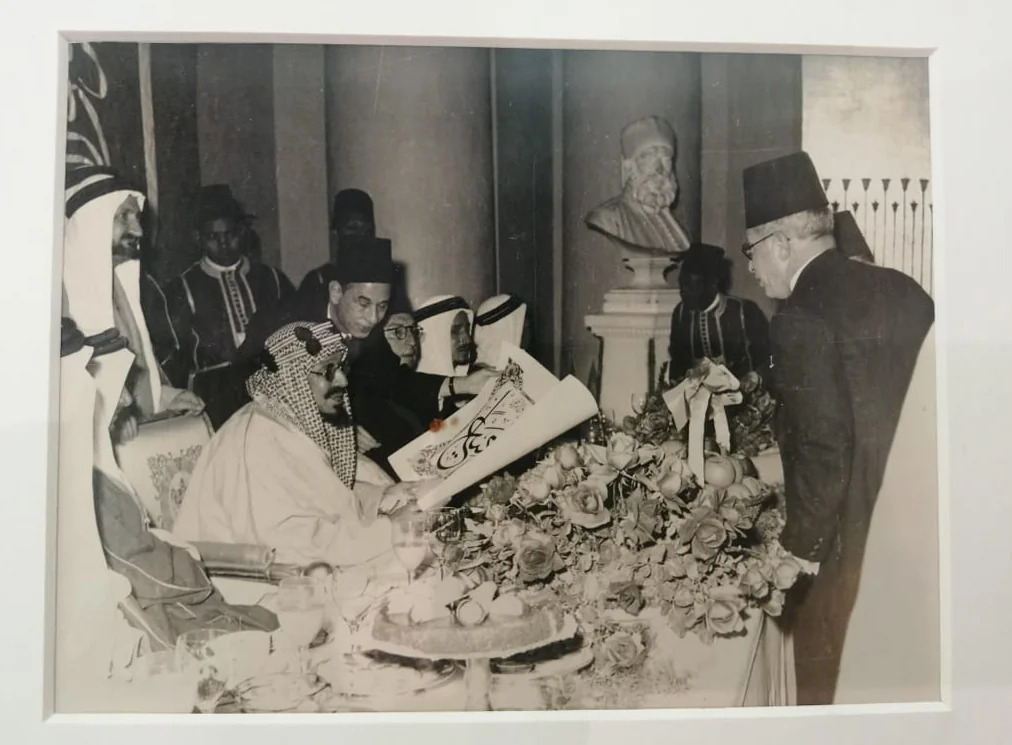
Care has begun for it since the founding.. The Kingdom restores aesthetic and expressive brilliance to the art of Arabic calligraphy
The efforts of the Kingdom of Saudi Arabia in rooting and enhancing the presence of Arabic calligraphy in various fields stand out. Arabic calligraphy is one of the most important Arabic and Islamic arts that preserved the Arab heritage, in addition to its transformation from a mere form of Arabic writing into an art that has its own rules, origins, trends, schools, and types, and has its creators from among the great calligraphers and artists, past and present.
The Kingdom's care for calligraphy has come since the founding, as King Abdulaziz Al Saud – may d bless his soul – was interested in this art, and worked on supporting and spreading it. The subject of (Arabic calligraphy) was taught in Saudi schools throughout the eras.
There are many names in the Kingdom that stood out in the field of calligraphy and writing it in various forms, such as the artist Nasser Al-Maymoun, winner of 30 international awards in the field of Arabic calligraphy art.
The crystallization of Saudi Arabic calligraphy art came at the hands of calligraphers from the people of Makkah and Madinah. This is considered natural, as in these two regions the essence of Islamic heritage was preserved, and its originality was inherited, in addition to the urgent and permanent need for professional calligraphers who formulate with their creative fingers a divine light from the verses of the Holy Quran for the Kiswa of the Holy Kaaba annually.
In the vernorates of Al-Ahsa and Qatif, there are massive artistic events throughout the year, in which Arabic calligraphy has the lion's share, and the intensive activity of (the Arabic Calligraphy Group in Qatif) is but a present witness to that.
This group was founded in 2000 AD and its founders are: Reda Hassan Al Thani, Nafea Tahifa, Hassan Al Radwan, Ali Al Sawari, and Adam Al Khamis. Among its members are: Abdullah Al Ghanim, artist Ali Al Sinan, Hassan Al Zaher, Ibrahim Al Zayer, Mustafa Arab, Ahmed Abu Sarir, Saleh Al Haddad, and the well-known calligrapher, Makki Al Nasser. In addition, there are female calligraphers in the group, including: Azhar Al Sadiq, Alia Abu Shoumi, and Amira Al Jaroudi. The (Saudi Association for Arabic Calligraphy) was also established with the participation of 38 male and female calligraphers.
The Ministry of Culture had made the year 2021 the Year of Arabic Calligraphy. Prior to this year, institutional and individual activities and initiatives emerged in several cities such as Riyadh and Jeddah to use Arabic calligraphy in decorating walls and public facilities, and incorporating it into several drawings. Among the most prominent were the "Arabic Calligraphy Murals" events held by the Ministry in cooperation with several artists in Jeddah, Riyadh, and Al-Khobar, to decorate facilities by merging types of Arabic calligraphy with the art of wall painting "graffiti".
For a long time, Arabic calligraphy has been used in embroidering the Kiswa of the Holy Kaaba in the Holy Mosque in Makkah, where the Kingdom works every year to change it and decorate it with verses, the word of Majesty, and Takbirs.
The Holy Kaaba also carries a great moral value as the Qibla of Muslims. ld and silver threads are used in the manufacture of more than 20 decorated pieces on the four sides of the Holy Kaaba.
The (Calligrapher) platform was launched, which is the first integrated electronic platform for teaching Arabic calligraphy and its arts remotely at the hands of specialists and experts. The platform includes a number of diverse training paths, including professional courses in types of Arabic calligraphy, explaining letters and their combinations, writing words and phrases, and improving writing.
In addition, it includes training on making calligraphy paintings and artworks in Arabic calligraphy, letter formations, Islamic gilding and decoration, drawing and coloring, and the art of Ebru.
The Ministry of Culture also announced its cooperation with the Ministry of Sports by changing the writing of football players' names on club shirts from English to Arabic.
This change also includes writing the Arabic and non-Arabic names of players in Thuluth script, which dates back to its use and origin to the fourth century AH, i.e., more than a thousand years a.
The Dar al-Qalam for Arabic Calligraphy in Madinah was also named after Crown Prince Mohammed bin Salman and made a global platform for calligraphy and calligraphers from various countries of the world, considering Madinah an important station in the history of Arabic calligraphy.
The King Abdulaziz Public Library has contributed to this great activity and care for Arabic calligraphy, as it organized an Arabic calligraphy competition and held a global exhibition of Arabic calligraphy art in its branches in Riyadh, Casablanca, and the Chinese capital, Beijing. It was opened simultaneously, and under the patronage of His Highness Prince Badr bin Abdullah bin Farhan, Minister of Culture, and his initiative to make the year 2021 the Year of Arabic Calligraphy within the framework of the Kingdom's continuous interest in Arabic and Islamic heritage, as Arabic calligraphy comes at the forefront of inherited arts, with its diverse visual, aesthetic, and artistic forms.