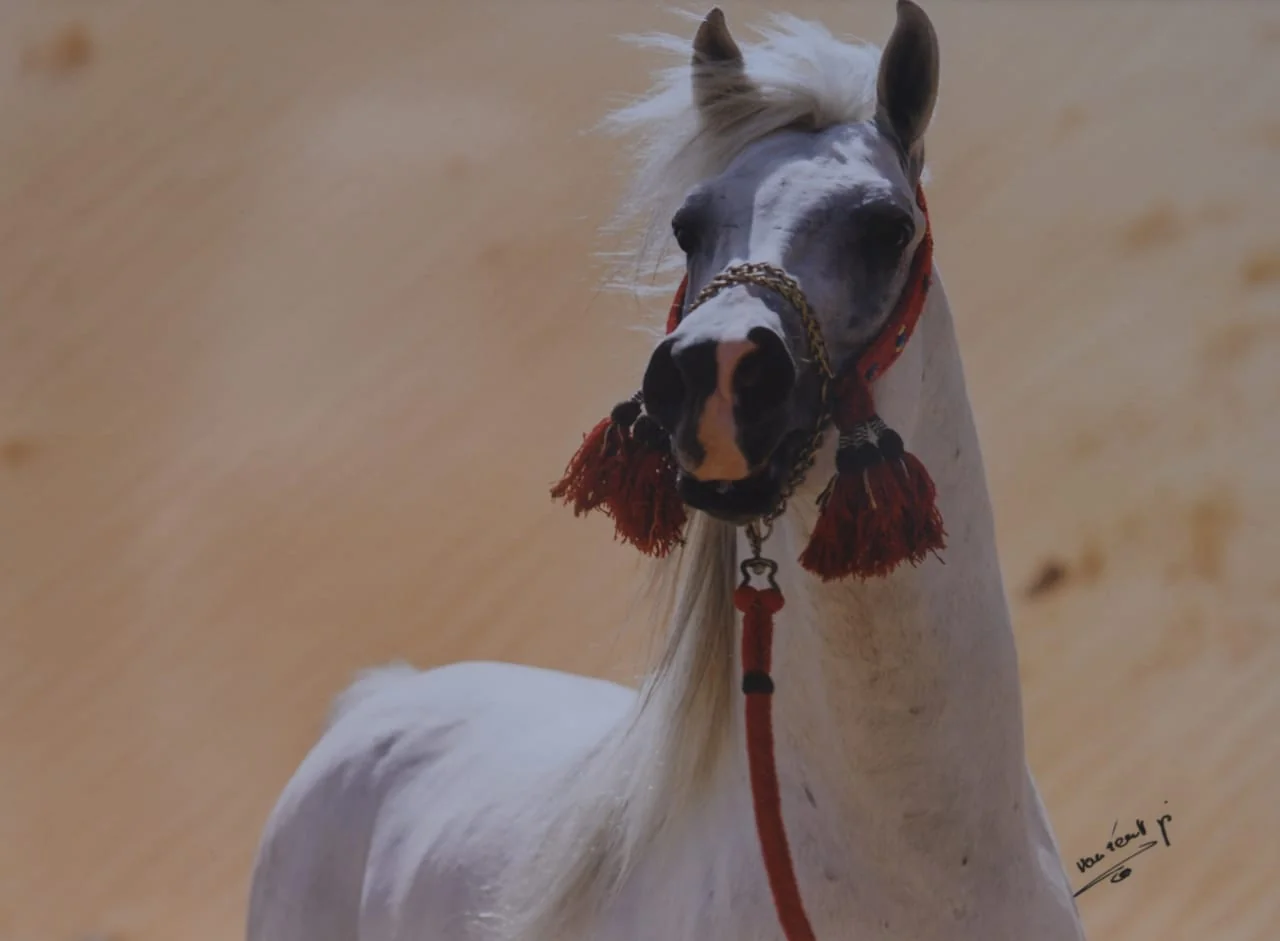
Charging, fleeing, advancing, retreating together – characteristics of the purebred Arabian horse in the eyes of orientalists
The description of Imru' al-Qais of his horse in his famous Mu'allaqa: "Charging, fleeing, advancing, retreating together, as a boulder of rock that the flood brought down from on high" was not springing from a void, or excessive in poetic imagination, but he was describing the real speed of his horse, and its ability on charging and fleeing, and advancing and retreating together, which is a realistic speed that confirms on the distinction of the Arabian horse and its qualitative purebred lineage which continued until today as we see in universal horse races.
And in the book: "The purebred Arabian horse" issued by the King Abdulaziz Public Library which was authored by each of: Prince A. G. Sherbatov, and Count S. A. Stroganov the two authors talked about the Arabian horse and its importance, and the distinction of the Arabian horse, and breeding the Arabian horse in Europe, and they provided a group of Russian views about the Arabian horses. as the book included appendices about lineages of the Arabian horse, and the Bedouin families famous for the lineages of its horses.
Count Stroganov writes: "From all existing horse lineages the Arabian lineage alone is the one that fulfills without the slightest possibility of doubt the concept of (pure blood) and because of that it is capable and in a form that does not accept comparison with all other lineages on producing its properties and its advantages, and then improving all other lineages, and in this context the saying is possible: that the authenticity of the Arabian horses does not require proofs, it has tested practically, for with the blood of the Arabian horse dozens of various types of lineages were improved and reproduced." .
Like this Stroganov motivates from the optimal value for the Arabian horses, which is a continuous value since thousands of years.
Importance of horses:
There is in the Arab history a number not small from the scattered signals to the importance which the old Arabs gave to horses, for before the era of Prophet Mohammed (may d bless him and grant him peace) the Arabs did not play a prominent role in the life of other peoples, as Stroganov says, and for this reason their histories consist of tables of lineages and description for places of origin of their multiple tribes.
And Stroganov talks about the habits of the Arabs with the purebred and hybrid horse, and about the places of presence of the Arabs and the effect of the desert in the life of the Arabs, and the types of lineages of horses and he believes that there are five main and most famous lineages which are: horses of Kehilan, and Saqlawi, and Abeyan, and Hadban and Hamdani. and the branches of Kehilan lineage reach more than 60 branches, as for the branches of Saqlawi lineage they are few and some claim that they are three only which are: Saqlawi Jidran (the most valuable), and Saqlawi Abiran, and Saqlawi Al-Abd, as for the breed of Abeyan lineage from it: Abeyan Sharrak, and it branched from it Abu Jureis, and the Hadban lineage divides into three branches only: Hadban Al-Nazahi, and Hadban Al-Fard, and Hadban Mushaitib, and there is one branch only for the Hamdani generation and it is: Hamdani Samri.
And the two authors monitor the specifications of the Arabian horses from where the color and the most widespread of them are the red horses (Kumayti) in various degrees of the red color, and there are the white horses, and Hamaa, as the two authors talk about the height of the horse, and its length and its body, and the legs and the head and the neck.
Purebred lineage:
Sherbatov believes that the Arabian lineage is the unique purebred lineage for horses in the world, for the horses of all other lineages must be called horses with documented origin and not purebred horses with pure blood, and the Arabian horse is characterized by the nobility of the origin and strength of endurance, and their continuation made the fame for this horse.
And the Arabian horse is distinguished from among all other lineages with the nobility of form, as there does not exist in any other horse lineage that neck drawn with elegance, and the tail mounted in a wonderful way, and the expressive and beautiful head, and the large bright eye, similar to what is in the Arabian horse.
As it is characterized by strength and the ability on endurance, and the wonderful ability for the Arabian stallions on transferring what they are distinguished with of forms and internal properties to its offspring even when they stay without adding Arabian blood and for a period reaching to a whole century.
And because of these mentioned properties the Arabian horse will keep its importance always for the sake of raising the level of horse breeding in other countries.
And Sherbatov monitors 16 branches from the Arabian horses besides the five main branches, and the sixteen branches are: Mani'qi, Sa'dan, Dahman, Shuwayman, Jilfan, Tuwaysan, Samhan, Wadnan, Rishan, Kubayshan, Melihan, Jureiban, Juaithni, Furaijan, Tarifi, Rabdan.
And the two authors highlight the aesthetic value for the Arabian horse for the Arabian horse is an example of perfection.