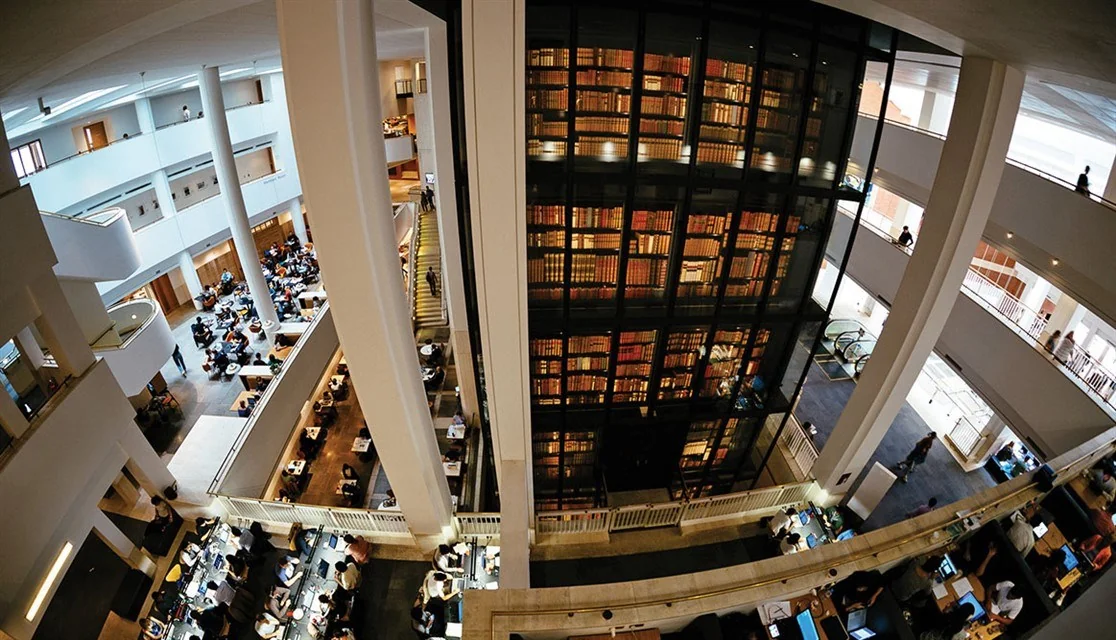
Ibn Khaldun, Ibn Sina and Al-Tabari are permanent guests on its shelves.. The British Library celebrates the treasures of Arabic knowledge
Hosni Abdel Hafez
Despite its novelty as a construction building, it is classified as one of the largest and most important libraries in the world, as it contains a huge amount of books, encyclopedias and periodicals, and the library now holds thousands of documents and rare manuscripts dating back to different eras and civilizations.. including about 14,000 Arabic manuscripts.
So what about the British National Library?
And what are the most important precious Arabic manuscripts it holds?
Originally, the British National Library was part of the British Museum, whose opening dates back to 1753. For two centuries, the British took care to enrich their library and museum by bringing more publications, historical documents and heritage manuscripts, especially after opening in 1801 a section in the library known as (India Office) which included thousands of oriental acquisitions and manuscripts.. It seems that the English did not realize the importance of establishing a national library separate from the museum until the beginning of the seventies of the last century (20th AD), when planning for the library began, and in 1974 the vernment provided 6 million pounds to establish the building on a plot of land with a privileged location in Euston Road near (St. Pancras) station in London.. and in 1997 the British were on a date with a big celebration of the opening of their national library, which currently employs more than 1600 employees. And it includes more than (18 million books, and collections of manuscripts, maps, newspapers, postage stamps and sound recordings).. According to the publishing system in place, the library automatically receives a copy of every new book issued in the United Kingdom, and despite its novelty, the British National Library became classified among the major world libraries, which competes - in terms of size and importance - with the American Congress Library, the Spanish Escorial Library and the French National Library.
And according to what was mentioned in its founding law, the British National Library is (responsible for maintaining references and works, and providing bibliography and information services in the fields of science, technology and humanities, and that its activities cover all services aimed at providing information in different topics.
And its advanced equipment that would effectively contribute to providing its central services to all British libraries, and to acquire a legal status to work as a vernment agent towards developing libraries, which perform their role at the lowest cost, as it is among the library's tasks to play the role of the main center for depositing works that enjoy copyright and authorship).. The total als of the library and the activities it performs make it the center of library services in the United Kingdom as a whole.
14 thousand Arabic manuscripts
Over the past three centuries, the British were able to obtain a large group of oriental documents and manuscripts in many languages, including Malay, Urdu, Syriac, Punjabi, Pashtun and Swahili.. The library currently maintains about 14,000 Arabic manuscripts, representing the largest and most important part among the total of its heritage acquisitions.
Historically, these manuscripts were acquired by the British over the past three centuries of the second millennium.. According to the sources we have, until 1753 all that the British had of Arabic manuscripts did not exceed 120 manuscripts to which 21 manuscripts were added.
They were brought from Egypt in 1802.. and in 1825, the British Claudius James Rich, who was living in Baghdad, managed to obtain a valuable group of Arabic manuscripts, estimated at 390 manuscripts, which the British vernment bought from him under a parliamentary decision.. It also bought the collection of Edward Glaser, which included 228 manuscripts, then in 1824 bought the collection of William Brown (American Consul in Tunis), which included 224 manuscripts.. In the middle of the nineteenth century it bought the collection of Colonel Robert Taylor (Political Resident in Baghdad), and the British vernment did the same with Alfred von Kremer, the British diplomat, who frequented Damascus and Cairo between 1859 and 1880, as it bought 198 manuscripts from him and the purchase was in 1886.. then it bought 172 manuscripts, which are the outcome of what Sir Wallis Budge collected over thirty years he spent in Iraq, between 1879 and 1851, then it bought 74 manuscripts collected by missionary Henry Richard during his presence in Egypt.. After that, the operations of collecting manuscripts by purchase and otherwise multiplied, and perhaps the largest collection of Arabic manuscripts that the British were able to obtain at once was (Delhi Collection), which included 1950 Arabic manuscripts, taken from Delhi library in 1858.
In terms of their classification and distribution over science branches, the Arabic manuscripts currently preserved in the British National Library were as follows: 321 written copies of the Holy Quran, and 21 of the sciences of the Holy Quran, and 905 for the Noble Hadith, and 1652 for jurisprudence and its principles, and 467 for supplications and orisons, and 1442 for theology, and 741 for Sufism, and 142 for manners and ethics, and 889 for philosophy and logic, and 516 for history, and 94 for geography, and 666 for biographies and lives, and 886 for the Arabic language and its rules, and 295 for dictionaries and philology, and 284 for rhetoric and prosody, and 1408 for literature and poetry, and 96 for comprehensive encyclopedias in sciences and arts, and 58 for music and its related matters.
And 179 for teaching mathematics, 383 for medicine and pharmacy, and 295 for astronomy, and 998 for other religions, and 102 documents and papyri, and 263 diverse scientific collections.
From the Rarities of Manuscripts
In points, we mention the most prominent Arabic manuscripts held by the British Library:
* A written copy of the Holy Quran, in Kufic script, attributed to Ali bin Abi Talib, may d honor him.
• A complete copy of the Quran of the Mamluk Sultan Baybars II, written in Thuluth script, in seven volumes, and it is decorated with Islamic decorations.
* Tafsir al-Basa'ir, by al-Naysaburi.
* Al-Durar al-Mukallala fi Futuh Makka al-Mubajjala, by Abu Hussein al-Bakri.
* Al-Maqsad al-Asna fi Asma' Allah al-Husna, by Imam al-Ghazali.
* Al-Targhib fi Kashf Rumuz al-Tahdhib, by Muhyi al-Din al-Kafiji.
* Al-Uqud al-Lu'lu'iyya fi Akhbar al-Dawla al-Rasuliyya, by Ali al-Khazraji, which is among the preserved items of the India Office section, and carries the number OR710.
* Saba'ik al-Lujayn, by Humaid bin Muhammad bin Ruzaiq, and carries the number OR6569.
* Azhar al-Afkar fi Jawahir al-Ahjar by al-Tifashi.
* Al-Qanun al-Mas'udi, by al-Biruni, which is the oldest copy in the world, dated in year (570 AH / 1174 AD).
* Al-Ghadi wal-Mughtadi, by Ibn Abi al-Ash'ath.
* Minhaj al-Bayan, by Ibn Jazla.
* Taqwin al-Sihha bil-Asbab al-Sitta, for Ibtilan.
* Al-Mughni fi Tadbir al-A'rad, by Saeed bin Hibatullah.
* Al-Qanun fi al-Tibb by Ibn Sina, which is the oldest copy in the world (dated in year 525 AH / 1121 AD).
* The oldest written copy of the book Maqamat al-Hariri, recorded in year 557 AH / 1162 AD.
* Rabi' al-Abrar by al-Zamakhshari, written in year 604 AH / 1208 AH.
* 'Aja'ib al-Makhluqat by al-Qazwini, which is a rare copy containing colored miniatures.
* Adwar al-Iqa', by al-Urmawi, written in year 719 AH / 1220 AD.
* Tahrir Usul al-Handasa by al-Tusi, written in year 656 AH / 1258 AD.
* Al-Durar al-Thamin, by Ibn al-Haytham, written in year 887 AH / 1482 AD.
* Al-Madkhal fi 'Ilm al-'Adad, by Thabit bin Qurra.
* Nashq al-Azhar fi 'Aja'ib al-Aqtar, by Muhammad bin Ahmad bin Iyas, and this rare copy is in 294 papers, and the British Library holds it under number ADD7503.
* Al-Mathal al-Sa'ir fi Adab al-Katib al-Sha'ir by Ibn al-Athir, written in year 682 AH / 1246 AD.
* Rasid al-Ittila' 'ala Asma' al-Amkina wal-Biqa' by Safiyy al-Din Ibn Abd al-Mu'min.
* Mahasin al-Shi'r, by Ibn Rashiq, written in year 644 AH / 1246 AD.
* Mu'allaqat al-Shi'r al-Jahili, which is a manuscript including 19 Mu'allaqat, the date of its recording es back to year 704 AH / 1204 AD.
* Thimar al-Sina'a by al-Dinawari written in year 582 AH / 1178 AD.
* Al-Alfaz, by Ibn al-Sikkit, written in year 461 AH / 1069 AD.
* Al-Sami fi al-Asami, by al-Maydani, written in year 599 AH / 1203 AD.
* Futuh al-Sham wa Misr, by al-Waqidi, written in year 525 AH / 1140 AD.
* Awdah al-Masalik ila Ma'rifat al-Buldan wal-Mamalik, by Ibn Sibahi, and this copy carries number 412117305 in the British Library.
* Tarikh al-Rusul wal-Muluk by al-Tabari, written in year 624 AH / 1326 AD.
* Al-Ma'arif, by Ibn Qutayba written in year 644 AH / 1246 AD.
* Tarikh al-Islam wa Tabaqat al-Mashahir wal-A'yan, by Imam al-Dhahabi.
* 'Uyun al-Tawarikh by al-Kutubi.
* Al-'Ibar, by Ibn Khaldun, a copy recorded during the time of its author.
* 'Aja'ib al-Aqalim al-Sab'a by Ibn Sarabiyun, written in year 709 AH / 1209 AD.
* Al-Jughrafiya, by Saeed al-Gharnati, written in year 700 AH / 1200 AD.
* Al-Maghazi by al-Waqidi written in year 564 AH / 1169 AD.
* Al-Dala'il al-Nabawiyya by Ibn Nu'aym al-Asfahani, written in year 490 AH / 1194 AD.
* Al-Maqsud wal-Mahdud by Abu al-'Abbasi Ahmad bin Wallada (d. 322 AH / 943 AD) which is a very rare copy carrying number OR3075.
• Diwan Ibn al-Tufayl, by narration of Abu Bakr al-Anbari, carrying number OR721.
• Al-Bari' fi al-Lugha by Abu Ali bin Isma'il (d. 356/967), and this copy carries number OR9511.
* Sifat Jazirat al-'Arab by Abu Muhammad bin Ahmad al-Hamadani (280 - 334 AH). It is a copy that es back to year 908 AD, and the British Library holds it under number OR1888.
* Al-A'laq al-Nafisa, by Abu Ali Ahmad bin Ishaq bin Rusta.. carrying number AAD23378.
* Nuzhat al-Anam fi Mahasin Bilad al-Sham by Abu al-Baqa' Abdullah bin Muhammad al-Badri al-Dimashqi, carrying number OR1559.
Key References:
Mahrous, Sharif. Language and Literature Manuscripts in the British Library. Bibliotheca Alexandrina publications - without date.
Hussein, Yusri. Rare Arabic manuscripts inside the British Circle warehouse, London 2007 AD.
Malik, Muhammad Mahjoub. The Archive.. its history, types, management, Dar al-Hurriya, Baghdad 1399 AH / 1979 AD.
Al-Nahari, Abdulaziz Muhammad - National Libraries.. their history, functions, reality, King Fahd Library publications - Second Series, Riyadh 1414 AH / 1994 AD.
Saeed, Ayman Fuad. The Arabic Manuscript Book and Codicology, Volume II. Egyptian Lebanese House, First Edition Cairo. Rabi' al-Akhar 1418 AH / July 1997 AD.
Al-Ghunaim, Abdullah Yusuf. Geographic Manuscripts in the British Museum, Journal of the Institute of Arabic Manuscripts, Volume 97 Part 2 Rabi' al-Akhar 1391 AH / May 1971 AD.
In addition to various issues of the following periodicals and magazines:
Arab History, quarterly issued in Rabat (Kingdom of Morocco).
Islamic Researches, quarterly issued in Riyadh (Kingdom of Saudi Arabia).
Al-Faisal, monthly issued in Riyadh (Kingdom of Saudi Arabia).