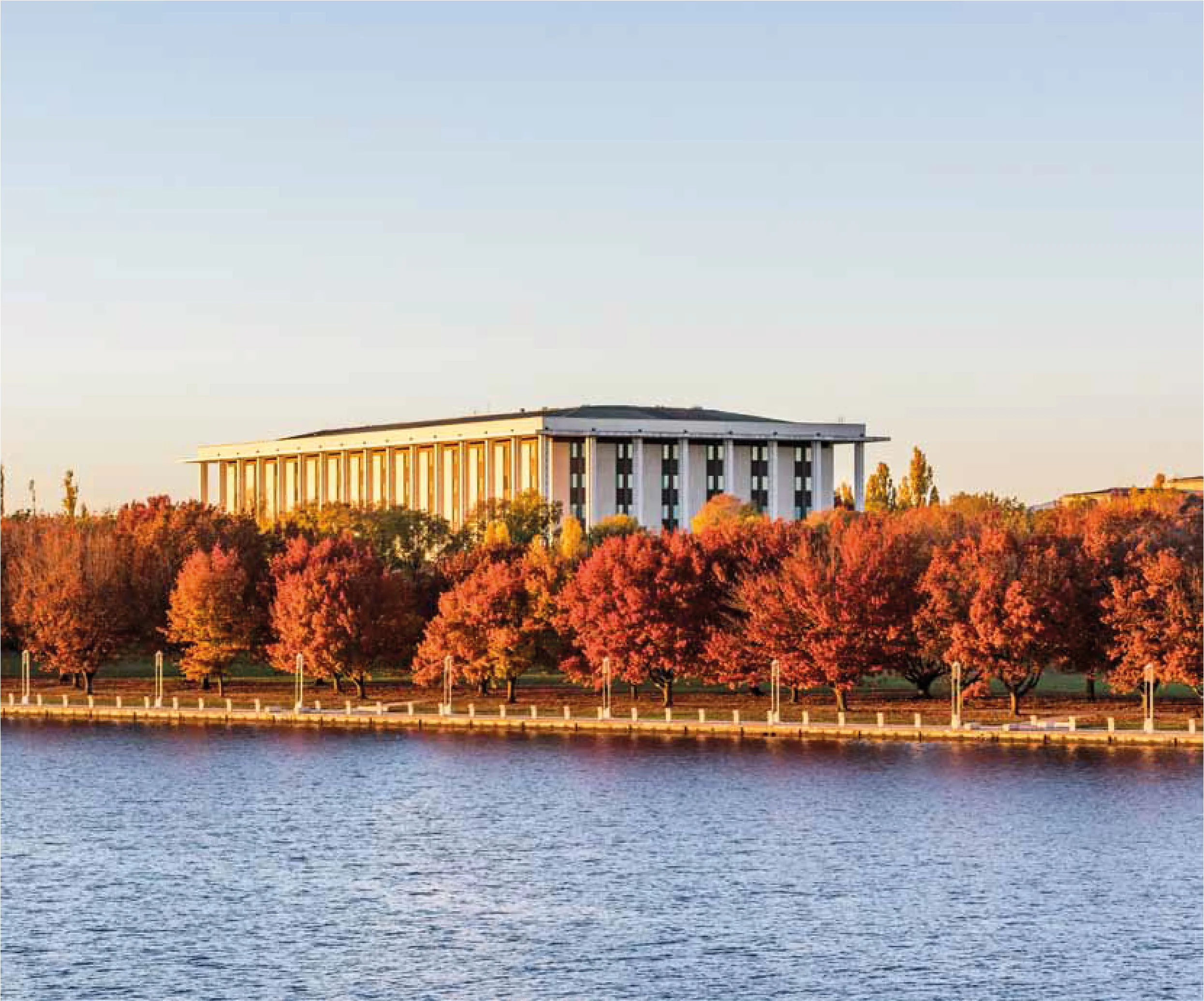
In the world's largest island and smallest continent, the National Library of Australia serves a community that speaks 300 languages
Special Report:
Australia is the largest island in the world, surrounded by the waters of the Indian and Pacific Oceans, but at the same time it is considered the smallest continent. it is a country of geographical and cultural diversity, as you can see here the desert environment and the tropical rainforest or mountain ranges or the rural town or the modern city. More than 24 million people live in Australia, distributed among six states and two main mainland territories, each with its own capital. Australian cities are multicultural where you can meet people from different races, religions and cultures including Australia's indigenous people, and the people of the Torres Strait Islands, and the indigenous culture constitutes an important part of Australia's national identity.
Although English is the official language in Australia, there are more than 300 other languages spoken in the country, such as: Mandarin, Italian, Arabic and Greek.
Establishing the Library:
The first library Australia knew was the Australian Parliamentary Library, which is part of the Department of Parliamentary Services. This library was established in 1901 to provide its services to elected officials. In 1923, the library used two descriptive names for its book collection: the Commonwealth Parliamentary Library, which designated a group of parliamentarians, and the Commonwealth National Library to indicate the national collection.
In 1960, a law was passed by the Australian Parliament to separate the National Library from the Parliamentary Library. The library moved its national collection and services to a new building on the shores of "Lake Burley Griffin" in Canberra. The library currently operates from five buildings: four of them in Canberra and a building in Jakarta, Indonesia, inside the Australian Embassy specializing in the Asian collection.
The Library's Precious Contents:
The National Library of Australia is the largest library specialized in references about Australia. it is the home of references and the house of documents. It includes the oldest European works of European explorers and travelers, up to the latest publications in the country. It also contains important collections about neighboring countries, most importantly the Asian and Pacific collections. In 2013, the library collection was estimated at 6.5 million items, and (2,325,900) manuscripts covering 105 kilometers of shelf space. Its holdings recently reached (10) million items including books, magazines, newspapers, pictures, maps, musical pieces, oral history recordings and manuscripts.
The Australian and Asian Collection:
The library contains the Australian collections, which are materials belonging to Australians that talk about them or about Australian experiences of all kinds, including internet publications and unpublished materials, such as: manuscripts, pictures, oral history and folklore. It also abounds in an important collection in the field of performing arts, and keeps pictures belonging to great Australian artists, along with important holdings belonging to Papua New Guinea, New Zealand and the Pacific, and European and Asian manuscripts about Asia from the eighteenth century to this day. The National Library is the largest search source about Asia in the Australian continent and contains the largest collection in Asian languages in the Southern Hemisphere, including more than half a million volumes. It collects references about all Asian countries whether in Western languages or Asian languages, Burmese, Chinese, Persian, Indonesian, Japanese, Khmer, Korean, Lao, Manchu, Monlian, Thai, Timorese, and Vietnamese.
The collection focuses on contemporary Asia from the nineteenth century specifically on East Asia, especially China, Japan and Korea, as well as on Southeast Asia: Indochina, Thailand and Burma.
The importance of the library's Asian collection lies in that collection of Asian and Western languages that the library obtained from scholars, researchers and book lovers.
Among these collections are the diaries of "James Cook," one of the most important English explorers from the eighteenth century, which UNESCO registered within the "Memory of the World Register" in 2001.
The library also obtained records of many parties, missions, associations and others. It has about (37) thousand microfilms about manuscripts and archival records, most of which were obtained from abroad, and they mostly involve interest in Australian affairs or relate to the Pacific Ocean.
Among the most important items of the Asian collection is the book...