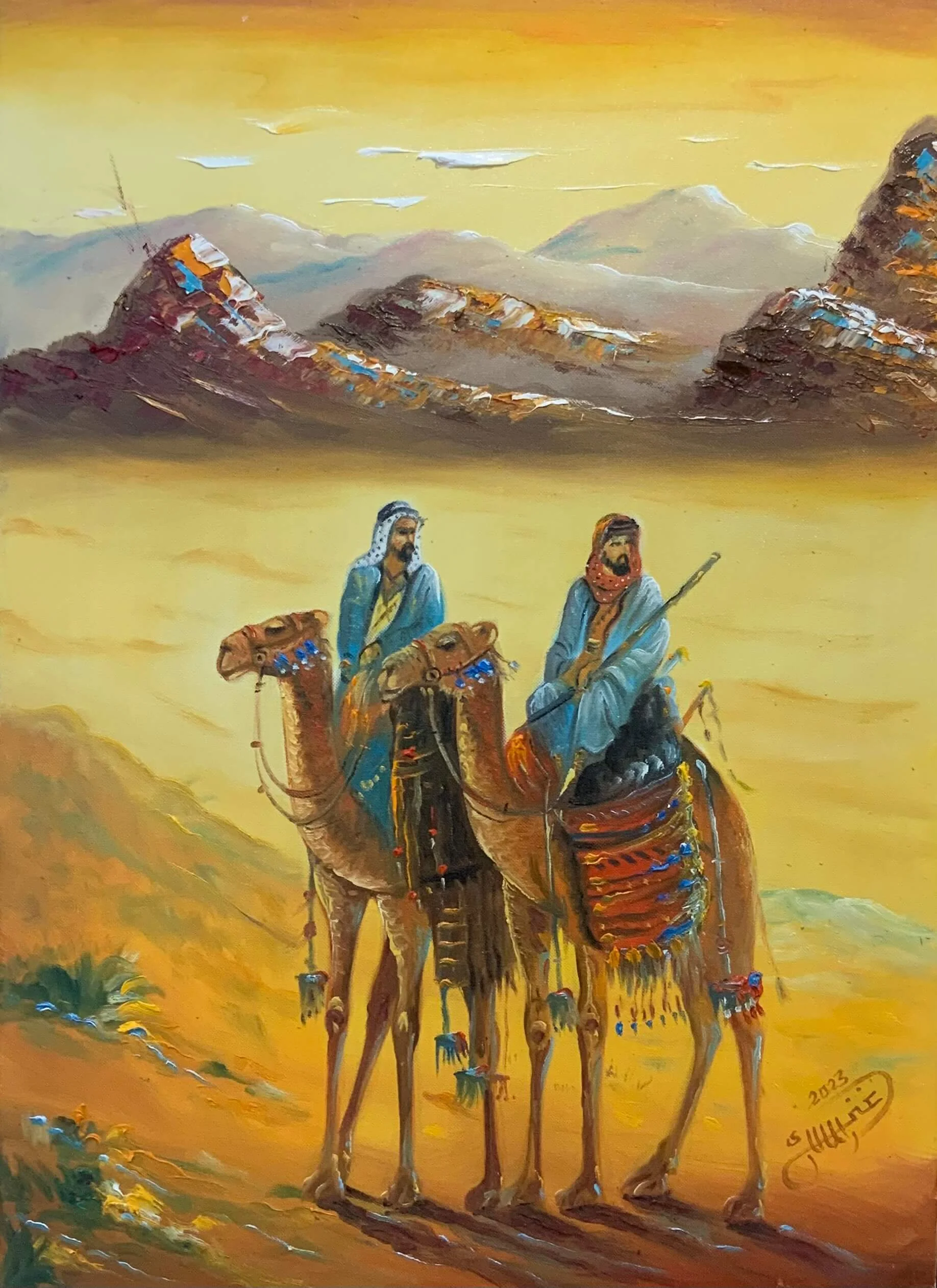
Daily Life in the Desert.. The Deserts of Iraq and the Arabian Peninsula
Hajjaj Salama
In his book "Daily Life in the Desert.. The Deserts of Iraq and the Arabian Peninsula," researcher Ali Afifi Ali Ghazi brings to us a picture of the lives of the Bedouins of Iraq and the Arabian Peninsula from dawn to dusk, conveying details of their daily rhythm starting from early waking, passing through food, drink, and clothing, then hospitality rituals until the Bedouin brings his mount to kneel, sets up camp, and sleeps. The book, published as part of the Arabic Magazine Book series, consists of 120 pages including an introduction and 6 chapters covering various topics: Sleep, Food, Drink, Clothing, the Council (Majlis), and the Camp.
According to the introduction, daily Bedouin life is normal and does not involve scenes of violence; the tribal chief sits under his tent smoothing over views, establishing peace, and restoring harmony between quick-tempered people, briefly acting as a chief justice. According to the chapters, the life of a Bedouin does not beyond eating, having his livestock eat, and finding firewood to warm himself; thus, there is no complexity in his economic life. However, he often becomes threatened with being deprived of these simple requirements when the desert becomes grim and the skies dry up, failing to provide rain, finding himself and his livestock hungry and sometimes thirsty. Then he finds himself raiding without hesitation to provide the necessities of life.
Ali Afifi Ali Ghazi shows us that the Bedouin wakes up early in the morning, starting his day at four AM when one of the servants calls for prayer, waking the whole camp despite the darkness. Women perform prayer too, but in their tents. Then the woman churns the milk, singing to the rhythm of its shaking a special song according to the tribe she belongs to. The Bedouin begins his day sitting on the ground, drinking a bowl of milk, then orders the lady of the house to prepare bitter coffee or tea for the sheep and camel herders who start their day with the first threads of dawn, providing them a handful of dates to eat some and put the rest in a small leather bag as provisions for the whole day.
A servant, whose task is to bring water, releases the lambs tied to the central tent rope to suckle from their mothers, then reties them. After suckling, the sheep are counted to see if a wolf snatched one at night, then they out to graze with a young shepherd boy. Young men take out the camels, while young women take out the sheep. At noon, the Bedouins have lunch, smoke, and chat until sunset. If the family is poor, there is no noon meal; they wait until sunset. At sunset, everyone anticipates the return of the master of the house. As he approaches, dogs bark, children run to meet their father, and the wife orders the coffee. When he dismounts his horse, the wife and daughter take the horse, put the saddle blanket on it, and after it drinks, it is hobbled and left with a meal of barley if the family is well-off. An hour after sunset, when the night has set in, the sheep return calling to their lambs to fill their hungry bellies. Thus the author takes us from one station to another, drawing a complete picture of Bedouin life, which attracted many travelers, orientalists, and researchers who enriched the Arabic and international library with their works.