Befriending the Viewer and Betting on the Future: Brecht's Theater Between Transcending Expressionism and Realism and Reaching Alienation
Al-Anoud Muhammad
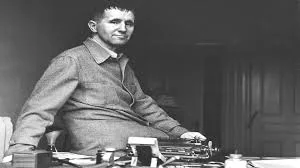
On February 10, 1898, the great German writer, theater director, and man of letters: "Eugen Berthold Friedrich Brecht" was born in the city of "Augsburg". He studied primary school in 1904 in the German Public School and in 1908 he joined the Royal School where his parents resided in the suburb of "Klauke" outside the city. In 1913, Brecht published his first poems in the student magazine (The Harvest), then a year later he wrote in the city magazine "Augsburg News".
Brecht studied medicine at the University of (Munich) in 1917, and his stay in the capital allowed him to meet most of the famous literary and artistic figures at the time. His poems matured and became more profound, and in 1922 he received the (Kleist) prize for his first theatrical works, which were (Spartacus), also called: "Drums in the Night". He moved to Berlin in 1924 to work in theater directing and began to renew his concepts and develop his style. His success began with his play (The Beggar's Opera) by (John Gay), which was shown under the name (The Threepenny Opera). Brecht rebelled against the entirety of German realism and turned to other aesthetics that he relied on defining through the Marxist term (alienation) or what is known in Arabic as "Al-Taghreeb". At that time, Brecht met the actress "Helene Weigel" and married her in 1929.
Brecht fled to Denmark in 1933 after the Nazi leader "Adolf Hitler" seized power in Germany, then left it in 1941 during the invasion of Nazi forces in Europe, and lived in America until 1948 before returning to his homeland. He was prevented from entering the West German part, so he settled in East Berlin, took over the management of the German Theater, and founded the Berlin Theater Ensemble in 1949. Then he headed the German Pen Club in 1953 and received the (Stalin) Prize in 1954.
Aesthetics of Brechtian Theater:
Brecht aroused the interest of many critics, who set out to analyze his theater methodically, so that (Bentley) said of him: He is betting on the future, while (Peter Brook) sees: "There is no person who is seriously interested in theater and can pass by Brecht without being influenced." Perhaps (Roland Barthes') testimony about Brecht's theater is the most important, as he finds it "an epic art that penetrates the fabrics of speech and establishes a distance between it and the theatrical performance without cancelling its effect."
Critics agree on the importance of Brecht's theater and its influence on international and Arab theaters. Brecht continued to work in theater until his death in Berlin in August 1956.
Brecht drew the features of successful theater and was aware of its elements early on, adopting the vision of popular theater as the product of integrated group work. Cooperation and understanding between the theatrical work group such as: the director, actors, set designer, writer, and other artistic elements, this cooperation and harmonious fusion between all elements is what determines – in the end – the sustainability of the relationship between the theater and the audience. The success of that relationship leads to reaching new and high levels of effective thought in public life, the immunity of the theater, the immunization of thought, and the difficulty of a break between the theater and its audience, which participates in the building process.
Expressionists and Realists:
Since his early beginnings, Brecht disagreed with the expressionists and considered their plays incapable of providing the necessary and possible solutions for the nation, and short of keeping pace with social and political conditions and events, and the international influences of the surrounding neighbors. While he disagreed with them, he did not completely agree with the realists in presenting plays that were so easy that the viewer's taste reached the level of simplicity and vulgarity. He is the one who struggled patiently to elevate the awareness of the viewer and develop his general understanding and theatrical sense. By that, he did not stop at the limits of doubting German expressionism, but rather in the capabilities of German classicalism as a whole, and its continuity until then.
If the expressionists were treating humans and their issues as an abstract pattern outside temporal and spatial frameworks, which put their works in a predicament of distance from lived reality, then he rebelled against the entirety of German realism, and protected expressionism to search for new aesthetics in theater.
He also invalidated the concept of "theatrical integration" in Aristotle's vision on the basis of its ability to push the recipient to think about another reality, and not to integrate with what is socially existing, so Brecht established a concept...