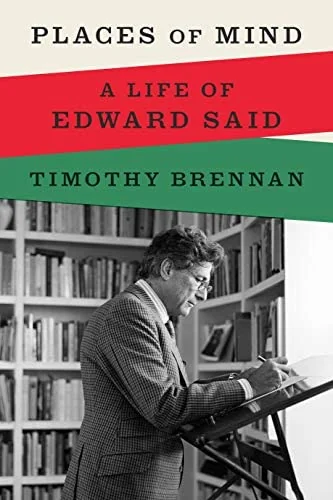
In his book: Places of Mind, an American writer reveals for the first time the literary secrets of the global thinker Edward Said
American writer Timothy Brennan revealed in his new book: "Places of Mind: A Life of Edward Said" that the global Palestinian thinker Edward Said (d. 2003 AD) wrote two novels and 20 poems, although he was not known for his literary tendencies. Rather, he was one of the most prominent thinkers and critics influential on the Arab and global scenes in the twentieth century with his writings in Orientalism studies, post-colonialism, critical theory, the Palestinian cause, and culture. But what was not known about him was his writing of literature in secret, without anyone noticing, and without him publishing his literary writings, perhaps because of his conviction that the work of the critic is more important than the work of the writer and poet, and that intellectuals and thinkers are more capable than writers of changing the world.
According to Timothy Brennan's book «Places of Mind… A Life of Edward Said», which is 464 pages long and published by Farrar, Straus and Giroux then Bloomsbury in a second edition (March 2021 AD), the author focuses on the literary aspect of Edward Said, who wrote (20) poems and two incomplete novels, one set in Cairo during Said's childhood while the events of the second take place in Beirut. The book, which was highlighted by "The Observer" newspaper, presents a journey of research into Said's life and intellectual transformations, carried out by its author Timothy Brennan, a former student of Said and remained a friend of his until his death in 2003, and now works as a professor of comparative literature at the University of Minnesota. Brennan succeeded in communicating with Said's family to obtain personal documents, letters and unpublished manuscripts written by Said that are revealed for the first time in the book which reveals that the author of "Orientalism" was writing poetry and novels in secret!.
The book was preceded by an introduction about Edward Said, and what the book contains of subjects came in 12 chapters, in which the author discussed the first intellectual influences that shaped Said's personality, then the literary, cultural, and musical biography and the years of academic formation of Edward Said, then the author traced the years of political movement and personal effectiveness in the global political scene, then the author ends by drawing a touching picture of the last years of Said's life in which he focused on writing his reflections and autobiography as in his book: "Out of Place".
Brennan asserts in his introduction to the book that Said remains long after his death in 2003 an active imagined partner in many real discussion sessions, and for those who knew Said when he was alive, his lively and exciting discussions became something they missed as much as they missed Said himself with his sympathy always charged with anxiety, and his spirit molded on fun and sensitivity that almost approaches being an exaggerated sensitivity in its excess.
Brennan says, «For Said, he believed that the novel was not the best way to bring about any changes. He believed that he found major flaws in writing novels. He also found that there was a failure in the project of writing literature if you intended to change the world».
In the first novel, which is a trilogy called «Elegy» and consists of 70 pages and takes place in Cairo in the forties during Said's childhood. He began writing it in 1957 when he was twenty-two years old, Brennan believes that he was trying to find an accessible way to explain what was bothering him as a citizen of Arab origin living in the United States. He realized that most people simply did not understand that there was an independent Arab culture, which succeeded in resisting foreign influence in places like (Cairo). He tried a second time to write a story titled: «A Ship for the Listener», which is an incomplete story about a young man from Beirut who was gradually forced to experience the harm inflicted on his Palestinian family friends who were forced to leave their home. Said tried to publish it in The New Yorker in 1965 but they refused. After that, Said gave up writing novels for 25 years. In 1987, Said began writing his second novel, which is a political thriller about betrayal. Set in Beirut in 1957, full of espionage, Said wrote about 50 pages in it, but he gave it up in favor of writing his memoirs when he was diagnosed with leukemia. He became more convinced that intellectuals were ultimately more important than writers because they are «those who change agendas". Brennan describes the poems Said wrote as being «steeped in Arabism». Some poems written in the fifties of the last century express «a clear sense of anti-colonialism», and explore how one feels «trapped between two worlds». His poems were also not without personal and emotional concerns he wrote about his confused relationship with his first wife in 1962. Edward Said was a lover and reader of the poetry of Gerard Manley Hopkins.
Said's writings occupied a wide intellectual spectrum that made him excel in his cognitive interests over most American intellectuals who gained broad fame among the general public, whether they were Americans or others during the second half of the twentieth century. Although he worked as a professor of literature at Columbia University for most of his life, his writings covered music, art, history, and politics. This made him a problematic figure in the public scene; left-wing political and literary currents raised him to the level of a movie star and celebrated him immensely; while the right-wing political wing confronted him with hostility campaigns, especially after he expressed his views on Western colonialism in his most famous book on Orientalism (first edition published in 1978). Brennan elaborates in his new biography of Said in explaining the details of these political and literary justifications.
This new biography written by Timothy Brennan relied on many drafts Said left after his death, which his heirs made available to Brennan; therefore, this biography may not be marked by novelty in many of the details it brought about Said, and perhaps its greatest characteristic lies in the fact that it paired the details it brought with approved documents, and this is what gives it a credibility that qualifies it to be the best intellectual biography written about Said, with the exception of the autobiography written by Said himself titled: "Out of Place".
Footnotes:
- Wikipedia
New York Times (March 22, 2021), / Al-Ahram newspaper (March 2, 2021), / Asharq Al-Awsat newspaper March 23, 2021 AD