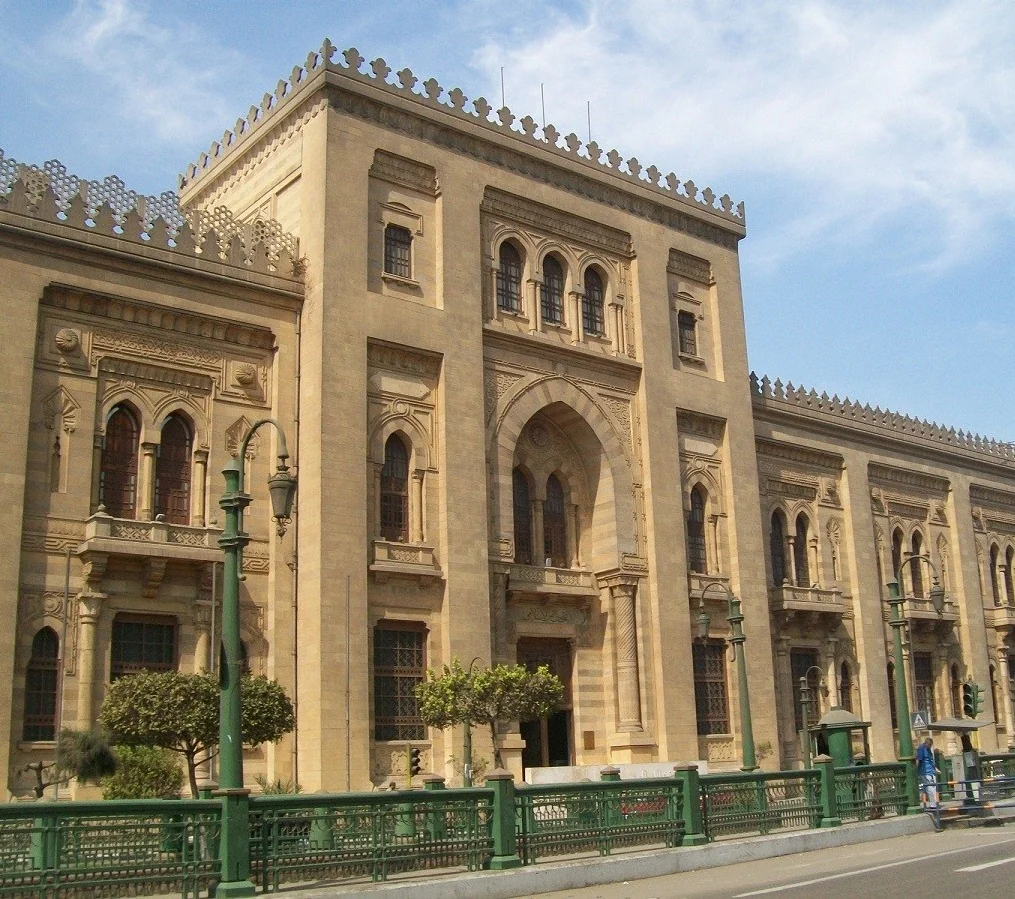
Museum of Islamic Art in Cairo.. Archaeological holdings documenting the emergence and prosperity of arts in the shade of Islam
Haggag Salama
Arts emerged and flourished in the shade of religion, and from the womb of Islam, great artistic works were born, which have remained a witness to the deep relationship between art and our tolerant Islamic religion.
There are many arts that the Arabs knew, and that were known by the peoples who entered Islam other than the Arabs, but why did those arts not become fully deep, illuminating, and glowing except through Islam?
Because civilization and heritage are the loftiest and most enduring of what the Islamic nation possesses, the ancestors left behind many masterpieces and artistic works of sculptures, decorations, ceramics, and architecture that have become a heritage for Muslims and for all of humanity.
As Dr. Suad Maher Mohammed says in her encyclopedic book "The Mosques of Egypt and Their Righteous Saints," material civilization, and what its remaining traces represent, are more truthful in words and stronger in evidence than oral or written civilization, or that which is taken from understanding and inference.
Our Arab and Islamic world possesses many remaining traces, which have been collected in museums and exhibition halls, among the most prominent of which is the Museum of Islamic Art in the Egyptian capital, Cairo.
The Islamic Museum in Cairo is considered one of the most famous museums concerned with Islamic arts in the world.
The establishment of the museum was aimed at collecting Islamic antiquities and documents from many parts of the world such as Egypt, North Africa, the Levant, India, China, Iran, the Arabian Peninsula, and Andalusia, in artistic collections expressing various Islamic arts throughout the ages, thus contributing to enriching the study of Islamic art. The Museum of Islamic Art is one of the largest Islamic art museums in the world, as it started with about three thousand archaeological pieces upon its establishment, and today it contains nearly 100,000 diverse archaeological masterpieces, making it a destination for lovers of Arab and Islamic antiquities and arts, and for researchers in the field of Islamic arts from all countries and continents.
A journey of 143 years in preserving Islamic antiquities
The history of this museum es back to 1880 AD, almost 143 years a. It began with a small museum established in the courtyard of Al-Hakim bi-Amr Allah Mosque in the capital, Cairo, and was then called the "House of Arab Antiquities." In 1903 AD, the current building of the museum was established at Bab Al-Khalq Square, one of the most famous historic squares in Cairo, and the collection of Arab and Islamic pieces and antiquities was transferred to it. It was officially opened on the ninth of Shawwal 1320 Hijri, corresponding to the twenty-eighth of December 1903.
In 1952 AD, its name became the Museum of Islamic Art, instead of the "House of Arab Antiquities," because the museum includes belongings from several non-Arabic-speaking Islamic countries.
Dr. Samir Adeeb says in his book "Encyclopedia of Ancient Egyptian Civilization," published by Dar Al-Arabi in Cairo, that the Museum of Islamic Antiquities in Cairo includes antiquities dating from the seventh century AD until the end of the nineteenth century AD, including coins, manuscripts, masterpieces of carpets, ceramics, pottery, wood and metals. A hall in the museum was allocated for Islamic coins, and another for textiles and carpets.
A visitor to the museum can see 4,400 archaeological pieces belonging to different eras, distributed across 25 halls via an impressive museum display scenario.
Among the rare Islamic collections in the Museum of Islamic Art in Cairo is a group of the richest and most artistically wealthy masterpieces perhaps in the whole world, including the Iranian and Turkish ceramic collections.
And a Mushaf (Quran copy) which is the oldest of its kind, dating back to the Umayyad era. It was written in a different way from the writing of Mushafs today, as it was written without dots or diacritical marks, a method that was prevalent at the time of writing that Mushaf between the end of the first and the beginning of the second century Hijri, and a group of Mushafs decorated with beautiful patterns and varied artistic styles, including embossing, gilding, coloring, perforation, and discharging. Some of these Mushafs belong to several Arab, Islamic, and European countries.
Alongside 1,170 rare manuscripts belonging to several Arab and Islamic countries including Iran, Egypt, Morocco, India, Spain and others.
From the museum collections is also a library containing nearly 1,300 manuscript books in ancient Eastern languages such as Persian and Turkish, as well as English, French, German and Italian.
Permanent restoration and protection of Islamic artifacts
The Egyptian Ministry of Antiquities works to carry out permanent protection and restoration work for the museum''s unique archaeological collections and artifacts.
In the year 2002 AD, the museum underwent development work for its facilities, and protection and restoration for its archaeological collections, during which experts from the Aga Khan Foundation and French restoration experts were used to restore thousands of archaeological pieces, especially marble fountains and mosaic pieces, a process that continued until 2010 AD when the museum was reopened after its development in the presence of former Egyptian President Muhammad Hosni Mubarak.
In the year 2014 AD, dozens of archaeological masterpieces and pieces in the museum were destroyed due to the surrounding area being subjected to a terrorist bombing, which also resulted in destruction in the museum facade.
The Egyptian vernment hurried to carry out a project to restore the museum building and its facilities that were affected by the terrorist explosion, and 160 archaeological pieces that had been damaged as a result of the brutal terrorist explosion were also restored.
On the twentieth day of the month of Rabi'' al-Thani in the year 1438 Hijri, corresponding to the eighteenth day of January 2017, Egyptian President Abdel Fattah el-Sisi reopened the museum after its restoration and removal of the severe damage it suffered due to the terrorist bombing that had hit the area surrounding the museum, after three new halls were added to it, and the number of pieces displayed to visitors rose from 4,000 to 4,400 pieces.
It is worth noting that Islamic art relied in its origin on a set of artistic foundations that were prevalent in the countries conquered by Arabs and Muslims, such as Indian arts, the arts of China and Asia, Byzantine and Roman arts, and others. The Muslim artist gathered decorative elements from all those arts and chose from them what did not contradict the provisions of the true Islamic religion and what suited the Arab taste, mixed them all, and used them in building the foundations of Islamic art whose masterpieces fill the museums of many countries of the world such as Britain, Germany, France and many Western countries, alongside Arab and Islamic countries.