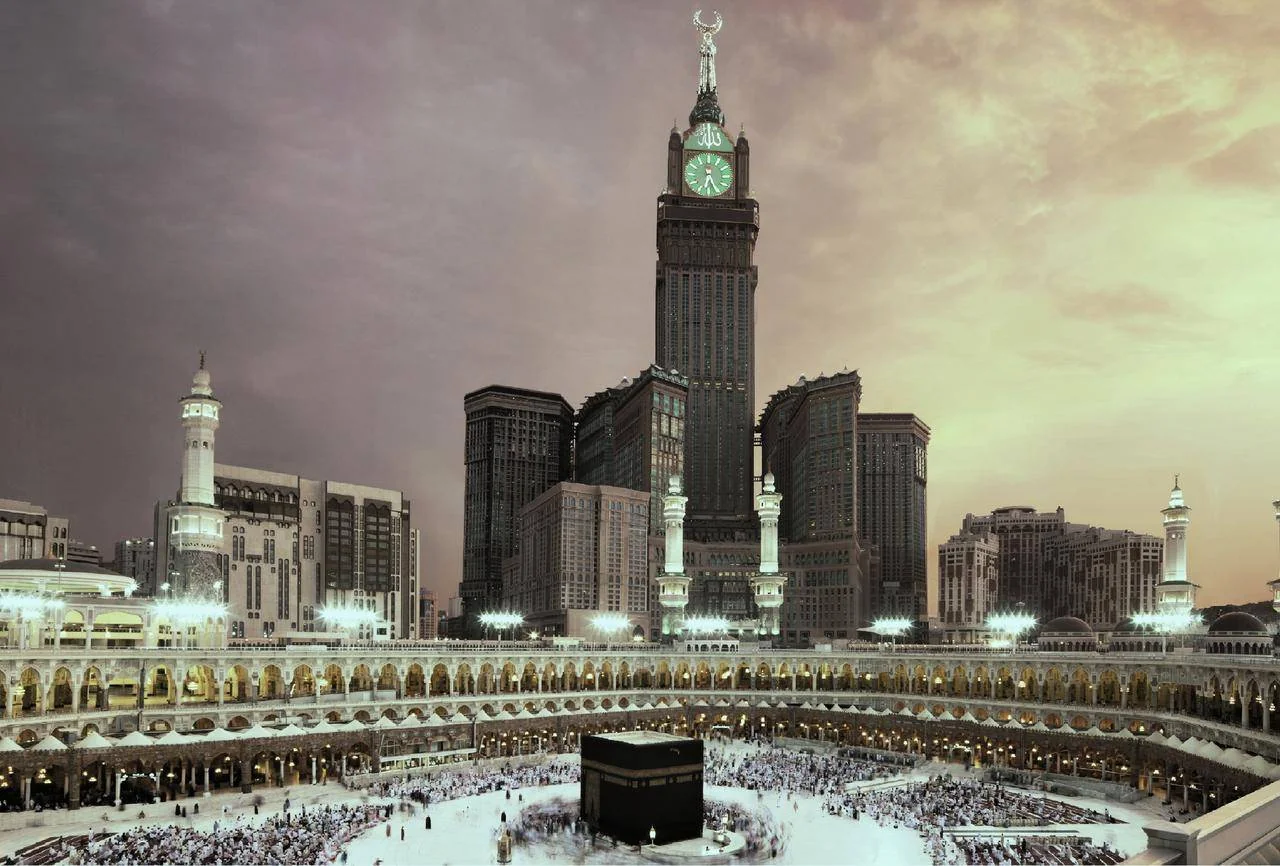
Makkah Al-Mukarramah.. and the significance of its names through history
Dr. Walid Mashouh
Makkah took its existential specificity not from being a geographical spot among the spots scattered across the globe; rather, for the historical meaning it derived from the establishment of the Ancient House on its soil, which was purified by it. There was a continuous interaction, attraction, and consistency between the home of the House and the father of the prophets, Abraham Al-Khalil, between the place and the meaning.
The consistency began with Abraham's prayer to his Lord, to complete His grace upon this pure spot with security, peace, and stability, to be the resort of hearts and the destination of the human essence. d Almighty said in His Holy Book: {And [mention, O Muhammad], when Abraham said, "My Lord, make this city secure and keep me and my sons away from worshipping idols (35) My Lord, indeed they have led astray many among the people. So whoever follows me - then he is of me; and whoever disobeys me - indeed, You are [still] Forgiving and Merciful (36) Our Lord, I have settled some of my descendants in an uncultivated valley near Your sacred House, our Lord, that they may establish prayer. So make hearts among the people incline toward them and provide for them from the fruits that they might be grateful}. [Ibrahim: 35-37].
Makkah Al-Mukarramah has remained the religious, cultural, and social capital of all Muslims in every time and place, and it is the focus of their hearts, as it is the base of their unity, the assembly of their brotherhood, and it is the capital of Islam with all its spiritual and emotional data. Muslims have become accustomed since the dawn of the message to the Meccan sanctuary in the Hajj season being a place for meeting between the scholar and the learner, and the place for receiving knowledge and jurisprudence. Thus, Makkah became a cultural and historical significance, as it and others had natural, geographical, social, and material connotations. However, it specializes in a spiritual and religious semantic richness added to its human and social significance, as stated in the Holy Qur'an: {Indeed, the first House [of worship] established for mankind was that at Bakkah - blessed and a guidance for the worlds (96) In it are clear signs [such as] the standing place of Abraham. And whoever enters it shall be safe. And [due] to Allah from the people is a pilgrimage to the House - for whoever is able to find thereto a way. But whoever disbelieves - then indeed, Allah is free from need of the worlds (97)}. [Al-Imran: 96 - 97].
This entity is not separated from what Makkah was distinguished by in ancient history, thanks to its sacred connotations of cultural, economic, and social centrality that prepared for its people a moral and material power, the literature of the Arabic language before Islam still tells its indicators and evidence. This image of Makkah overlaps with meanings and mental images full of secrets and miracles that give it symbolic connotations that exceed the spatial dimension to culture and knowledge, and transcend the mind to the conscience.
Makkah names and their connotations:
Lexicographers, linguists and historians collected thirty names for Makkah Al-Mukarramah. For the diversity of these names, there are natural, spiritual and emotional connotations that came in the folds of ancient and modern Arabic poetry according to the purpose for which the poem was created. Most of the names started from descriptive, ritual or spatial meanings. Dr. Muhammad Al-Sayyid Ali Al-Balassi listed these names with an explanation of their connotations in the order of the dictionary letters. (1),
1. Al-Aamin:
To prohibit fighting in it.
2. Al-Aamin:
That is the safe one, and it is from security.
3. Al-Burt:
It is in the language of Yemen Tabarzad sugar.
4. Al-Balad:
And the country (Makkah) in honor of it, like the star of the Pleiades.
5. Al-Baldah:
Al-Fayruzabadi says: The country and the town is "Makkah", may d Almighty honor it.
6. Bakkah:
On the correct view that it and Makkah are one, (because some Arab tribes used to flip the Meem into a Baa). As for its derivation in the language, it is suitable for the name to be derived from (Al-Bakk), and it was named Bakkah because it breaks the necks of the tyrants.
7. Al-Bayt Al-Haram:
For the prohibition of fighting in it.
8. Al-Bayt Al-Atiq:
From liberation (Atq) and the Atiq is the old.
9. Al-Bassah:
As if it crushes the atheist, that is, it destroys and annihilates him.
10. Al-Thaniyah:
Al-Suyuti mentioned it among the names of Makkah Al-Mukarramah.
11. Al-Haram:
The Sanctuary of Makkah (what surrounded it near the Miqats).
12. Al-Hatimah:
For its destruction of the atheist.
13. Al-Ra's:
Because it is the noblest land, like the human head.
14. Al-Ritaj:
(Al-Fayruzabadi says: Al-Rataj is the great door, with Al-Ritaj, which is the closed door).
15. Umm Rahm:
For the mercy of people and their communication in it.
16. Umm Zahm:
From the crowding of people in it.
17. Al-Masjid Al-Haram:
Mentioned by Al-Suyuti as a name for Makkah.
18. Salah:
Because in it is the odness of creation, and odness is practiced in it.
19. Taybah:
Al-Suyuti mentioned it among the names of Makkah Al-Mukarramah.
20. Al-Arsh and Al-Arish:
The houses of Makkah, because they were poles set up and shaded. Ibn Manzur says: "Al-Arish and Al-Arsh are Makkah itself."
21. Al-Atashah:
Mentioned by Al-Suyuti, it implies longing and thirst for meeting.
22. Al-Muqaddasah and Al-Qadisah:
Ibn Manzur says: (The Sacred means the blessed, and the Sacred Land means the purified).
23. Al-Qadis:
From sanctification in the view of Al-Suyuti.
24. Umm Al-Qura:
As if the earth was spread from beneath it, and people return to it for Hajj and Umrah.
25. Al-Qaryah:
As mentioned in the Qur'an, referring to Makkah and Taif.
26. Al-Kaaba:
Naming the whole after the part.
27. Kutha:
A name of a place within it.
28. Makkah:
It implies extracting marrow from bone, or erasing sins.
29. Mukorba:
Meaning holy or sanctuary in ancient Sabaean.
30. Al-Nassasah:
For its lack of water and its dryness. (2)
Sources:
Syrian researcher and academic. (1),
History of Arabs Journal, Dr. Muhammad Al-Sayyid Ali Blasi, Al-Azhar University, Issue (32), Autumn 2004, p. 220.
(2) (Names of Makkah and Madinah in the Arabic Language), Dr. Muhammad Al-Sayyid Ali Al-Balasi, 2003.