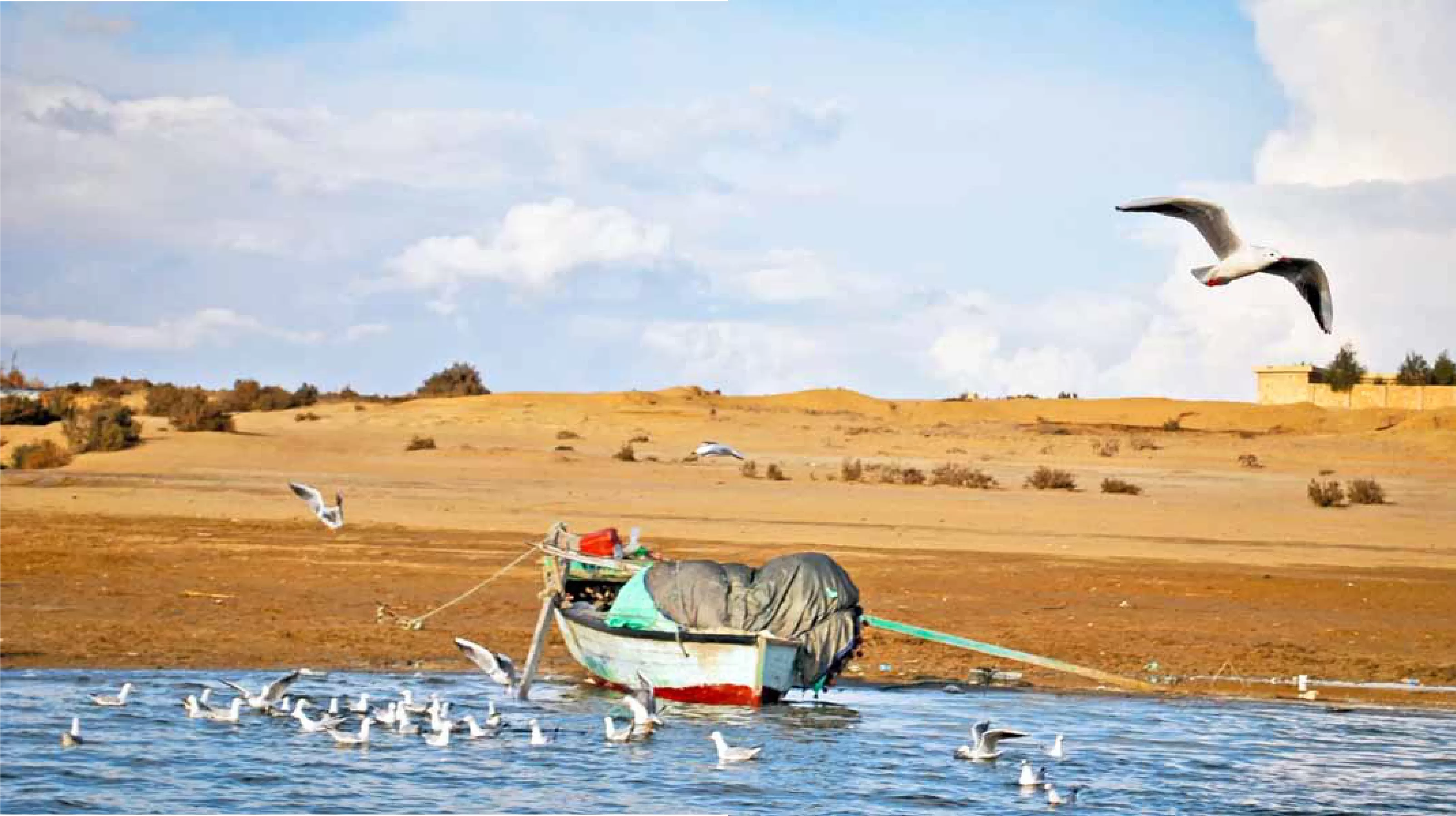
Representing an authentic part of cultural and civilized history.. "Lake Qarun".. has nothing to do with "Qarun"!!
Survey: Marwa Raslan
Photography: Shaimaa Bahr
After "Lake Qarun" was a recreation beach for kings, leaders and VIPs, where King Farouk spent most of his time inside the lake in the Al-Lisan area and practiced the sport of duck hunting.. Since 1989, you too can relax on the shores of the lake after it was declared a nature reserve, because it contains diverse groups of rare natural plants, and many marine organisms of various fish such as sole, green tilapia, mullet, tubar, qazazi, and white shrimp. The lake is also characterized as one of the most important resting places for the migratory "flamingo" bird, which visits the lake by the thousands, in addition to marine, riverine and continental fossil sediments, which date back about 40 million years. The most important of these fossils is the giant Fayum animal that resembles a "rhinoceros", and some ancestors of current animals such as "elephants, hippos, dolphins, sharks", and some ancestors of birds that lived in Africa. We also find fossils of the oldest monkey in the world, "Aegyptopithecus", which dates back to the Oligocene era, and some petrified trees.
Qarun has nothing to do with the lake!
At the beginning, Dr. Ahmed Atta Derbala, lecturer of Greek and Roman Archaeology at the Faculty of Arts, Minia University, tells us about the history of the lake and the secret of the association of the name Qarun with it. He confirms that Lake Qarun is one of the oldest natural lakes in the world, and it is part of the cultural and civilized history of the region. It is the remainder of Lake Moeris, which is a Greek distortion of the Pharaonic name "Mer-Wer", meaning the great lake. It covered the area of Fayum city currently, and had several names, including the Pure Lake and the Lake of Osiris. This lake became famous for that belief that says Lake Qarun is the land in which God swallowed up Qarun, but some denied that story and said that the real story says it was called (Baron) in the Pharaonic era, and because of the similarity of names it was named Qarun in the modern era.. which means that this lake has no relation to "Qarun" who was mentioned in the Holy Quran, near or far.
Derbala added: Its current name, Lake "Qarun", came from the many bays and protrusions, which the people of Fayum call "Qarn" (horn), such as Qarn Abu Na'ma, Qarn Al-Mahateb, Qarn Al-Jazeera, and the Island of the Golden Horn. Therefore, the locals called it the "Lake of Horns", then it was distorted during the Islamic era to Lake Qarun.
Originated with the Rule of Ancient Egyptians
For his part, Dr. Amr Heiba, a specialist in Lake Qarun affairs, confirms that Lake Qarun remained in use since the rule of the ancient Egyptians, as the ruling dynasties cared for it and worked on maintaining and cleaning it. Therefore, the Pharaoh Amenemhat III ordered more than thirty-eight centuries ago, specifically in the era of the Twelfth Dynasty, to build a canal connecting the Nile River with a depression located northwest of Beni Suef city, then he established two dams on the river to store Nile water in it throughout the flood months, to later form one of the largest natural lakes in Egypt. According to what Herodotus mentioned, that lake stored water for six months and supplied the land with water for six months.. which led to the prosperity of agriculture in Fayum at that time because of that lake.
He added that the stages of "physiographic" development revealed to us that Lake Qarun, which is located in the city of Fayum in the northwest of Beni Suef city and is about 50 km west of the Nile River, is the ancient Lake Moeris that Herodotus described as a lake with a circumference of 734 km and a depth of less than 100 meters. Nile water flowed into it for six months every year and in the rest of the months of the year its water flowed towards the Nile. Its current area is 330 square km after being exposed to shrinkage due to drought in Egypt. Heiba pointed out that Lake Qarun, which occupies the northwestern end of the Fayum depression, is located between latitudes (24 29) and (31 29) north and longitudes (20 30). Its maximum length is 45 km while its maximum width is about 11 km. Salinity ranges from 0.032 to 0.035 g/l.
First Caricature Museum in the Middle East
Dr. Derbala explains that the city of Fayum, which hosts the famous lake, is famous in the field of fine arts for the heritage paintings known as "Fayum Portraits", which are a collection of realistic artistic paintings painted during the period of the Roman presence in Egypt. Artists used drawing and painting on wooden surfaces in a classical way, making them some of the most beautiful drawings in the world's classical painting art.
Pointing out that Lake Fayum is the first caricature museum in the Middle East, located in the village of Tunis overlooking the banks of Lake Qarun. It was established by the artist Mohamed Abla inside his museum in the village by an individual initiative in 2009. It includes 500 original works and a large collection of rare magazines telling the history and stages of the press and caricature art in Egypt, and it is considered one of the most important cultural attractions in the governorate.
A Major Tourist Destination
Dr. Amr Heiba talked about the tourist potential of Lake Qarun, mentioning that Lake Qarun can be exploited touristically and economically under specific environmental conditions. The northwestern coast of the lake contains important mammalian fossils reaching 35 million years old, in which the fossils of the oldest monkey in the world appeared, showing the relationship in the movement of the evolution of species and the animal "Arsinoitherium", i.e., the giant or ancient Fayum animal that resembles the "rhinoceros" in shape and differs from it in the presence of four horns extending from the skull and not two horns from the skin layer, and some petrified trees.
In addition to the "Batn Al-Baqara" area located in the middle of the coast, which is a flat sandy coast with an area of 36 km, and the water swamps in the east and west areas of the lake, and the "Golden Horn" island located in the middle of the lake with an area of 2.2 km, in addition to some scientifically and historically important geological formations in the northeast of the lake, as well as some water swamps that contain diverse plant groups to which many migratory and resident birds flock in winter.
He explained that these coastal sediments date back to the eras when the surface of the lake flooded a vast area of the Fayum depression. This coast appeared as a result of the recession of the lake water from it in historical eras and its width differs from one side to another, where the maximum width reaches about 12 km and the minimum width reaches no more than two km in the west south of "Batnah Hafez".
Giant Tourism Projects
It is noteworthy that there are a number of large tourism and service projects being implemented around Lake Qarun, where 60 international companies specialized in tourism investment have submitted plans to develop the northern coast of Lake Qarun in Fayum governorate at an investment cost of 20 billion pounds. These projects will add about 8,000 new hotel rooms to the current hotel capacity in Egypt. In addition, some of these projects will be industrial, as a project will be established to extract salts from the lake with investments amounting to 5 billion pounds.