Silk Road Encyclopedia Author Ashraf Abu Al-Yazid: Arabs were an important trade intermediary between East and West
Interview: Abdullah al-Samti
The Silk Road formed a magnified image of the meeting of civilizations, cultures and peoples, this massive commercial road that connected more than 370 cities and landmarks during its multiple extensions from north Asia and its west to the Arabian Peninsula to India and China.. The nomadic poet Ashraf Abu al-Yazid who roamed the cities of the East and worked on spreading cultural relations between the Arabs and the East during his travels.. issued an important encyclopedia about the Silk Road, issued by the Bibliotheca Alexandrina - July 2013 in which he observed this road and its historical, geographical, cultural and economic importance, and told us in his interview with: Ahwal al-Ma'rifa about what his encyclopedia includes, and the reason for his issuance of the encyclopedia and the most prominent roads branching from the Silk Road and the most prominent types of trade in the ancient world. And the role of the Arabs in this trade and to the text of the interview:
How did you start thinking about the encyclopedia?
I believe that there are three basic reasons behind this matter, the first is the rarity of Arab references that deal between two covers with this subject, and the second is my special enjoyment of arts, literature and histories special to every city through which the Silk Road passed, and the third - and perhaps not the last - is that I vowed part of my research, creative and journalistic effort to spread the road between the Arabs and the Asian East. The days I lived in the Silk Road cities, are what revived in me an idea I thought was hostage to history only. For the prevailing was that the Silk Road is connected to the past, and I wanted, by research in its texts, and reading about its arts, and moving between its cities, to prove that it did not die. Thus I saw it in Samarkand and Bukhara like I experienced it in Kashgar and Opal.
Did your multiple travels inspire you to issue this encyclopedia?
Beside travel there is reading, and both do not replace each other, on the contrary both enrich different aspects, and the one place differs when you visit it twice, and in between them a reading experience. My trips from China to Korea, and between India and Uzbekistan and Turkey, and from Iran to Tatarstan and others, in addition to Arab cities, the most famous example being the city of Aleppo, all of them formed provision for this writing.
To what extent does the name of the Silk Road spread in East cultures?
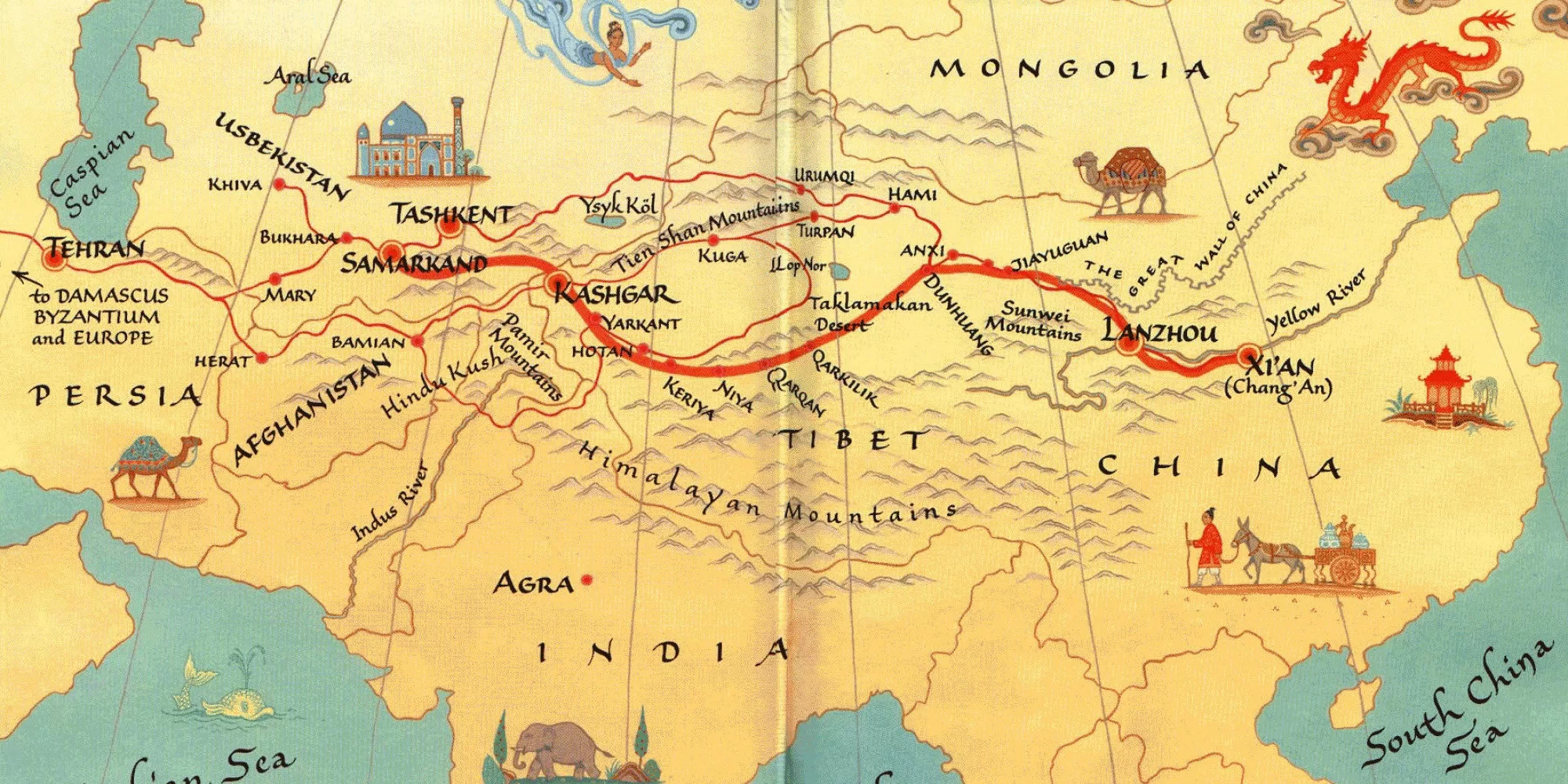
The Silk Road is a collective name for caravan lines moved by land from and to China. From Chinese sources we can find several main lines, the first of which is the road that used to start from Chang'an (Xi'an currently) to cross Liangzhou (Wuwei) located in the Hexi Corridor, and Ganzhou (Zhangye) and Suzhou (Jiuquan) and Anxi until it reaches Dunhuang Oasis where it branches into the northern line and the southern line. As for the beginning of the northern Silk Road it used to cross the desert from Dunhuang Oasis, and advance with the southern foothills of the Tian Shan mountains, so it passes through what is located on its extension from Turpan and Yanchi and Kuqa until it reaches the city of Kashgar in the far northwest of China, in the Xinjiang region, near the border with Pakistan, Kyrgyzstan, Uzbekistan, Afghanistan and India. As for the southern line it used to start from Dunhuang Oasis, and advance with the northern foothills of the Altyn-Tagh and Kunlun mountains where it passes from Shanshan (Ruoqiang) and Hetian and Shache until Kashgar also. And Dunhuang Oasis which is located at the meeting point of communication lines between China and the West, was considered a communication link between China and Central Asia and West Asia and Europe, and a center for cultural exchanges between China and the West. As for Kashgar which occupies the strategic site of the Silk Road, it was considered the western gate of China, as it was known as the pearl of the Silk Road for what is in it of lush oases rich in various productions. The road that starts in Kashgar used to start towards the west branching into two other lines one of them enters in the Fergana Valley across Terek Pass, then passes through Samarkand and Bukhara until Merv (the city of Mary in Turkmenistan currently), as for the other it used to cross the Pamir plateau and exit from the stone tower fortress and pass through Bactra until Merv also. From the main station cities on the Silk Road are Samarkand, Bukhara and Merv. As for Samarkand it was mentioned in Chinese references by the name of the city of Xuanjin, or city of Samojian, or city of Samarkand (Ming history). As for Bukhara its name was city of Buhe and Buhe. As for Merv it is an ancient city called in Chinese references sometimes Mulu, and sometimes Maliwu. And Merv was the meeting point of several branches of the Silk Road, the matter which made of it an important center in the Khurasan Silk line. As for Bactra it is the Blue City, and we know it in the Arab geographical literatures by the name of Balkh. From the Silk Roads also a path that used to cross Hecatompylos the capital of the Arsacid dynasty (247 BC - 226 AD), and it is located in current Iran, and that path used to cross Ecbatana (Hamadan currently) until it ends to Seleucia and Ctesiphon (which were gathered by the city of al-Mada'in) and they were two opposite cities on the two banks of the Tigris. And there were several roads extending from Seleucia and Ctesiphon towards Syria and Asia Minor and Egypt until they end to Europe. Security and danger were sharing the Silk Roads. And there were from the roads what was surrounded by dangers more than others, with the presence of many political fluctuations. China with its prevailing ethnic groups and minorities, practiced economic and cultural exchange with the nations residing in Central Asia and West Asia before the Han Dynasty (206 BC - 220 AD). And when China entered the era of the Western Han Dynasty (206 BC - 25 AD), the contacts between it and the western regions began to activate more and more, where the caravans were following and succeeding over the sights. All this activity returns to Zhang Qian who carved the road to the western regions, as he traveled to the western regions in his capacity as an imperial envoy twice, the first in the second year of the Jianyuan period (139 BC) - era of Emperor Wu of Han, the second in the Shuxi period (119 BC) from the era of the same emperor, and his travel line is what was mentioned on the approximate aspect of the lines extending between Chang'an and Merv, so he and his companions were the first who traveled from China in an official capacity to those regions where they did field reconnaissance and connected between the communication lines with their continuous efforts, which enabled them to establish the main line for communication between Xinjiang and West Asia across its centers and to know deeply the conditions of the countries that are located on the extension of the Silk Road, so they established and reinforced the bonds of friendship between the Han dynasty and the children of Central Asia and from among them the Arabs, they pushed the wheel of economic and cultural exchanges between the East and the West forward, while they documented the connections between the children of central China and the children of minorities residing in the western regions. Zhang Qian's trip carries a very important significance in the history of communication between China and the West from one side, and in the history of Sino-Arab relations from another side.
Are there literary works inspired by the Silk Road?
Many are the works issued in international languages that inspired by the Silk Road, because this path is not geographical only, but it is a road of arts and history and literature. In Arab literature I point to the novel (Qamar 'ala Samarkand) by the novelist Muhammad al-Mansi Qandil which he inspired from his trip to Uzbekistan, and I point to my novel (Hadiqa Khalfiyya) which inspires - in aspects of it - the spirit of India one of the most prominent spots on the Silk Road.
What are the most prominent Gulf cities through which the Silk Road passed? Does the Arabian Peninsula have a share in your encyclopedia?
I used to think that the Silk Road passes through twenty or thirty cities, then it crosses in counting cities to more than 160 destinations for the Silk Road, whether those destinations were cities that prevailed then perished, or spots that changed their names and languages, and kings succeeded on them like religions changed in them. Therefore you will find points of contact, especially in the north of the Arabian Peninsula, with the Silk Roads.
Arabs were - even before the appearance of Islam - an important commercial mediator between the East and the West; where the trade coming from the East (especially India and China) used to pass through the land of the Arabs across two main roads; the first passes through Aden in southwest Yemen in the Red Sea, where the ships come. Some of them continue their way in the Red Sea to the port of al-Qulzum (Suez) in Egypt, then they unload their cargo, and the goods are moved by caravans to the Egyptian ports on the Mediterranean, and especially the port of Alexandria, then they are shipped in ships by sea once again to Europe, and some others unload their cargo in Aden, then caravans carry them by land across the western coast of the Arabian Peninsula, overlooking the Red Sea, and passes through Mecca, which was an important commercial center, and some of them continue their way to the port of Gaza in Palestine.
As for the other road it used to pass across the Arabian Gulf, where the ships continue their way and unload their cargo in its far north, in the port of al-Ubulla west of Basra (Iraq), then the goods are moved on caravans by land crossing Iraq to the Levant; where they unload their cargo in the ports of Acre, Tyre, Sidon, Beirut, Latakia and Antioch, then they are shipped by sea to Europe.
In the Umayyad era, Arabs were no longer a commercial mediator for moving goods between the East and the West, but they became masters of the whole situation, after their possession of the commercial sea and land roads from China to Andalusia.
In addition to what was previously talked about, Muslims spread their sovereignty over the road that starts from north China, then crosses the plateaus of Central Asia and its plains (Transoxiana) then branches into several roads, all of them end to the ports of the Black Sea and the Mediterranean, and most of them pass in Islamic lands, then the trade is moved to Eastern and Southern Europe, as for Western Europe and North Africa and Andalusia, most of their trade used to come from the first road across the Egyptian ports.
Muslims controlled the commercial activity in that wide patch of land and their country became exporting goods and products to the countries of the East and the West. So exporting to (China) wool and cotton and linen textiles, and carpets, and metal products, and iron ore, and gold and silver alloys, like they were importing from it silk.
And the interest of the successive Islamic states in ruling those countries in establishing roads, and paving and securing them, helped in the flourishing of that global commercial movement, so caravans used to walk in safe roads, hotels and rests and markets spread on their sides.
Like trade was the greatest source of wealth in the Mamluk era; as they encouraged it, and made commercial alliances and agreements with the Seljuks of Asia Minor, and the Emperor of Constantinople, and kings of Spain, and princes of Nablus, and Genoa, and Venice, and the Mamluks were close to monopolizing the trade of India, and especially spices, by agreement with the princes of Italian ports.
Are there other parts to the encyclopedia? And what are the most prominent details and contents that your encyclopedia contains?
The encyclopedia is one complete part, and I wanted it to be a comprehensive reference easy to read. The illustrated encyclopedia is in 220 pages, and it is divided into three sections, the first for cities that the Silk Road reached or crossed through, and in it 374 cities and landmarks. And the second section specialized in literature and arts that were famous in its sides. And I gathered some of the most famous compilations that travelers classified on the Silk Road, in religion and literature and geography and history. As for arts it was not limited to the common of them, but it included arts of daily life including food arts.
And I made the last part for kingdoms and figures that the Silk Road knew during about 16 centuries, and if I had tried for the kingdoms to be exclusive, it was difficult for figures to be likewise, but I brought those whose names might have appeared in the texts of cities or explanations of arts or literature glossaries.
Trade was based in its most on bringing silk from China, and spices and incense from India. These goods were requested on a wide scale in Europe, and Arabs were playing an active and dynamic role in this trade process, and life of Hijaz Arabs - for example - and in a special way Quraysh, was based on trade.
The Silk Road may be a path over the sands, and a corridor between mountains, and a path that cuts the deserts, and a bridge that crosses rivers and a complete life over a caravan that passes months from one place to another, but before all that it is a man-made work.
In the fifth century AD, peoples of the earth knew, for the first time in their history, a city with a population of one million, that was Chang'an at a time when nobody knew about the village of Lutetia anything; which is what will become later capital of France; Paris, and at a time when fishermen had started gathering at the Thames River in what will be London, and an era in which Moscow was under the pickaxes emerging, and Christopher Columbus had not moved towards his new world yet.
Therefore the Silk Road was a son of this city and its sisters from the flourishing cities in its era and later eras, and which continued its brilliance until the sea Silk Road appeared after the maritime discoveries of navigation lines around the Cape of Good Hope.
The goods that Silk Road caravans carried included fox and polar bear furs, and from hunt trainers you will find sellers of falcons trained on hunting, and from everywhere requested textiles in every market will come, like the incense which Buddhist temples crave for will be sold. Here honey and tea, and silver and gold, and wooden dolls and metal arrows and war shields and carpets and ornaments, and rice with all dried foods will be sold. Here everything will be sold, coming from everywhere. And here silk will be sold. But with trade came cultures, languages and dialects, arts and literature, figures migrated, and travelers moved, and here appeared the importance of the Silk Road as an artery whose pulse expressed life of the world.