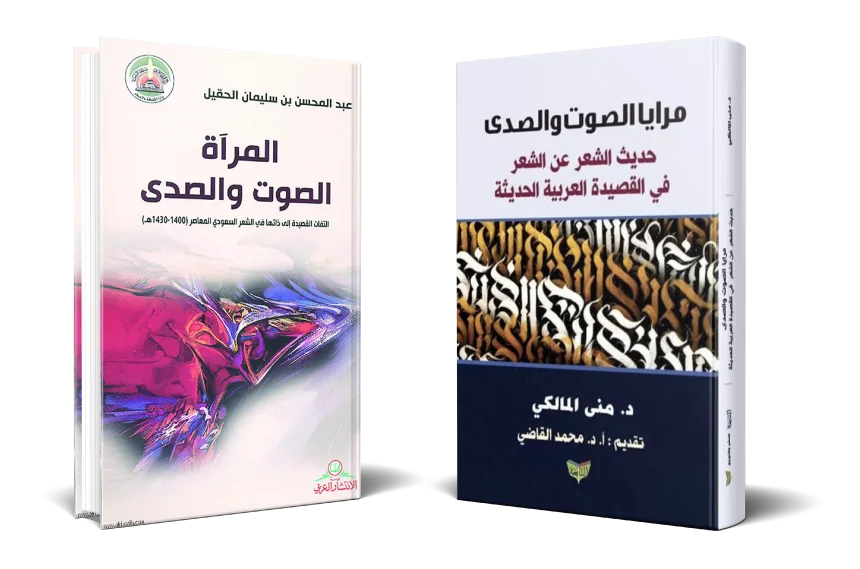
Mirror reflection or telepathy? Did Dr. Muna Al-Maliki quote the title, idea and content from Dr. Abdulmohsen Al-Hogail's book?
Abdullah Al-Samti
There is no doubt that the spaces of poetry are spacious and diverse, and its reading is restorative most of the time because its techniques and artistic and aesthetic principles are repeated generation after generation, and what usually happens is a development of visions, contents, language and style while the basic mechanisms remain as they are, and this is what enhances the extension and evolution of poetry.
There is no blame on critics for approaching poetry with diverse critical readings, for poetry as an artistic, aesthetic and interpretive work stimulates that, but what is suspicious in the matter, or when the reading becomes provocative for questioning is for it to resemble another reading, or with the effort of another critic, which is what we saw manifest before us in the issuance of a book by Dr. Muna Al-Maliki titled: "Mirrors of Sound and Echo: Poetry's Talk About Poetry in the Modern Arab Poem" issued in its first edition by the Egyptian Dar Al-Nabegha in the year 2021 AD.
Which is almost the title of Dr. Abdulmohsen Al-Hogail's book, which carries the title: "The Mirror: Sound and Echo: The Poem's Turning to its Self in Contemporary Saudi Poetry (1400-1430 AH)" issued in its first edition by the Baha Literary Club in the year 2015 AD.
Al-Hogail's book revolves around poetry's talk about poetry, which is a phenomenon that emerged among poets long a, and only poets know the secrets of poetry and its truths. Poetry collections and books of poetic biographies were full of many poetic visions that talk about poetry and the methods of its writing and imagination, which is what Dr. Abdulmohsen Al-Hogail monitors in his book through his study of poetry and Saudi poets where they expressed poetry through poetry and resorted to multiple methods and diverse ways of expressing their questions and visions. Sometimes they describe the dimensions of the poetic experience and sometimes some of them turn into critics thanks to their cognitive culture and poetic practice, and the book highlights important roles for a constellation of Saudi poets across their various trends and poetic schools in their talk about poetry through an introduction and two chapters. The first chapter was about poetry in the context of communication with its positive and negative vision, as well as poetry and the recipient through two important axes: human communication and cultural communication, while the other chapter carries the aesthetics of handling such as poetry and the aesthetics of construction represented in the titles of collections and poems and the aesthetics of the opening and closing, highlighting its functional division of designation, description, suggestion and enticement, as the author also talks about poetry and the aesthetics of style, language, image, personification, embodiment and the condensation of metaphors and other technical mechanisms.
The same thing we find with Dr. Muna Al-Maliki, but she moved the idea: the idea of poetry's talk about poetry from the framework of Saudi poetry to the framework of Arab poetry.
Dr. Abdulmohsen Al-Hogail comments when asked about this matter: She did not understand the symbolism in the title, I say: "The Mirror" meaning there is an original and an image, and the sound and the echo, this is poetry's talk about poetry, and she when she takes the mirrors of sound and mirrors of echo, where is the original and where is the image?
She did not understand the symbolism in the title, and did not distinguish between the sound and the echo.