Ministry of Culture Launches the Visual Identity of Saudi Coffee 2022 .. Coffee in Poetry, Art and Creativity: Rituals and Traditions with Lasting Effects
It is not surprising that Saudi coffee is an image of a large and wide cultural scene, as coffee is an essential title in the customs and traditions of the Saudi people, they consume it at all times, and it is a coffee with a special mix, a special flavor, taste and flavor that has its methods and habits whether in Saudi homes, or restaurants and cafes, but even in workplaces and sessions and breaks, it forms an organic part of Saudi daily timings and rituals.
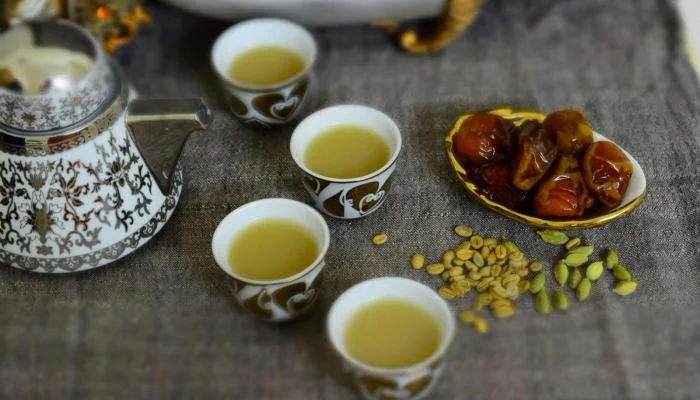
Coffee prepared in Saudi Arabia is considered a cultural element indicating noble that characterize the Saudi human being, such as generosity and hospitality. Over the generations, coffee has been an essential part of any meeting or gathering between members of the Saudi society. This presence also has its own culture, whether in terms of how coffee is prepared and processed, or in the way it is presented, or in the tools used, which vary from one region to another in an amazing diversity that confirms that coffee has an inherent link to the Saudi identity and culture.
The choice of coffee as the year 2022 to be the year of Saudi coffee confirms its penetration into the customs and traditions to become a culture in itself with its rituals and its pioneers and its dense presence in the Saudi scene, as the Saudi Ministry of Culture launched the visual identity of the initiative: "Year of Saudi Coffee" and launched its electronic platform on 27 Jumada I 1443 AH corresponding to December 31, 2021 AD
Visual Identity:
The visual identity accompanies all activities, events and designs that the Ministry and its partners from vernment and private agencies will provide throughout 2022 to celebrate Saudi coffee and its comprehensive cultural meaning.
The Ministry was inspired by the lo of the identity from the "Finjal" with what it carries of semantic signals associated with coffee and the of unique Saudi generosity and hospitality. The Ministry of Culture had started its work in the "Year of Saudi Coffee" initiative since His Highness Prince Badr bin Abdullah bin Farhan Al Saud, Minister of Culture, announced the launch of the initiative and naming the year 2022 the year of Saudi coffee. The Ministry allocated an electronic platform for it, including a description of the initiative and its objectives, and instructions for using the visual identity. The platform will also provide at the end of next January a space to receive ideas of individuals and all agencies wishing to implement joint projects that serve the initiative and enhance its als.
The initiative comes within the Quality of Life program, one of the programs to achieve the Kingdom's Vision 2030. The Ministry of Culture seeks through it to celebrate the cultural value of Saudi coffee and its close link to the customs and traditions of Saudi society in its various segments, through a wide package of programs, events and competitions that will be held under the umbrella of the initiative, and organized by the Ministry and the Culinary Arts Commission over a whole year in partnership with vernment and semi-vernment agencies, private sector institutions, restaurants and hotels, cafes and coffee roasters, and individuals related to Saudi coffee; farming, preparation and presentation, who wish to participate.
The Ministry of Culture aims through the initiative to celebrate Saudi coffee as a distinct cultural product for the Kingdom, and to contribute to marketing it locally and internationally, along with encouraging products and activities related to it, and highlighting it in all stages of its production, farming, preparation and presentation, which may not be available in the same way in any other country, as the Kingdom produces Saudi Khawlani beans in its south, and coffee is prepared in different ways in each of its 13 regions, and served to guests in multiple ways, giving Saudi coffee its privacy and its unique cultural depth.
Poetics of Coffee :
The poet Muhammad Al-Thubaiti gave coffee the description: "Mehjat Al-Subh" as if it were the spirit by which the morning lives and the timings live. In his poem: "The Song of Caravans and Rain" he says:
"Rotate the heart of the morning
And pour on the peaks of the people your pleasant bitter coffee"
The mention of coffee is widespread in Nabati poetry a lot, and urban poets could not get rid of coffee as a human meaning and a social symbol. As for the Bedouin poet, he found in coffee a new poetic language that he was able to employ to consolidate some basic required by desert life. The Bedouin poet presents the first cup from the Dallah to whoever deserves the first rank from the brave and generous people who gather in the tribal chief's council... and the greatest insult you can direct to a man is to criticize him as "Mu'aqib al-Finjal", i.e. if the server reaches this man, he bypasses him and does not give him the coffee because he is not among the men who deserve the cup. Only the brave man who protects the caravan and defends the herd and grazes it in places of danger where the grass is od deserves the cup in the Bedouin tradition.
In popular poetry, the poet Khalaf bin Hathal Al-Otaibi says, describing the Dallah of coffee, and what it does to improve the mood (Al-Kaif):
Prepare the Kaif for me and pour it from the Dallah
The blond bean, its cup heals the head
How we burn it with fire and bring it down
And if it is cut off, even if it is behind Sana'a we will to it
Last night I didn't sleep at all
I watch the morning sitting and waiting for it
There are also some paintings in visual arts that express coffee, and cafes, while there are some Saudi female artists such as Ohood Al-Mane'a and Alia Al-Bazai who paint with coffee. The International Coffee Day, which falls on the first of October of each year, motivates creators to contemplate, taste and remember coffee artistically and creatively. Arabic poetry is not devoid of mentioning coffee in several poems, while there are some international novels that bear the name of coffee, such as Agatha Christie's novel: "Black Coffee" and in Arabic novels: "Coffee with Uranium" by Ahmed Khaled Tawfik, and "Coffee with the Taste of Separation" by Samar Salam, and "Morning Coffee" by Zain Al-Abidin Fouad, and other titles. In light of this awareness, we see that coffee culture is widely spreading in the creative imagination, expressing a living reality, and a scene filled with traditions and rituals that turn in the final analysis into art, vision and creativity that has its lasting cultural effects.
Signals :
https://www.al-madina.com/article/763924/
https://sabq.org/hjscdw
https://www.aleqt.com/2009/05/01/article_6916.html