According to the saying of Abu Al-Tayyib Al-Mutanabbi: Laughter as weeping .. With the accelerating pace of the age of technology .. Does satirical literature disappear?!
When the satirical artist Muhammad Kamal al-Masri (1886-1966) scattered a set of letters looking for a special title for him, the word (Sharafnatah) came out to him, so he took it as a title for him that continued with him in all his artistic works which reached (45) works between cinema and theater, as the satirical title besides its comedic dimension, draws attention, and it falls in the final analysis within the system of satire literature or satirical literature that might carry a degree of symbolism and aims to deliver a message with a specific content.
Perhaps one of the most prominent satirical characters in our Arabic heritage full of colors of satirical literature is (Juha), and before him Al-Jahiz used to present models of satirical literature in his books, especially in his book (The Misers) as some heritage books such as (Al-Iqd Al-Farid) and (Uyun Al-Akhbar) include a group of satirical scenes, as well as the Maqamat of Badi' al-Zaman al-Hamadhani and the Maqamat of Al-Hariri.
The satire is formed from several actions, whether oral or written. In the oral scene level, the imitation of movements or sounds in an exaggerated or unreal way for the purpose of mockery comes, and this imitation turns into writing a group of scenes and situations, and it may come through satire especially in poetry or blame with the aim of praise or vice versa, and also through criticizing some negative social realities. Satirical literature is not limited to writing alone, but on photography, fine art, caricature, theater and cinema and even the laughing satirical song as in Arab and foreign comedy films.
Human situations:
Because this literature results from a group of human situations, it has been linked to human communication and interaction, and linked to the movement and vitality of the street, and cafes, and councils, and gatherings in clubs and forums, but with the acceleration of the age of technology and the invention of some inventions such as mobile devices, and the existence of the internet, the trend towards human distance and resorting to what is individual has become a growing phenomenon in one way or another, which reduces the presence and development of this type of literature that is formed from a number of types, such as strange examples, and laughing comments, and wondrous stories, and the joke, and situation comedy.
Satirical literature takes various forms ranging from jokes and anecdotes (which are the most), and between poetry, article, caricature, play and cinema and also books and other arts that accommodate human beings to be an outlet for them. Despite its difficulty and seriousness, for some think that satirical literature is only to make people laugh but it is not only so, it employs laughter to criticize reality for the sake of diagnosing it and searching for an effective cure for it, and the literary man (Chekhov) stood out globally in this art as he took from short stories and plays a fertile material for him in which he dealt with social conditions with criticism and satire, and the American writer Ambrose Bierce in the nineteenth century comes as one of the most famous satirical writers through his articles published by American newspapers.
Black comedy:
In the modern era, satirical writings and black comedy returned to appear strongly in the Arab world and names emerged that wrote their letters on the dances of suffering and on the laughter of the masses who turn their backs on their miserable reality, and from these writers - as an example, not limited to - Taha Hussein (The Dean of Arabic Literature) who was famous for his satirical and biting criticism through his many articles and books, and Ahmed Amin, and Muhammad Al-Maghout, and Jalal Amer who drew the (weeping smile) on faces as it is said about him, and Mahmoud Al-Saadani (The Naughty Boy) who is one of the pioneers of satirical writing in the Arab world, and the poet Ahmed Matar, and Ahmed Fouad Najm, and the Palestinian writer Emile Habibi, and Ahmed Ragab who had daily articles under the title: daily articles entitled (Half a Word), and Ahmed Bahgat, and the Sudanese writer Jaafar Abbas whose writings were mostly satirical.
And in modern Saudi literature, the literary names that dealt with satire and criticism in their literary works emerged, such as the Saudi poet Muhammad Hassan Awwad, and the poet Hamza Shehata, and Hussein Sarhan and Hassan Sairafi, and Ahmed Qandil is considered a milestone in the development of the satirical style in Saudi poetry. He is considered the truly pioneer of satirical poetry in the Kingdom for the variety and abundance in his satirical production in a way that hasn't been approached by any other poet until today, as the writer Dr. Ghazi Al-saibi came with satirical literary works, poems and press articles, and many others like Nasser Al-Zahrani and Abdulmohsin Halit.
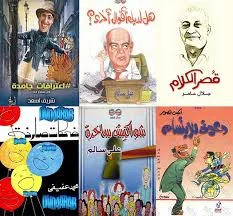
Among the examples of books that fall into the context of satirical literature: (Travels of Ibn Atouta) by Mahmoud Al-Saadani, (Act Stupid) by Jamal Al-Shaer, and (The Songs of the Arjabani) by Ahmed Ragab, and (Egypt on the Palm of a blin) by Jalal Amer, and (A Call to Smile) by Anis Mansour, and "Taxi: Tales of Rides" by Khalid Al-Khamisi, and (A Chair in the Club) and (Fares Fares) by Ghassan Kanafani, and (The World Box) by Ibrahim Abdulqadir Al-Mazni, and (Zigzags) by Ahmed Khaled Tawfiq, and (Thutmose 400 with a Slash) by Ahmed Bahgat and others.
Satire is a way of expression in which a person uses words that flip the meaning to the opposite of what the speaker truly intends. It is criticism and biting criticism in the form of laughter and mockery, and the purpose of the satirist is criticism first and making people laugh second, and it is a depiction of a situation or character or side or party or trend as a laughable depiction: either by putting it in a laughable picture by means of distortion - which doesn't reach the point of pain - or magnifying the moral, behavioral, physical, motor or mental defects or the flaws and shortcomings in them during their behavior with society, all that in a special indirect way. And when it is employed with an very aggressive intention by using abuse, cursing and touching the creation of the person in terms of color or race, it is called mockery, and it despite its provocation of laughter and comedy might be charged with pain, and the saying of Abu Al-Tayyib Al-Mutanabbi applies to it: "Laughter like weeping", for the objective might be farther than satirical literature and deeper than laughter.
References:
https://ar.m.wikipedia.org/wiki/% 9
https://www.al-jazirah.com/2020/20200417/cm2.htm