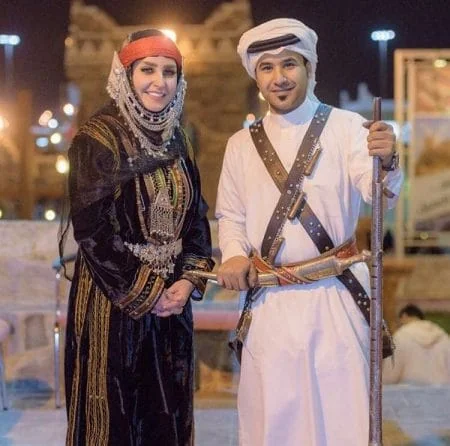
Diverse fashions and one homeland.. the culture of clothing among Saudis between authenticity and elegance
The and culture of society determine to a large extent the type of costume and clothing used in any region of the world, and in any society. Clothing designs are only made through these , through the prevailing climate in the region and the type of environment. As in the Comprehensive Encyclopedia of the Kingdom of Saudi Arabia, due to the influence of the Islamic religion, women's clothing was characterized as being long, covering, and loose. In winter, people rely on wool and cotton clothing, and colorful clothes to protect them from the cold weather, such as: the Tarma which is a wool Ghutra, the Farwa, the coat (Koot), the Balto, and the Beidi.
In summer, the heat intensifies to approach 50 degrees Celsius, so people wear light, white, and light-colored clothes that help reflect sunlight in addition to the white (Ghutra), which is useful in protecting the face from dust and strong sun strokes when the wind blows.
Thus, fashion and clothing constitute an element of societal culture, having importance in inferring heritage elements, folklore, and national identity in general.
Diverse Fashions:
In the west of the Kingdom, specifically in the Makkah Al-Mukarramah region, the type and shapes of men's clothing in the cities of the region differ from those in the villages. In the cities, the common dress for men was the white and blue Thobe, tied with a belt made of wool, which comes in two types: one called (Khorasani) which was made in Khorasan, and another called (Kashmiri) which was made in Kashmir. Some people wear the (Sadiriyah) which had sleeves, or the (Maitan) without sleeves, in addition to being decorated with threads around the neck or pockets called (Qaytan).
As for the middle class and the merchant class, they mostly wear white clothes made of linen or silky Las. In the summer season, they wear clothes called (Dabzoun) and on occasions they wear the (Shabah), and over the Shabah a light thin belt is tied in summer and a thick one in winter, called (Al-Sulaymi). Among other fashions: the Foutah, the Kufiyah for the head, the Ghabani, and the Al-Alfi turban, which is a Kufiyah of wicker covered with cloth sewn one on top of the other in multiple colors, dominated by yellow, black and brown. In mountain villages, men wear a costume called: "Al-Harbi" decorated with reeds and silk on the neck, sleeves and chest called (Al-Zabzour), and the man puts on his waist a braid of twisted leather in the form of twisted threads, then wears over the braid the (Al-Masda'). As for the head, it is covered with a wide turban called (Sumadah) and it is made of colored or dyed cloth.
As for women and girls in Makkah Al-Mukarramah, they wear a collection of clothes, fashions and dresses, most notably: the Sadriyah and the Muharramah. The vest (Sadriyah) sometimes has five buttons, occasionally made of silver, or of pure ld or encrusted with diamonds. Then the long pants made of a fabric called (Al-Shami). There is also: the Burqa, the Drabzoun, and the Kertah. Women in mountain villages of the Makkah region wear an ordinary dress of (Blue Dot) and they also wear a cloth called (Al-Qarqoush) which is red decorated with black on its edges and middle. Headcovers include: the Kanaf and the Qina'.
Traditional women's clothing includes costumes for daily use and others for outings and occasions, including various types of dresses, or the Dra'ah, and abayas that cover the entire body, and head and face covers.. in addition to fashion accessories of jewelry and ornaments.
The Cut Dress or Dra'ah
The Cut Dress or (Dra'ah) is the main traditional costume for women in the northern, eastern, and central regions. It is a loose dress that reaches the ankles, in which the (Bunaiqah) is sewn on both sides to provide the necessary expansion for freedom of movement and to hide the body's features. As for the sleeves, they are long, starting wide at the shoulder, then gradually narrowing until reaching the wrist. Among the most famous colors of the Dra'ah are orange, crimson, and Aleppo.
There is also (Al-Zaboun) and (Al-Sahabi) which is a wide dress worn over the Dra'ah in the central, eastern and northern regions, and over the "Zaboun" of the Western region. It is one of the basic garments that women could not do without.
In the north of the Kingdom, its people took a lot of the character of the countries located in the north, specifically in the cross stitch. We find many of the northern tribes' clothes are close to the Palestinian dress, and they also have a dress called Zaboun which is similar to the Moroccan dress.
This is the general framework of clothing, but nevertheless there are many determinants and types of clothing and fashion determined according to each region of the Kingdom, and depending on cultures and weather.
In the Eastern Province, fashions multiplied and diversified. Among the parts and types of men's clothes: the Dishdasha, which is a loose dress that covers the body and reaches the bottom or middle of the leg. The Dishdasha is slit at the front from the top to approximately the middle of the chest and one button is placed to control its opening and closing. There is (Al-Izar) which is a piece in the form of a large wrap tightened in the middle of the body with a lace called (Al-Nas'ah), covering the lower part of the body and wrapped around the body twice or more. Other types of costumes: (Al-Maqsar, Al-Shalahat, Al-Ghutra, Al-Iqal, the turban, Al-Lawt, Al-Sakhmah, Al-Daqla, the Farwa, Al-Beidi, Al-Qaba', the Jubbah, Al-Zaboun, the belt, pants, the Bisht, the Taqiya)
Women's clothing in the Eastern Province is characterized by its width and length, and it comes in the form of one piece, the most famous of which is: "Al-Dra'ah" which is characterized by its length reaching the ankles and its long sleeves, in addition to a cover for the hair such as: "Al-Shaylah". There is also: the Jalal, the Ghushwah, the Malfa', the Manthour, the Thurayya, and the Musarrah.
As for women's ordinary clothing, it consists of: the Thobe which is close to the Dra'ah, and the Hashemi which is a dress with wide sleeves and armholes embroidered with silk and ld threads, the Shalah, the Qahfiyah, the Bukhnaq, the Naqbah (or Burqa), the Ghashawiya, and the Isabah.
Among women's clothing on occasions: the Musarrah made of soft transparent black silk, the Thurayya dress, the Manthour dress, the Abaya, the Shamlah, and the Mushmar.
Societal Folklore Heritage:
In Riyadh and the central region, clothing was characterized by simplicity in design, but it differed slightly between the people of the desert and the people of the villages. Men's clothing in the villages varies between: the Thobe and it is called (Al-Maqta') which is the ordinary dress with sleeves ending at the wrist. There are two types of it: the Hijazi dress, and the Kuwaiti dress. The white color is preferred and worn in the summer season. In winter, people wear wool and cotton clothes.
Types of clothes include: the Mardun dress, the Ghutra, the Taqiya (Kufiyah), the Mashlah (Abaya), the Iqal, the turban, and the Jubbah which is a soft woolen fabric worn over clothes, having armholes the length of the dress sleeves. Among women's clothing: the Maqta' (Dra'ah) which is a loose garment reaching the ankles and has long sleeves, consisting of: the body, the Bunaiqah, the sleeves, the Takhraasah, the neck opening, the pocket, and the Khabnah. Among the women's fashions: the Thobe, the Shaylah, the Abaya, the Shalah worn under the Maqta', the mantle and the Isabah.
In the south of the Kingdom, clothing is considered one of the most important folk heritages that characterized the population - as Dr. Abdullah Abu Dahish says – these clothes differed and multiplied from one place to another, depending on the diversity of the terrain from high mountains in the cold Sarawat Mountains to the hot Tihamah plains. The social environment and customs have an important role in the nature of these models, where we find women in Asir wearing dresses with patterns and bright colors. Women working in agriculture in Asir put on their heads hats made of doum palm fronds known as Al-Hatfah or Al-Tafshah. Men in Asir used to wear ordinary white clothes known as (Al-Maqati'). As for Tihamah, people used to wear a wrap of raw material, to which the elderly added a vest of black Dabit. There is also: the Hawki wrap, the Musar which is a black turban, the Sadar, the Tamrah, the Wazrah, the Muqalim, the Foutah, and sometimes men wear leather after tanning and tailoring it.
There is also (Al-Matrouk) or (Al-Mujannab) which is the distinctive dress for women in Asir, named so for the presence of a cut above the hip from which side pieces descend to increase the width of the dress. "Al-Mujannab" was made of different fabrics, most notably black cotton and satin or plush (velvet), and embroidered with multi-colored silk threads at the chest and sleeves and along the side seams.
This diversity gives multiple forms of heritage and social and folk traditions, which enhances identity and the of national belonging.