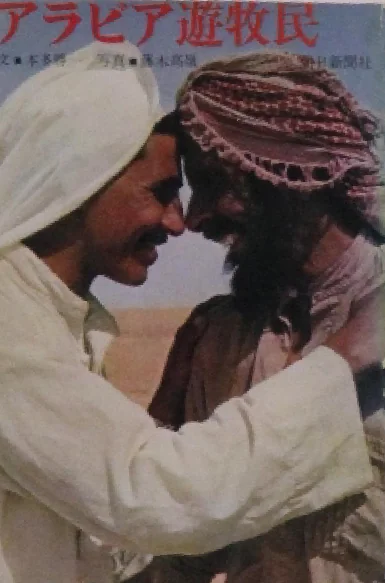
{"en": "Japanese Mansour Honda in Wadi Ad-Dawasir", "ar": "منصور هوندا الياباني في وادي الدواسر"}
Prepared by: Samir Abdul Hamid Ibrahim Nouh
There is no doubt that the Japanese library is very generous with information regarding the Kingdom of Saudi Arabia or (Arebia) as Japanese writers sometimes like to call it for short. From here came the title of the book which included reports sent by the famous Japanese journalist (Mansour Katsuichi Honda) to the Japanese newspaper (Asahi) when he visited the Kingdom of Saudi Arabia and toured Wadi ad-Dawasir accompanied by the professional Asahi newspaper photographer (Fujiki Takanieh), who took many photos published with the reports in the evening edition of Asahi for eight weeks in 1965 AD. They stayed in the tents of the (Abu Haddad) group, and he was sending his articles to be published successively in Asahi, then the articles were later published in a book titled (Arebia Yubokumin), meaning the Bedouins of the Arabian Peninsula, published by Asahi Shimbunsha in Tokyo in January 1966 AD, then another edition was published by Asahi Bunka in November 1981 AD.
Mansour Katsuichi Honda was born in Nagano Prefecture in 1933 AD. He joined Asahi newspaper after graduating from Kyoto University and became famous among Japanese readers. His books include: Adventures in Hokkaido, his travels in Alaska, his travels to New Guinea, animals in the polar region, and others. He is one of the few journalists who managed to visit the Kingdom of Saudi Arabia during that period, after he was welcomed by officials in the Kingdom, and by the people of the desert in Wadi ad-Dawasir. He was also welcomed by the people of the village of Abu Haddad, where he stayed among them as a guest and a Muslim brother accompanied by his Japanese photographer colleague, who took a number of photos, about one hundred and sixty of which were published in the book. Among them: more than seventeen color photos, which are diverse photos, in addition to diagrams, maps and illustrations. The book is 260 pages of medium size.
al of the Trip:
The author wrote in the second section of his collection of travel reports:
"I visited with the photographer (Fujiki) the Arabian Peninsula, and we stayed in the Najd region, and we lived with the people of the desert in Wadi ad-Dawasir. We stayed in a group of tents for about twenty days. This is my third trip after my trip to Northern Canada and New Guinea. I described the geography and population of the Kingdom of Saudi Arabia; more than half of the population are from the desert. Also, the Kingdom of Saudi Arabia is witnessing rapid progress under the rule of King Faisal bin Abdulaziz Al Saud. This report does not aim to give an idea about the progress and development of the Kingdom of Saudi Arabia, but it aims to show the importance of the desert people who usually play an important role in history. From here, I tried to provide information about them from the reality of their lives. For Japan, it is difficult to imagine desert people, and they are seen as if they come from the depths of history. For us, contacting the desert people is much harder than contacting races that practice agriculture. Desert people in the entire world have a personality that is almost similar, and I mean by this: self-pride, courage, valor, then taking caution and being wary. Our contact with the desert people in Saudi Arabia was for a short period, and we had a problem related to language, and we were not fully convinced by the information we obtained, but we were able at least to give an idea about the desert people that suits our journalistic mission."
Converting to Islam:
The trip to Saudi Arabia was not the first trip to an Islamic country by Mansour Honda. As he explained in his report:
((This was not the first time I traveled through the desert in Islamic countries. When I was a student, I visited Karakoram, Hindu Kush and Pakistan: therefore, I gained experience in traveling to Islamic countries and to desert and mountainous regions. From here, no fear ever entered my mind, but the problem was in how to write reports or journalistic articles. Islamic countries are mostly of a dry nature, and humans sometimes have nothing to attract you, and I felt it was hard to make friendships with the original people of the country. Despite all this, I decided to travel to the Najd region, and there in the middle of the Arabian desert.. no wine, no cigarettes, no songs, no dancing.... this place is one of the driest places in the world, and one of the hottest places on earth in the summer season.. Today is Friday, April 22, and in three days I will leave Japan for the Najd desert... I visited the Tokyo Mosque in Yoyogi, and on this day, the blessed Friday, I became a Muslim, and found welcome and encouragement from Japanese, Pakistani and Arab Muslims. I have an Islamic name which is Mansour. I basically do not belong to any religion, but personally, I do not reject faith in d.
From here, what I did was a type of conversion, (Nyoshin) Islamic conversion, and not a change of religion or turning from another religion (Kaishu). Of course, to be honest with myself, I can say that journalistic work played a role in pushing me to convert to Islam, but on the other hand, I say: I had a passion for Islam, and a special desire to convert to Islam, the religion characterized by unique and special features distinguishing it from other religions. I was reading the Quran, and when I was a student, the teachings of Islam were very clear to me and very easy, more than the teachings of Christianity. However, currently I have not started praying towards Makkah, yet I can say: I am very serious in my Islam and adhere to the teachings of Islam more than any other Muslim who might not care about the teachings of Islam. In any case, I didn't have a feeling inside me that I would do an espionage act; so I converted to Islam, and he refers to some Europeans who converted to Islam to enter the Arabian Peninsula.))
Trip Details:
The author wrote the details of his journey, which Fujiki captured with his camera lens, making the journey come to life as if it were a visual tape. He started by stating the reason for choosing the summer period to travel to the Najd desert, then mentioned that he entered the Kingdom from Dhahran and rode the "Desert Train" as he called it from Dammam arriving at Riyadh, "the capital of the middle of the desert" as he termed it. Then he set off searching for his desire which he found in Wadi ad-Dawasir where he stayed in the tents of Abu Haddad or as he mentioned the village of Abu Haddad. The writer described the daily life of the Bedouins and mentioned their kindness and contentment, and their honoring him by inviting him to live among them. He also described their keenness to perform prayers, described the climate and mentioned daily temperatures, and mentioned Riyadh time and its equivalent according to GMT. He then clarified the connection of human life in the desert with the camel, and mentioned that the camel is truly the ship of the desert. As for the heroes of the desert at night, they are the wild animals such as the scorpion and the lizard and others, which he called night visitors. He described the vast desert he was wandering in, the drought, the water problem and the problem of moving sands. He detailed the talk about the shepherds and their daily lives, mentioned his friend Hussein and his three wives, and his son the shepherd Saleem and his songs, and compared them to the song that became famous in Japan titled "The Desert in Moonlight" which specifically meant the Najd desert. In other pages, he talked about the personality of the Bedouin human, focusing on his kindness and contentment in the middle of the disturbing desert, and held a comparison between the Bedouins in the desert and the Eskimos in the North Pole. He digressed in talking about hunting or raiding or what he called (The Bitter Handshake) referring to the hesitation in relations with others reaching what he called lack of trust in the other, then he returns to say: the desert people are very ordinary people, while also the Japanese are not like that; Japan is also an unknown place due to the difference of cultures. One word or one movement forms a type of cultural difference. The song "The Desert in Moonlight" which was famous in Japan expresses the difference between dream and reality.. there is someone crossing the Arab desert on a moonlit night.. a story like a dream, but the reality in the desert might be different. This desert song was famous among Japanese, and when you listen to it, you imagine the desert in moonlight, with two she-camels passing. A she-camel for the prince and a she-camel for the princess, both passing in the desert.. a romantic song, but the truth is different and reality is different. The desert means difficulty, roughness, and hardship, not romance and ease. it means sandstorms and the blaze of the sun. It can be said: the desert means pain and suffering, and extreme drought. But for the Japanese, the desert is just imagination, drawing the desert in a beautiful way and presenting it romantically; this is what we believed until we faced reality and knew the truth of the desert. But the background of this song and the view of the desert remain in the minds of the Japanese: The caravan passes in the middle of a desert in moonlight, Two she-camels passing together.. above them two palanquins (howdahs); A palanquin of ld and another of silver. In the lden palanquin sits a prince, And in the silver palanquin sits a princess, While the two she-camels are tied by a string so they don't move apart. And the prince and princess wear the same white clothes. I wonder where they are ing In the middle of this vast desert Where the moon casts its silver rays on the two lovers. They pass over the sands and over the hills. They do not utter a single word... but they pass On their way in the middle of a desert in moonlight. Finally, the writer holds a comparison between the conditions of the Arabs, people of the desert, and the conditions of the desert people in Alaska in Canada, and the Bedouins of (Highlander) in (New Guinea). On the sidelines of the main trip, the author had visited Riyadh and Jeddah, so he described Riyadh and the development and construction it is witnessing, and wrote about Jeddah, its beauty and the fish of the Red Sea.
Riyadh, a City in the Middle of the Desert:
Riyadh is a small city so far. Only ten years a they started developing and modernizing this city. As for Jeddah, it is the entrance to Makkah, and Dammam is the oil port, therefore the two cities are more built-up than Riyadh. However, Riyadh is witnessing these days a rapid construction movement, and they are planning for it to become a modern city. They are building modern buildings in the middle of the desert. Most vernment offices, schools and hospitals have moved to Riyadh. The population of Riyadh has now reached 300,000. King Faisal bin Abdulaziz succeeded his brother King Saud in ruling. People here say: he is a great ruler and a wise king. Riyadh the capital is not changing alone, but people's minds are also changing. Riyadh the capital is not developing alone, but people are also developing day after day. Although Saudi Arabia is one of the few countries in the world now said to be a model monarchy, there are some neighboring countries seeking to change the situation in this country, for example: Nasser in Egypt. There are also complex relations because of oil, and King Faisal finds many complex issues before him seeking to solve them with wisdom, for the matter is not easy and simple. We were moving here and there inside Riyadh freely. we saw the modern buildings increasing in number, but the houses of ordinary people are still as they are in mud bricks. Here it cannot be said that the existence of these houses built with mud bricks means the poverty of their owners, no... because in the city located in the desert where rain is scarce; these mud houses are the most appropriate and best to prevent the heat of the sun and its blaze. Here some people believe the mud wall at the fortress and the palace should not be demolished as these monuments must be preserved. Riyadh, for travelers coming from Japan, is not an ordinary capital. in most Islamic countries you see women who might not cover themselves with the hijab, or the chador or the burqa or similar things, but in Riyadh 100% of women cover themselves with the hijab. Those who reveal their faces are only the flight attendants and nurses, and after we took a permit to photograph them, we knew they were all from Palestine or Lebanon, i.e., imported from abroad. Of course, we didn't see the face of a Saudi woman. The Islamic society moves according to Islamic Sharia, and people's lives are not separated from religion, ethics and Sharia, and the most important is obeying d.
Spirit of Humor and Wit:
The writer referred to the issue of searching for a translator to accompany them on their trip to the desert, and described the meeting with the first person who applied to work as a translator in humorous words:
((We searched for a translator, and a person named X applied. He was in his thirties. We held an interview with him. We tried to speak with him in English, but he did not answer us with a single word. He was just murmuring something you don't understand. We tried with him a lot but he was only laughing. Perhaps he is not od at conversation because he was reading, apparently. So we asked: is speaking easier for him or reading? but he did not answer. However, he said one word: Yes. After that I started asking him very slowly, but he was only responding with the word Yes. Then I wrote the question and showed it to him, and I discovered that he doesn't know how to read at all! Therefore, he failed the interview, but I started thinking why did he come to work as a translator for us? He doesn't speak, he doesn't read, and he doesn't utter except one word which is Yes. I don't understand... maybe this is a matter related to culture, this I cannot understand! ..))
The Invitation of the Desert People:
On June 12, we were seven individuals in two cars. we set off to the city of Al-Kharj, 80 kilometers from Riyadh. we chose to through the desert because we wanted to see people on our way to Al-Kharj. The Al-Kharj region is rich in groundwater, and there are agricultural projects, which makes it perfectly suitable for grazing. Our guide on the trip was named (Abu Yemen). He stopped living with the Bedouins four years a and joined the National Guard. He belongs to the tribes of Wadi ad-Dawasir, and the tribes of Wadi ad-Dawasir are famous in Najd. Our guide knew the people well, and he was an expert on the geography of the region, so he benefited us a lot. we passed through Al-Kabshat, Safwan, Abu Rakba, Al-Harrah and others. we saw clusters of tents between twenty tents sometimes to forty tents. but there are no water wells. On June 17, we reached the tents of Abu Haddad, which were 25 tents, and we felt that the village was suitable for us, so we decided to live here for a while. The number of the flock of sheep and ats reaches two hundred. A head of a tent invited us for tea, so they served us Arabic coffee, tea and camel milk. They served it to us in a large bowl. I felt that the camel milk was like soap foam; they had just milked it. I started drinking with my whole face inside the bowl, so my face was covered in foam. the taste of this milk was less fatty than what I was used to, but it had a special smell that I was not used to before, but I didn't care much about that. When I drank about a cup, I wanted to return the bowl but the head of the tent said to me: Drink more! Drink. I personally love milk, and I used to drink two liters instead of lunch, but for me, what I drank this time was enough, so after I drank half a liter I told our host: This is enough, and I handed the bowl to my colleague, and discovered that this bowl is not for me alone but will around everyone.
The Shepherd Saleem and His Daily Life:
Japanese people are usually keen on verifying matters, especially regarding time. From here, the writer was interested in monitoring Saleem, the second son of Hussein, the head of the family where the two Japanese stayed as guests. The writer detailed his talk about Saleem, mentioning that he is eighteen years old. He starts his day with sunrise, leaving the tent with the flock and returning after sunset with the flock as well. As for his daily program, it is as follows:
. June 20:
- Prayer at 4:20 am then sleep.
- Waking up at 6 and eating food.
- ing out with 50 head of sheep and ats at 6:45.
- Arrival at the pasture at 11:10 am.
- Siesta at 12:15 and waking up at 4:30 pm.
- Moving the flock to another pasture at 4:45 pm, then eating dried yogurt (Aqat) and dates.
- Prayer at 5:00.
- Gathering the flock in one place at 6:30, and prayer at 7:00 pm.
- Sleeping in the desert at 7:30 pm.
. June 21:
- Waking up the next day, praying, then leaving the flock and eating dried yogurt and dates and drinking at milk at 4:00 am.
- Heading to Abu Haddad at 5:00 and returning to the tent at 10:00.
- Helping the family, resting and drinking tea at 12:00.
- Prayer at 2:00 then leaving with the flock at 2:30.
It is interesting that the writer details the names of the sheep and ats according to their age, as if he were reading the book (Figh al-Lugha) by al-Thaalibi. He also mentioned the selling price of sheep, ats, kids and camels in Saudi Riyals sometimes and in Japanese Yen at other times, and cared a lot about grazing, which represents the basic activity for the desert people.
((Boys and youths practice grazing until they marry, and whoever doesn't marry continues grazing livestock throughout his life. If the couple doesn't have a son, they must hire someone to graze. The child starts working with his father at six or seven years old, and when he reaches nine or ten, his father intentionally puts him in the desert to get him used to desert life. Thus, when the boy reaches ten years old, he relies on himself completely, and manages his own affairs alone at this age. Saleem himself makes the dried yogurt and eats it with dates. I watched him in the morning when he started chanting: I am the man on whom the sun shines, making him glowing in this intense heat. I raise my voice in prayer to d to send clouds and bring down rain. I do not call upon anyone but d, for d alone responds to my prayer.. I will read the Quran and when I engage in prayer I will call upon d.))