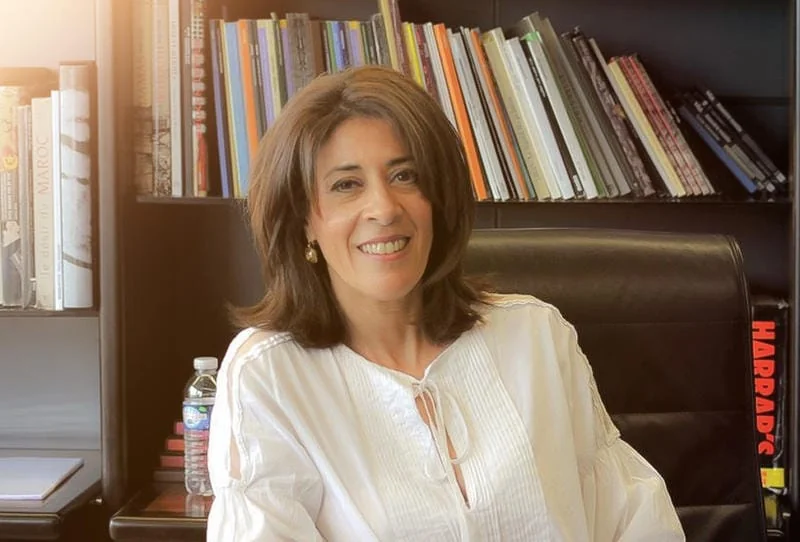
Ranked among the top 100 most powerful Arab women.. Mona Khazindar: A life full of arts and expanding the horizons of cultural work
When the name of Ms. Mona Abed Khazindar appeared in the list of the 100 most powerful Arab women in the year 2013, this inclusion was a great tribute to outstanding cultural, scientific and social efforts. Ms. Mona Khazindar has not stopped moving creative and cultural work throughout her professional experience, providing a bright image of her country, the Kingdom of Saudi Arabia, in international forums. In previous years, Mona Khazindar was able to win the position of director of the Arab World Institute in Paris, surpassing two great writers from Iraq and Syria after fierce competition from them, namely the well-known Iraqi poet Shawqi Abdel Amir, who is the supervisor and founder of the monthly publication (Book in a Newspaper) in the capitals of the Arab world, and the Syrian writer Farouk Mardam-Bey. Today, she has been a member of the Shura Council since October 2020 and a member of the Saudi General Authority for Culture since 2018.
If we review the professional biography of Mona Khazindar, we will find it full of great achievements in the cultural field. So how do we get to know this bright national face that provided a clear picture of Saudi culture, especially during her management of the Arab World Institute in Paris? Towering works: Mona Khazindar was born in the United States in 1959 and lived there with her family. Her father is the well-known writer and thinker Abed Khazindar - may d rest his soul - one of the most prominent intellectual voices in the city of Jeddah, and the author of towering works in comparative literature and criticism, where he contributed during the nineties of the twentieth century AD to introducing new literary and critical schools and translated some stylistic and structural concepts and text sciences into Arabic. His articles in Today''s Culture in Al Riyadh newspaper caused wide echoes at the time. This father is credited with what his daughter has reached now; he provided her with special care since her beginnings, especially in aspects of love for history, languages and civilizational communication. The writer and historian Mohammed Al-Qashami, in an article of his in Okaz (May 21, 2011), quotes her as saying: Her father Abed Khazindar had instilled in her a passion for literature since she was young. Whenever he read a novel, he would urge her to read it, then they started exchanging books and reading, and there was a continuous literary dialogue between them enhanced by reading books. Her mother is Shams Al-Husseini Khazindar, who began editing the women''s page in "Al-Yamamah Newspaper" in Saudi Arabia in 1964.
Mona Khazindar obtained a Bachelor''s degree in Comparative Literature at the American University in Paris, according to Wikipedia, and continued until she obtained a Master''s in Modern History at the Sorbonne University. Mona Khazindar is fluent in three languages: Arabic, French and English. Mona Khazindar participated in holding many exhibitions during her career at the Arab World Institute, which began since 1986 as she was responsible for the permanent collection of modern and contemporary art and photography in the Institute''s museum, which includes 499 artworks.
Artistic and cultural achievements: In past stages, she chaired the commission of a number of important art exhibitions held by the Institute, which received the praise of critics and the acceptance of the public, including "Views of Contemporary Arab Photographers", "Modernity in the Plural Form", "Umm Kulthum the Fourth Pyramid", "Palestine" and "Creativity in all its States". She also supervised the publication of "catalogs" and art books related to these exhibitions, in addition to writing a number of publications, and writing articles and studies in the artistic field, especially contemporary Arab artists. She contributed to translating many scientific messages for many Arab artists and intellectuals, and visited the Kingdom to give a lecture organized by the Ministry of Foreign Affairs represented by the Agency for Information and Technology Affairs, on: "Cultural Diplomacy in the Ministry of Foreign Affairs", during which she explained that cultural diplomacy has a political economic impact, praising the Kingdom''s experiences, whether it was the Janadriyah festival or the external cultural participations of the Kingdom.
Mona Khazindar held the position of Director General of the Arab World Institute, as the first woman to hold this position. It is one of the most important Arab cultural centers in Europe, based on French law, where it was established to be a tool for introducing Arab culture and spreading it, founded in 1980. It is an institution aimed at developing knowledge of the Arab world, and launching a movement of deep research about its language and cultural and spiritual . It also aims to encourage exchanges and cooperation between France and the Arab world represented by twenty-two Arab countries. This cooperation is culturally diverse, especially in the fields of science and technology, which leads to developing relations between the Arab world and Europe. Mona Khazindar''s assuming of this position comes after brilliant names followed one another in managing the Institute since its inception such as: Mukhtar bin Diab from Algeria, Mohammed Bennouna from Morocco, Bassem Al-Jisr from Lebanon, and Naser Al-Ansari from Egypt. She was nominated as the first Saudi woman to win the Arab Women''s Forum award, which held its fifth session in Beirut under the slogan "Women and the Arab Spring", and received the title of "Arab Woman of the Year 2012". Khazindar founded Palette, which is a cultural and artistic gathering for organizing cultural projects and publishing art publications. It was chosen by Bienal del Sur (the International Biennial of Contemporary Art in South America) to select 5 Saudi artists and cooperate with them within the framework of her participation in the 2019 edition. Thus, Mona Khazindar''s achievements do not stop whether in her representation of the Kingdom in international forums or in her cultural trends that overlook the future and work on planning the national cultural space.