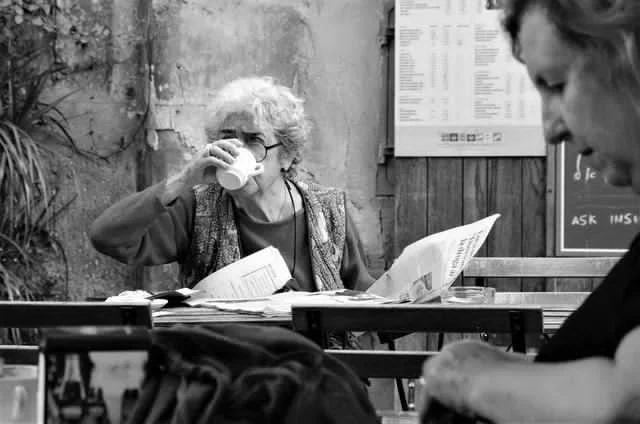
Corona changed everything... even coffee
Cafes have long been one of the most important live platforms for cultural communication, and they are almost a solid cultural corner in the history of global culture, where they have played an unforgettable role in many cultures and literary lives.
On the banks of these cafes, intellectuals and writers used to gather and broadcast their dialogues, until they became an important place for cultural exchange and a tourist symbol sought by visitors. However, after the Corona pandemic, things changed a lot in the world.
Italian cafes have been subjected to closures and restrictions due to the pandemic - but how much have habits changed? In this article, translated and presented by Ahwal Al-Ma'rifa magazine, Verona-based writer Richard Hogg gives us a tour of his city's cafes as he looks at the pandemic's impact on Italian coffee culture.
Richard Hogg has lived in Verona since September 2011 and writes about the region's history, football, and culture. His first book, "Notes from Verona," is a short collection of memoirs from inside pandemic-locked Italy, and he is currently researching his next book on wartime Verona.
Here are excerpts, translated by #Ahwal_Al_Ma_rifa_Magazine from the Italian website "The Local", of the article that looks at the changing world due to Corona through coffee, cafes, and many familiar habits that have become a thing of the past.
"As anyone who follows me on social media knows, coffee breaks are a vital part of my daily routine. Or at least they were pre-COVID.
Don't get me wrong, I still take breaks, and they usually involve coffee. But in the post-COVID landscape, coffee breaks are not what they used to be. The days I spent enjoying a coffee in a sunny square while enjoying a fresh pastry have, unfortunately, become a distant memory.
Caffè Coloniale is another respected Veronese cafe. Tucked in a courtyard behind Juliet’s balcony, it has a bit of an old-air memory. Again, it is quiet, even during that peak coffee-drinking period between ten and eleven. Usually, the dozens of tables outside are full, but this morning only two (including mine) were occupied.
Nico is another person who felt the difference of the lockdown. He is a language teacher from Trieste, a city with a long tradition of coffee consumption and home to global brands including Illy and Hausbrandt.
Despite the restrictions, he enjoyed his usual coffee, but his habits changed. When circumstances allowed, he would meet a friend for coffee, but he misses those spontaneous encounters or the chance to meet friends, acquaintances, or even complete strangers.
Nico remains optimistic: "We will soon return to drinking coffee as before, spontaneity will return, but some of the faces around us will change."
Of course, I don't usually come to Piazza Bra for coffee. In fact, I have spent much of the last ten years avoiding the place, in a failed attempt to avoid being mistaken for a tourist! But, for the sake of journalistic integrity, I decided to reach the beating heart of Verona's cafe culture. And I'm glad I did.
Piazza Bra is where thousands typically flock every day to enjoy a coffee or a pre-opera aperitif in one of Italy's most iconic public spaces. As much as it pains me to say it, my coffee here was a truly enriching experience.
The place was quiet. I stayed all morning without feeling the pressure to move on. I could, in truth, have stayed all day. It is simply the best place to sit and watch the world by.
The coffee was among the best I've had all week. I even managed to get a fair amount of editing done on a completed chapter of my next book on wartime Verona. And all this a stone's throw from the stunning form of the Roman arena.
Now that Veneto, like the rest of Italy, is back in the orange zone, what does that mean for coffee breaks here in Verona? Well, once again, all the city's cafes and restaurants are now closed, although some will continue to offer a takeaway service.
But, as my experience last week made clear, cafes offer much more than just coffee: spontaneous encounters, ssip, chance meetings, and sometimes a beautiful spot in the sun to sit and watch the world by.
All this will have to wait until I get back to the kitchen to fill a Moka.
Since most of my teaching responsibilities are now online, and my writing work is done at home rather than in the library, my coffee breaks are usually solitary, either alone in the kitchen or on the balcony.
Preparing the morning brew is now a regular part of my daily routine. I sleepily fill the kettle, put the ground coffee in a funnel-shaped filter, close the lid, and turn on the stove.
Then it's just a matter of waiting.