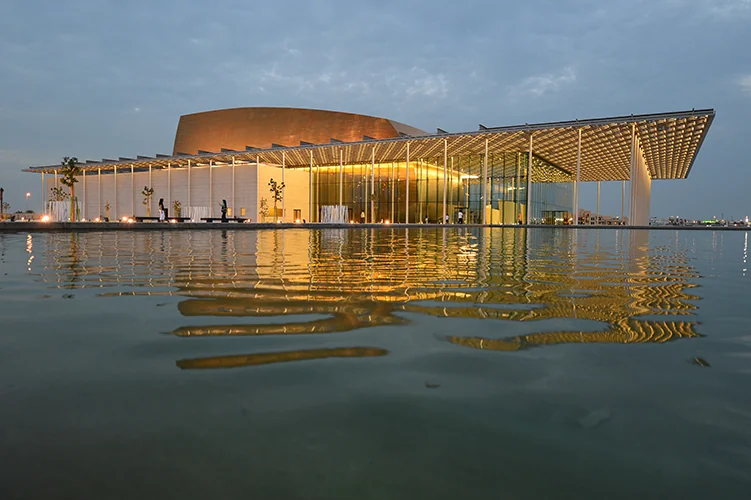
A look at the cultural landmarks in the Kingdom of Bahrain
Haggag Salama
The history of human settlement in the Kingdom of Bahrain dates back more than 4,000 years, during which different civilizations succeeded each other and played an important role in shaping Bahrain''s identity and human legacy, starting with the Dilmun civilization, then Tylos, Awal and the Islamic civilization.
Bahrain is proud to be an attractive pole for visitors from all over the world, given its civilizational components and renaissance in various sectors. The cultural pluralism and ethnic diversity witnessed by the Kingdom, in addition to the low cost of living and the availability of educational and health services, also contribute to making Bahrain one of the preferred destinations.
Manama, the capital of the Kingdom of Bahrain and its largest city, enjoys a distinguished regional and international reputation as a destination for cultural tourism. Manama was chosen as the Capital of Arab Culture in 2012, the Capital of Arab Tourism in 2013, and the Capital of Asian Tourism in 2014. Meanwhile, Muharraq, the oldest capital of Bahrain and its largest inhabited island, was named the Capital of Islamic Culture in 2018.
In this context, the vernment of the Kingdom of Bahrain, represented by the Bahrain Authority for Culture and Antiquities, works to permanently update and develop cultural infrastructure, in addition to activating the role of culture in comprehensive social and economic development.
The Bahrain Authority for Culture and Antiquities adopts support for the Bahraini cultural movement through enhancing the role of museums, popular heritage, and other cultural components of Bahraini society, in order to enrich the local community''s knowledge of its origins and civilization, which is estimated to be thousands of years old.
It seeks to open up to other cultures around the world by attracting diverse international cultural events, in addition to its continuous work to expand the audience base for culture in the Kingdom, and promote Bahrain and draw its image as a distinguished civilizational country characterized by vitality and diverse human activity, open to world cultures.
The Kingdom includes many cultural landmarks that attract masses of visitors.. Here, through these lines, we take a tour among the most important cultural landmarks and establishments on Bahraini soil.
Bahrain National Theatre
We begin our tour from the Bahrain National Theatre, which opened in November 2012, under the generous and royal patronage of His Majesty King Hamad bin Isa Al Khalifa, the King of the country.
The Bahrain National Theatre has hosted many international performances in the arts of theatre, singing, opera, and more. In terms of musical concerts and music, the theatre stage welcomed the Russian Century Orchestra, the legendary musician "Yanni", the concert of Spanish opera singer Plácido Domin, and Russian ballet performances by the Bolshoi and Mariinsky troupes, and the Il Divo group.
The theatre also provides space for cultural activities, as it received the 39th Bahrain Annual Fine Arts Exhibition in 2013, the Korean folk fashion show, and a number of other press conferences and award ceremonies.
The Bahrain National Theatre was built on an area estimated at 12,000 square meters. The theatre, which accommodates 1,001 seats in its main hall, is located next to the Bahrain National Museum with a distinctive sea view. Its engineering designs and wooden interior walls are an attempt to simulate the atmosphere of "One Thousand and One Nights" tales.
The theatre includes, along with its main hall, a cafeteria and an outdoor lounge overlooking the theatre lake. It also contains a small hall that accommodates 100 people dedicated to training, press conferences, and small celebrations.
The Bahrain National Theatre is one of the largest theatres in the Arab world, and the third largest opera house in the Arab world after the Egyptian Opera House and the Royal Opera House Muscat.
The Bahrain National Theatre is the most important culmination of the Kingdom''s efforts to enrich local culture over past decades, as its history full of achievements saw the establishment of the first school in the Gulf in 1919 AD, and the establishment of the first radio station also in 1941 AD, in addition to a large number of cultural halls and cultural work centers.
Bahrain National Museum
Among the Kingdom''s landmarks is also the Bahrain National Museum, which was officially opened on December 15, 1988, by the late His Highness Sheikh Isa bin Salman Al Khalifa, the Amir of the state. The Bahrain National Museum, which was designed by the Krohn & Hartvig Rasmussen office, is considered one of the finest museums in the Gulf region, and today it is one of the lofty cultural edifices in the Kingdom of Bahrain.
The museum is located on an artificial peninsula in a central strategic location overlooking Muharraq Island, and is distinguished by its white marble facade and its charming courtyard.
The museum complex consists of two connected buildings with a floor area of about 20,000 square meters. The main building includes permanent and temporary exhibition halls, as well as a lecture hall, gift shop, and café. The administrative building includes administrative offices, research areas, restoration laboratories, and collection stores.
The Bahrain National Museum summarizes the memory and history of Bahrain, spanning over 6,000 years, and is manifested through halls of Graves, Dilmun, Tylos, Islam, Customs and Traditions, Traditional Trades and Crafts, and Documents and Manuscripts.
The museum halls connect to a main lobby, which is a vast and dramatic space beautified by natural light rays, and includes the "Investment in Culture" exhibition.
Qal''at al-Bahrain Site Museum
There is also the Qal''at al-Bahrain Site Museum, which opened in February 2008 to protect the historical features of the archaeological site, in addition to documenting historical periods by preserving the archaeological pieces discovered at the Qal''at al-Bahrain site.
The museum is located opposite the historical Bahrain Fort, which is one of the most important known historical political and military forts in the Arabian Gulf region. This fort is part of the Qal''at al-Bahrain site, which was inscribed on the World Heritage List of the United Nations Educational, Scientific and Cultural Organization (UNESCO) in 2007. The museum, from its location, overlooks the most beautiful natural and spontaneous scenes where the marine environment harmonizes with the green belt of the area. This is one of the environmental spaces that has not been affected by urban change.
The museum collections tell of five different historical periods present in five different halls. These halls use artifacts discovered at the Qal''at al-Bahrain site to provide a historical explanation based on the chronological sequence of archaeological pieces between corridors.
As for the 3D design of the Qal''at al-Bahrain Site Museum, it is on two floors and works to weave a strong relationship between its indoor atmosphere and the open nature outside. The back facade of the museum overlooking the sea also allows for opening a passage from the inner village to the shore.
Other parts of the museum include the main courtyard and the connected café, which overlooks the sea across from Bahrain Fort. The museum also includes a lecture hall and a gift shop.
Art Centre
The list of cultural landmarks in the Kingdom of Bahrain also includes the Art Centre, which opened in May 1992. This center is considered one of the latest and most important exhibition halls in the Kingdom of Bahrain, reflecting the extent of care and patronage given by the Kingdom of Bahrain to culture and arts, and what the fine arts movement in the Kingdom of Bahrain has reached in terms of development and prosperity.
Through its intensive annual program, the Art Centre offers many cultural events such as workshops, lectures, and artistic and photographic exhibitions.
Al Khalifiyah Library
There is also the Al Khalifiyah Library, located in the heart of old Muharraq city, where the original library building, considered one of the oldest public libraries in Bahrain, was rebuilt. The new building contains a reading hall, a research center, a computer lab, and a number of offices. The library, open to the public, provides continuous general cultural programs and activities.
Jasra Handicrafts Centre
The Kingdom of Bahrain also includes the Jasra Handicrafts Centre, which opened in 1991 in Jasra village located on the west coast of Bahrain. The center hosts a number of artisans specialized in traditional industries. The center aims to inform visitors and those interested in the creative and aesthetic aspects of handicrafts and the traditional and developed products that the artisans manufacture daily. The Jasra Centre also includes workshops equipped with the latest training means and technical equipment for traditional crafts and handicrafts, attracting many training programs throughout the year.
Al Bareh Art Gallery
We also visit Al Bareh Art Gallery, which is a space to host art exhibitions for regional artists. It also hosts art programs with different orientations throughout the year, giving it a renewed character from time to time. In addition, the "Abcad" exhibition space allocates a non-profit space as an experimental art field.
Shaikh Ebrahim bin Mohammed Al Khalifa Centre for Culture and Research
We move to the Shaikh Ebrahim bin Mohammed Al Khalifa Centre for Culture and Research, which took over the same area that once contained the majlis of Shaikh Ebrahim bin Mohammed Al Khalifa. It includes a number of scattered heritage houses in Muharraq along with a heritage house in Manama. These houses highlight the most important traditional Bahraini heritage features as they host dialogue sessions, lectures, programs on philosophy, literature, poetry, culture, and arts.
House of Poetry – Ibrahim Al-Arrayed House
From the Shaikh Ebrahim bin Mohammed Al Khalifa Centre, we move to the House of Poetry, which is a meeting place for poetry and poets. It was once the home of Ibrahim Al-Arrayed, who was for more than half a century the most important poet and writer in Bahrain. Visitors can explore the contents of Al-Arrayed''s private office and look at the many volumes of poetry collections contained in the house''s library. The House is a branch of the Shaikh Ebrahim bin Mohammed Al Khalifa Centre for Culture and Research.
Mohammed bin Faris Hall for the Art of Voice
We conclude our tour among the cultural landmarks on the soil of the Kingdom of Bahrain with a visit to the Mohammed bin Faris Hall, located near the Mohammed bin Faris House for the Art of Voice. It is a branch of the Shaikh Ebrahim bin Mohammed Al Khalifa Centre for Culture and Research. Regular free musical evenings are held there by the Mohammed bin Faris Folk Band, which preserves ancient and authentic Gulf traditions.