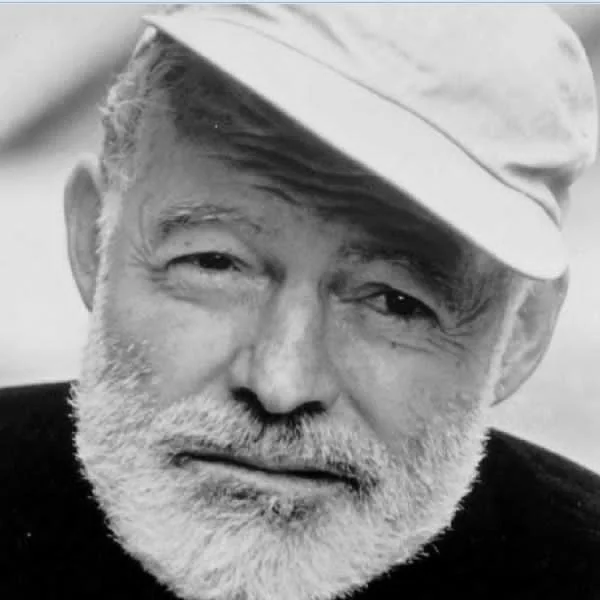
Ernest Hemingway: How mental illness afflicted the mind of the great novelist until it brought him down
The novelist Ernest Hemingway, who committed suicide at the age of 61, often struggled, like many members of his family, due to his psychological conditions, as revealed by this report published by Biography magazine, and translated by Ahwal Al-Ma'rifah magazine. He is one of the most influential writers of the twentieth century, as the voice of Ernest Hemingway, with his unique literary prose, admired critics and readers alike. His larger-than-life personality made him a star beyond the printed pages, for his press articles, short stories and novels, to other worlds. But behind that lden facade, Hemingway faced a lifelong battle against depression, alcoholism and mental health issues, all of which contributed to his death by suicide on July 2, 1961. But it was not only Hemingway who suffered, as several generations of his family suffered the same disasters, as his family faced similar problems, in what one of his granddaughters described as the "Hemingway curse".
Hemingway had a turbulent relationship with his parents; he was the second child of Clarence "Ed Hemingway" and his wife Grace. Ed was a successful doctor and Grace was a former singer and music teacher. Therefore, much of his childhood was divided between the family home in Oak Park, Illinois, and a house in the woods of Michigan, where Ed satisfied his love of hunting and the outdoors. But Hemingway struggled to connect with his father, who despite his calm outer appearance, could be a violent and tyrannical bully. He seemed to be on a path of self-destruction from an early age, in search of adventure and escape from his life in the suburbs, as Hemingway left home in his teens, eventually volunteering as an ambulance driver in World War I, where he was seriously injured in Italy and fell in love with his nurse, and her ultimate rejection of him led to a bout of depression that became a feature of his later life. While working as a journalist in America, he married his first wife, Hadley Richardson, and the couple moved to Paris so Hemingway could focus on writing novels.
He soon found himself at the heart of an artistic circle of fellow expatriates, known as the "Lost Generation," where he established relationships with future prominent figures such as F. Scott Fitzgerald, Gertrude Stein, Ezra Pound, John Dos Passos, and others. Despite Hemingway's destructive personal life, he achieved professional success, publishing his first novel, "The Sun Also Rises," in 1926. This is how the suffering began. In December 1928, when Hemingway was twenty-nine years old, his father killed himself, shooting himself with a family pistol after a long period of material and financial setbacks. Hemingway was deeply shaken by his father's death, for which he largely blamed his mother. He felt that he might suffer the same fate as his father, writing to his mother shortly thereafter, "Maybe I'll the same way." He also imagined the events in his 1940 novel "For Whom the Bell Tolls," in which the main character's father commits suicide in a similar manner. For many of his family and friends, Hemingway's risky life choices, including his obsession with hunting and blood, and the bullfighting scene, as well as his rush to join the action during the Spanish Civil War and World War II, reflected a sad fascination perhaps with darkness and death. He was also reported to have told actress and close friend Ava Gardner in 1954: "I spent a lot of time killing animals and fish so I wouldn't kill myself."
Hemingway's final years were turbulent. In 1940, Hemingway bought a house in Cuba, and although he continued to travel the world, it would be his primary residence for the next twenty years. He published his last major novel, "The Old Man and the Sea," in 1952, winning a Pulitzer Prize in 1953 and the Nobel Prize in Literature in 1954, which catapulted him to a new level of international fame. In the same year, Hemingway nearly died following two plane crashes while traveling in Africa, suffering a fractured skull and ruptured liver and spleen in addition to other injuries. These accidents led to a sharp deterioration in his physical and mental health, with a bedridden Hemingway ignoring doctors' orders. When he and his fourth wife, Mary Welsh, finally returned to Cuba in 1957, he began work on A Moveable Feast, a memoir of his early years in Paris. But unlike all previous works that had seemingly flowed out of him, he struggled to finish the piece (it would be published posthumously), and his frustration deepened his depression. As the political situation in Cuba deteriorated, Hemingway and Welsh left in July 1960, and over the next few months, Hemingway became increasingly isolated and paranoid, convinced he was under FBI surveillance.
He tried to get help at the Mayo Clinic shortly before his death. In the autumn of 1960, the couple settled in a newly built home in Ketchum, Idaho. Hemingway's instability worsened, as his anxious mind became convinced that despite his publishing success, he was on the verge of collapse. In November, Welsh and Hemingway's doctor persuaded him to fly to the famous Mayo Clinic in Minnesota. His doctors prescribed the then-new drug Librium, as well as a course of electroconvulsive therapy treatments, which robbed him of his short-term memory and seemed to provide little relief. But Hemingway's doctors, perhaps convinced by his still-powerful and persuasive charm, released him into Welsh's care after only seven weeks. Back in Ketchum, he found himself unable to write, often struggling for hours or even days to write a few sentences and was forced to cancel his plans to attend John F. Kennedy's inauguration in January. He threatened to kill himself several times, and when he was flown to the Mayo Clinic for a second time in April, he was said to have tried to throw himself onto the propeller of the plane carrying him there. By this time, news of his stay at the Mayo Clinic made headlines, with locals reporting sightings and conversations with Hemingway, whose doctors allowed him to come and as he pleased. The doctors released him again in late June. Two days after arriving home, on the morning of July 2, 1961, he found the keys to the gun cabinet, pulled out his favorite shotgun and several shells, and then shot himself in the head inside the foyer of the house.