Reviving Modern Arts while Re-Establishing Traditions and Authentic : Creating the New Culture and Its Transformations in the Kingdom of Saudi Arabia
Reviving Modern Arts while Re-Establishing Traditions and Authentic
In a qualitative and advanced civilizational way, the Kingdom of Saudi Arabia broke the traditional culture system that was based on what is authored in books, what is produced by writers, poets, and authors, and what some cultural centers and platforms provide of various activities.
In recent years, the Kingdom entered a stage of making the current qualitative culture that focuses on reading reality and its vitality and linking it to a moving, living culture.
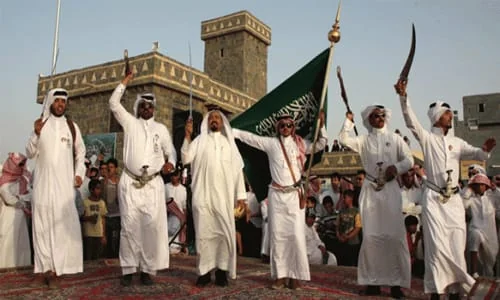
The direction towards establishing a set of strategies for the Ministry of Culture, taking care of reviving heritage and archaeological sites, re-vivifying the city of Diriyah as a heritage and future capital of culture, and caring for various elements of culture without limiting them to poetry, literature, and fine art, to cover new expressive spaces for fashion, cooking, tasting, equestrianism, camels, heritage sites, as well as folk dance arts, folkloric arts, in addition to known arts such as cinema and theater, literature, Arabic calligraphy, fine arts, and Arabic and Islamic miniatures with care for some traditional social cultural elements such as coffee or what relates to authentic Saudi drinks and food. All these matters gave culture in the Kingdom new dimensions other than the traditional elements that dominated Saudi culture since the Kingdom's founding on September 23, 1932, as a new modern awareness advanced to replace what is traditional in its ideas and visions. The Kingdom bypassed the stage of literary clubs, the culture and arts association, literary salons, and small and large libraries - which clearly performed their roles in recent decades - to make them auxiliary elements in providing cultural activities, not dominant elements in their traditional form.
Qualitative Culture:
In his speech that tops the Ministry of Culture website:
Prince Badr bin Farhan Al Saud says: "Culture is an essential part of the ambitious national transformation that our country is undering under the leadership of King Salman and Crown Prince Mohammed bin Salman. Vision 2030 states that culture is one of the components of quality of life, and stresses that the Kingdom needs to increase its cultural activity. Our mission in the Ministry is to build on this work and contribute to achieving the als of Vision 2030."
Thus, the cultural vision of the Ministry of Culture starts from the dimensions provided by Vision 2030 and considers culture as a component of the quality of life, which the Ministry clearly presented in drawing its new cultural strategy so that a great interaction occurs between culture and reality, culture and society, and culture and national identity in general.
Hence, the vision of the Ministry of Culture and its orientations were launched on March 27, 2019, representing the work framework for developing the cultural sector. The Ministry identified three main als: culture as a lifestyle, culture for economic growth, and culture for enhancing the Kingdom's international status. These als align precisely with the strategic axes of Vision 2030 represented in building a vital society, a prosperous economy, and an ambitious nation.
The Ministry of Culture identified 16 priority sub-sectors to focus on, and established 11 commissions to develop cultural sectors, namely: Culinary Arts, Literature, Publishing and Translation, Theater and Performing Arts, Fashion, Film, Heritage, Visual Arts, Museums, Libraries, Music, and Architecture and Design.
Cultural Panorama:
Saudi culture no longer purely represents traditional ideas that circled around books and writers for long, but has expanded to provide a comprehensive system and a diverse cultural panorama, investing various cultural elements in moving the public towards caring for the Kingdom's cultural identity.
(Riyadh Season) came to form a vital cultural pattern meeting the aspirations of Saudi society in breaking artistic, vocal, and musical isolation to join with national, Arab, and international singing with consecutive concerts by major singers, reviving the singing and musical market significantly.
Artistic festivals, including the Red Sea International Film Festival, formed a bright cultural aspect confirming the importance of artistic communication globally, and making the incentive for the Saudi film industry a basic necessity. The same happened in re-vivifying heritage and archaeological sites and placing them on the UNESCO World Heritage list.
The culture presented today is a promising culture, evidenced by the change in cultural mentalities that adopt the movement of the cultural street. Literary clubs or the Culture and Arts Association are no longer the only contributors, and cultural salons no longer meet the needs of new generations for a qualitative panoramic culture linked to the age. Hence, the demand for what the Ministry of Culture and new platforms provide has been clear and unprecedented.
Diverse exhibitions, events, and conferences launched by the Ministry of Culture all point to a new qualitative effort and a new mentality for making a different and advanced culture in the Kingdom. The Ministry presented activities such as: National Cultural Awards, Art Residency, and conferences on philosophy, translation, and arts, and a global center for Arabic calligraphy carrying the name of Prince Mohammed bin Salman.
The strategy of the center, launched in December 2021, aims to transform it into a global platform for calligraphy and calligraphers internationally, serving Arabic calligraphy as a means of intercultural communication in heritage, arts, architecture, and design, along with incubating talents.
The strategy identified the "vision" of the Prince Mohammed bin Salman Global Center for Arabic Calligraphy (Dar Al-Qalam) in "elevating Arabic calligraphy as a means of cross-cultural communication in the fields of heritage, arts, architecture and design, while enhancing the Kingdom's status and influence in its preservation and development."
The center's mission was to "establish the center as a global reference concerned with protecting the legacy of Arabic calligraphy by incubating talent, developing knowledge, and developing creative horizons."
Additionally, the holding of diverse renewed exhibitions, headed by the Riyadh International Book Fair, which was presented in a vivid form in its last edition in October 2021.
Activities of public libraries, the King Abdulaziz Foundation for Research and Archives, the King Abdulaziz Center for World Culture (Ithra) in the Eastern Region, and the King Abdulaziz Public Library complete the vivid picture of the Saudi cultural panorama. The King Abdulaziz Public Library held an exhibition for Arabic calligraphy and is currently holding an exhibition for Islamic and Saudi coins to add a new space of qualitative knowledge linked to heritage and history from several artistic, linguistic, cultural, and social viewpoints.