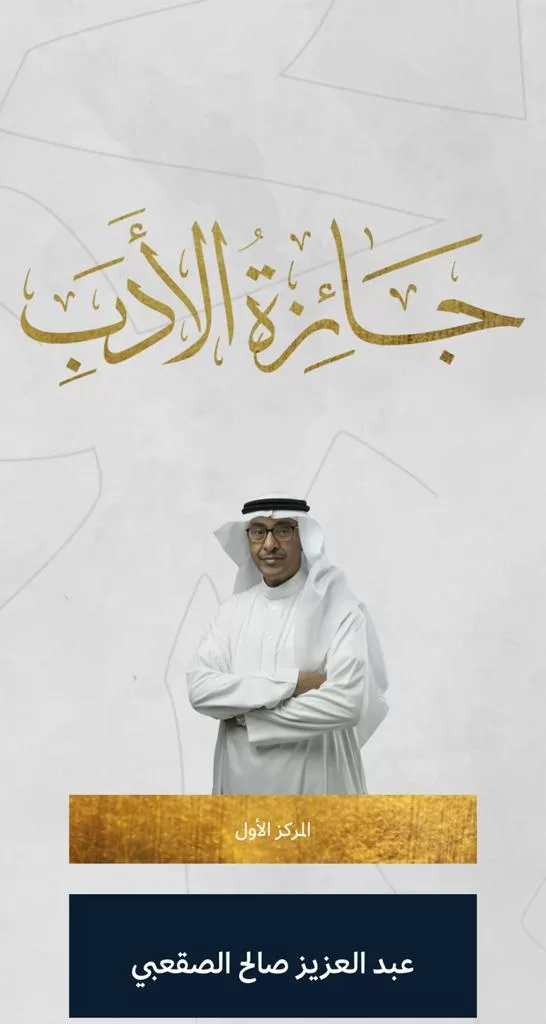
After winning the Ministry of Culture Prize for the Novel 2021, Abdulaziz Al-Saqabi: I write in all narrative forms and my novel is a witness to the era
Interviewed by: Abdullah Al-Samti
The novelist Abdulaziz Al-Saqabi, winner of the Ministry of Culture prize in the field of literature for the year 2021 for his novel: "A Nap at Noon", emphasized that his winning the prize is a motivator to continue cultural giving and expressed his thanks to everyone who contributed to granting him the prize. Al-Saqabi saw in his interview, which he granted exclusively to Ahwal Al-Ma''rifah magazine, that his winning novel is part of a long experience that lasted for more than forty years, and that in this novel he tried to present a work in which there is much enjoyment and benefit and to be a witness to the era, while he called for care for critical studies and the return of literary supplements in newspapers and magazines, and care for the theater, especially after the formation of a special commission for it by the Ministry of Culture. This is the text of the interview:
- First.. how do you see your win of the literature prize for your novel: A Nap at Noon published three years ago?
After success from God, winning the prize represents for me thanks and appreciation from a high official body in the state represented by the Ministry of Culture for my literary achievement represented by the novel "A Nap at Noon", which is part of a long experience that lasted for more than forty years. Of course this is a motivator for me to continue cultural giving, and to seek to provide what is better. Here I feel bliss and joy for this win, and I thank everyone who recommended and approved granting me this prize.
- Is it an appreciation for the novel or for your achievement as a whole?
What is different about this competition is that according to specific technical mechanisms, there is no paper at all in its procedures, where in addition to a digital copy of the novel, a completed CV was requested, and samples of studies and research presented about my creativity. I think complete information was requested from each participant to meet the conditions of the prize. Of course the novel "A Nap at Noon" is an extension of my creative achievement. Here I think the starting point for the prize is the novel, and to support this win all the referees must have looked at the CV and the titles of studies about my creativity that I attached, in addition to published samples. In general, the novel is the entry point for the prize as this year''s session of the competition was dedicated to the novel.
- You published your first novel 33 years ago: Smell of Charcoal. What is the aesthetic line and its journey between the first novel and A Nap at Noon?
When I wrote the novel Smell of Charcoal, the novel did not have a presence in the Saudi cultural scene at that time, the favor was for the story. But it was an adventure to write a different text that benefits from the story and theater writing technique, and is characterized by relative length. The novel Smell of Charcoal is of the "novella" genre or the short novel, very different from the rest of the novels I wrote after that. Perhaps the internal censor at that time was strong so I didn''t give the heroes freedom, and I didn''t elaborate. But when I wrote the novel Case of a Lie after about two decades, it was different, usually more mature and bolder. Thus I continued in my novel writings to write more than one novel, and the talk will be long when stopping at each one of them. In general, each novel represents a special experience, and when I wrote the novel "A Nap at Noon" I perhaps possessed the reading experience first, then life and writing experience which made me present a work I tried to make much of enjoyment and benefit and to be a witness to the era.
- Your narrative writing varied between the story, the very short story and the novel. What does that mean from an artistic and expressive point of view? Can''t one type embrace the creative experiences and the experiences of reality?
I have never written poetry at all. I am a narrator, and my writing of the novel or the very short story or even the play is an extension of writing the short story. Each form of these types of narration has its characteristics and cases of writing. I might need to write a flash that does not exceed two lines so I turn to writing the very short story. I might be surrounded by multiple characters and want to monitor the life of a thorny world, certainly the novel will be the outlet for writing that. Therefore, it is impossible for one type of narration to embrace the experiences of the creator. The important thing is for him to be aware of the characteristics of each type, and seek to provide the good and distinguished text.
- You have theatrical works.. Do you think Saudi theater has developed over the past decades or is it still in its early stages? How do you see the current Saudi theatrical movement?
It is better not to talk about the past decades when talking about the theater in the Kingdom, for an important reason which is that there has become a special commission for theater under the supervision of the Ministry of Culture. Of course there is a new phase for theater whose features have not yet become clear. Therefore let us be optimistic and say that the theater in the coming days will witness a prominent and distinguished presence. In the past, theater did not have its legitimacy as it relied on the efforts of some theater people and their love for that art, and their desire to provide a theatrical act, with simple support from culture and arts associations, and other government and private institutions. Of course the matter depends on relationships, and scattered attempts in some areas that have a group of creative people in the theater such as Taif, Al-Ahsa, Dammam, and Jeddah, with an absence of many regions and cities of the Kingdom, unless there is a theater festival, and this is rare. Now the matter will be different, theater presumably gained its legitimacy, and inevitably there will be organization for theatrical groups and associations, and God willing there will be distinguished works, and the indicators suggest that by approving and launching the national theater, and starting with civil associations.
- What is the position of critics regarding the diversity of the creative product you have? Do you feel that there is a critical shortcoming towards your literary works?
We cannot deny there is a crisis of criticism and follow-up for creative achievement in the Kingdom in poetry, story and novel, perhaps due to the decline of printed literary journalism and the rarity of literary magazines. But the beautiful thing for me is there are critical studies outside the Kingdom, in addition to a group of academic studies and research for obtaining Master''s and PhD on my creative works and this is something I am proud of. Critical studies are important for the creator, and for the creative movement in general, because the good critic adds his vision to the good work first, and exposes weak works. Here we stop a little as unfortunately in the time of modern social media many bad works were promoted, and achieved spread because of the writer''s fame in those means and the large number of his followers. We hope for the return of cultural supplements in newspapers and magazines and the return of critics who serve the literary movement with their opinions and evaluation of creative achievement, and searching for channels including books to follow creative achievement and introduce it and clarify the good and guide everyone who puts his first steps on the path of creativity with the points of strength and weakness in his creativity. I here do not deny the importance of criticism and refereed scientific studies for the creator, and their motivation for him to continue his creative giving.
Illumination:
Abdulaziz Al-Saqabi is a Saudi storyteller, playwright and novelist. He has published several narrative works, including: Neither Is Your Night Mine Nor Are You Me, and A Slap in the Mirror, and Smell of Charcoal, and The Storyteller Loses His Voice, and You are the Fire and I am the Butterfly, and Women''s Stations, and A Nap at Noon.