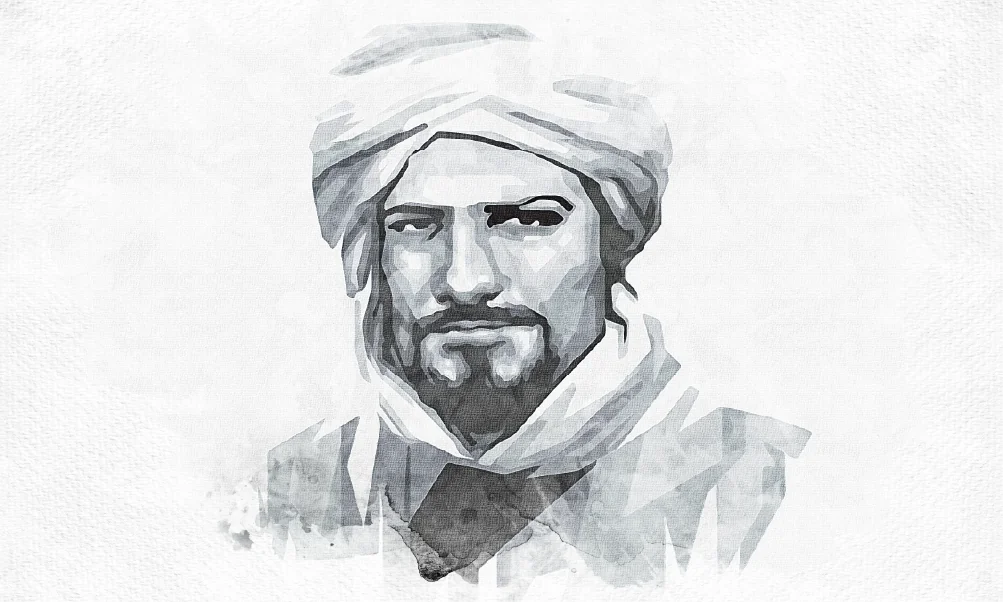
Sultans brought him closer and scholars neglected him .. "Ibn Battuta" between two eras
Dr. Abd al-Salam Shaqour*
This study aims to take a careful look at Ibn Battuta and his journey in two distant times: his time and our time. The purpose is to clarify the position of Ibn Battuta and his journey in the eyes of his contemporaries from princes and scholars in their attitudes and writings, and then present the image of Ibn Battuta and his journey in the view of our time; clarifying the position of Ibn Battuta among his peers, and the importance of his journey in literary and historical studies.
Ibn Battuta in His Time
How did the people of the eighth century, which is the time of Ibn Battuta, view "The Rihla" (A Gift to Those Who Contemplate) and its author? How was Ibn Battuta received in Morocco after his return from his long journey? To what extent did scholars from among the students of chains of narration care about the man? Did students race as usual when a scholar returns from his journey from the East to sit around him, take from him and hear from him? Was he frequently mentioned in the indices of sheikhs? Did biographical books care about translating his biography? Did subsequent travel books benefit from his journey, as it is known that travels benefit from each other and the later ones quote the earlier ones (1),? And what was the echo of his journey in the East in eastern Arabic sources?
Answering these questions and others requires conducting a general inventory of the writings of the people of the eighth century AH / fourteenth century AD (2), and also requires returning to the time of Ibn Battuta with the intention of highlighting its major features and placing Ibn Battuta within its general framework.
Ibn Battuta lived for three quarters of the eighth century / fourteenth in the time of the Marinids in Morocco. He was born in Tangier and grew up in it. Tangier had favor with the Marinids, as there were men from Tangier among the servants and poets of the Marinid princes (3). The one who introduced him to Sultan Abu al-Hasan while he was then in Tunis in his ill-fated campaign, according to what was mentioned in his journey, was a man from his home town (4).
The main concern of the Marinid sultans (5) was to unify Morocco and restore its empire to the borders it had in the days of the Almohads, which were the Atlantic to the west and Barqa to the east, along with the unification of Morocco and Andalusia and the restoration of the Andalusian cities lost during the intense dispute between the Almohads and the Marinids, such as Cordoba and Seville (6).
Many factors and many foundations prevented the realization of this great political project, including: the alliance between the princes of Bani Abd al-Wad and the Queen of Castile, the sedition of the Bedouins in Ifriqiya, the disaster that befell the fleet of Abu al-Hasan in the Mediterranean, and the skirmishes and intrigues of the Nasrids. Whatever the case, the Marinid princes, especially the great ones among their kings such as Abu al-Hasan and his son Abu Inan, were in the eyes of scholars, poets, elite and common people the hope for restoring the unity of Morocco, saving Andalusia and restoring Morocco's glory and prestige. That was the image of Morocco.
In this space lived Ibn Battuta, and he undertook his journey and ended in it to the furthest regions, crossing deserts and jungles, exposing himself to dangers. He visited cities that time does not allow to be mentioned, and it is enough for us to point out that he reached India, China and the remote Asian roots, then to the depths of Africa crossing the Great Sahara. Ibn Battuta fluctuated in his journey between states of extreme poverty and outrageous wealth; he lived the life of the poor and the life of ministers, and collected in that an experience and strange news. Thus, he was among those whose company palaces are adorned with, and their conversations are embroidered with the mention of his news. Ibn Battuta returned with a great amount of political experience, as he was a minister and ambassador of kings, and with a greater amount of news about the peoples he visited. How did the people of his country, the Moroccans, receive him?
The Attitude of the Marinid Princes Toward Ibn Battuta
Ibn Battuta enjoyed the attention and care of Sultan Abu al-Hasan and his successor Abu Inan. The first meeting between Ibn Battuta and Abu al-Hasan - known to the common people in Morocco as the Black Sultan (7) - took place in Tunis after his return from his journey around the year (749 AH). Abu al-Hasan was then in Tunis in the company of the sheikhs and scholars of Morocco. Abu al-Hasan admired Ibn Battuta and liked what he heard from him. He was expected to summon him to his court in Fez upon his return, but Abu al-Hasan al-Marini passed away after a severe ordeal. His death, may d have mercy on him, was after he miraculously survived drowning in the ill-fated sedition that intensified against him. When Ibn Battuta reached Fez, news reached Abu Inan, who brought him to his palace and added him to his scientific sessions. He was among his companions alongside the great sheikhs of his era from the people of Morocco and Andalusia (8). By order of Abu Inan, our friend dictated his journey to Ibn Juzayy. Perhaps Abu Inan wanted to benefit from Ibn Battuta's wisdom and experiences in politics, so he prepared a journey for him to the Sudan to see its conditions and to link relations with its rulers. It seems that Ibn Battuta's star faded after the murder of Abu Inan, so the care for him decreased, but we find mention of him as a judge, and this was the extent of the care for him in his appointment as a judge in a remote desert; no wonder his news was lost after that.
The Attitude of Scholars Toward Ibn Battuta
Students and scholars turned away from Ibn Battuta and did not pay attention to him in what they compiled. He was not taken as a source for chains of narration or transmission, although the man carried rare licenses and strange anecdotes. Thus, Ibn Khaldun did not mention him in his autobiography (9) with which he concluded his great history: Kitab al-Ibar, although he was on terms of knowledge and connection with him. Perhaps he met him in Tunis among the retinue of Abu al-Hasan, including his sheikhs, and perhaps he sat with him in Fez during his time there as a scribe for science, for Ibn Battuta was among the peers of Ibn Khaldun's sheikhs. Ibn Marzuq also did not mention Ibn Battuta in the book he dedicated to Abu al-Hasan, which is (The Correct Authentic Support in the Achievements of Our Master Abu al-Hasan). It is likely that Ibn Marzuq sat with Ibn Battuta in Fez if the man was lucky with the Sultan. In any case, Ibn al-Ahmar describes him as "the historical", meaning the historian in our language today. Al-Sarraj ignored Ibn Battuta in his index, despite mentioning the obscure ones who are not usually paid attention to. Ibn al-Khatib was the only one among his contemporaries, as far as we know, who dedicated a biography to him, which he quoted from his sheikh Abu al-Barakat ibn al-Hajj al-Balafiqi, noting that that biography, with its extreme brevity, does not do Ibn Battuta justice, as he is described in it as (having little pursuit of knowledge) (10), meaning that he did not have a keen interest in seeking knowledge. Then there is in this biography doubt in what Ibn Battuta narrates. Thus, nothing interceded for Ibn Battuta with the scholars of his time and those after him despite what "The Gift to the Contemplator" reveals of wide knowledge of Maliki jurisprudence and his memorization of a number of the Prophet's hadiths with their chains of narration, which enabled him to dictate some of those hadiths by order of the Sultan of India as a biography for him (11),. Nor did Ibn Battuta find favor with litterateurs among those who compiled literary and poetic selections, especially the poetry he composed, to find a place for him among the pages of their works. This strange neglect followed Ibn Battuta in subsequent ages, so biographical books, general and specific, did not dedicate the care he deserved in Morocco. As for his share of care from biographical authors in the East, it is limited, as far as we know, to the biography dedicated to him by Ibn Hajar in "Al-Durar al-Kamina" (12), quoting the text of "Al-Ihata" of which there was a copy in the Maghrebi gallery of Al-Azhar Sharif in Cairo at that time. That was the image of Ibn Battuta in his time, and it may be useful to ask about the secret of kings' reception of him and scholars' neglect of him. Ibn Battuta's era did not realize the importance of his journey, nor even the value of Ibn Khaldun's Muqaddimah, and the two were contemporaries, by virtue of the culture that was then prevalent and the interests that were then common. If Ibn Battuta had edited a few pages on jurisprudence, people would have been delighted with him and scholars would have turned to him, but he, may d have mercy on him, collected unattributed news and unrecorded traces, and there is no value for knowledge that has no chain of narration or license in it.
Ibn Battuta in Our Time
We must admit that we discovered Ibn Battuta thanks to what others wrote about him. It is true that Ibn Battuta's journey spread and became famous, evidence of which is the abundance of its manuscripts, but it was not a demand for scholars, but rather an oasis for those who wanted to spend hours, fleeing the fatigue of study and scientific achievement. What it included was closer to jest than to seriousness: oddities and wonders that no mind believes, and news with no chain of narration or origin. Interest in Ibn Battuta and his journey increased in our time, and talk about the journey opened windows that were closed and worlds that were locked, evidence of which are these seminars dedicated to him and his journey. Perhaps the most important doors opened by this journey are three, and therefore we will stop at each one of them separately: 1- The Gift to the Contemplator in the balance of literary studies. 2- The Gift to the Contemplator in the field of studying intellectual schools. 3- The Gift to the Contemplator as a source for the history of Islamic sultanates. "The Gift to the Contemplator" is considered a fertile field for modern and contemporary literary study; for the fertility of this journey and the multiplicity of its levels, and in this we stand first at the attempt to classify this journey and its classification. Research in travel literature has concluded by classifying this literary genre into two types: one is the Hijazi journey, and the second is the ambassadorial journey. Each of the two types has characteristics and features determined by the als of each specific type. The Hijazi journey is not defined by its subject matter, which is describing the journey to the Hijaz with the aim of Hajj only, but by what is mentioned in this catery, as it is an index journey that includes texts related to chains of narration, narrations and sheikhs whom the traveler met, in addition to anecdotes, news, literary rarities and scientific debates. As for the ambassadorial journey, it is devoid of all that, and presents its reader with other materials connected to another world that has no relation to receiving, transmitting, narrating and chain of narration. Each of the two types also has its own style and distinguished structure. In Ibn Battuta's journey, materials from the two mentioned types of journeys meet: it is therefore a Hijazi journey as Ibn Battuta's intention in it was to perform the Hajj and visit the Prophetic Garden, and it includes Hijazi journey material of index nature connected to the news of scholars and what was taken from them in his meeting with them. In "The Gift to the Contemplator" there is other news commonly mentioned in ambassadorial journeys, specifically in his talk about the peoples he visited, along with the reference to Ibn Battuta traveling on behalf of the King of India to China. Thus, "The Gift to the Contemplator" is unique in its field, not limited by the boundaries of known journeys, as it combined what we know in journeys and surpassed them. Ibn Battuta's journey is personal memoirs, an autobiography, and a scientific index, due to the texts it provides that bring it closer to all the mentioned literary genres. In the journey there are references to Ibn Battuta recording his memoirs, and he explicitly mentioned losing some of those records in an incident that almost cost him his life. These are personal memoirs, and we don't think at all that Ibn Battuta kept in his memory everything he dictated to Ibn Juzayy. Ibn Juzayy is explicit that he was writing from Ibn Battuta's dictation and records, to the point that if he added something from himself, he pointed that out. Styles meet in the journey; it has a large amount of descriptive style and also narration, and each style is in its place, and each of the two styles has a special method for treatment. All that was mentioned and what we mention about the doors and windows that the journey opens in the face of the literary student confirms the necessity of interest in this journey and the necessity of giving it special care in our educational curricula in the literary field. It would be very useful to include the full text of the journey among the prescribed literary works in educational programs. In the text there is pleasure: enjoyment and benefit, due to the news it contains that tempts the student to follow it, styles from which the learner benefits, and a world of imagination that fuels the student's imagination and benefits him in stimulating his talents. In the journey, besides that, there is a picture of the Islamic world in a stage of its history written by a Muslim traveler who differs from the pen of a foreign traveler who does not understand what he sees, and even if he understands, his religious belief prevents him from being fair and just in presenting what he presents and choosing what he chooses from what he sees. It would also be useful to rewrite Ibn Battuta's journey in a modern style presented to children under the title "The Little Ibn Battuta", similar to what the West does with its literary mother works. Moreover, the journey opens wider fields for those who want to invest its resources and creative energies, such as: presenting it to children in the form of illustrated series on television screens and presenting it in plays and cinematic films. "The Gift to the Contemplator" is a large commercial project that makes culture its basis, and the effects of this commercial project far beyond financial profit.
The Importance of "The Gift to the Contemplator" in the History and Culture of the Islamic World
Ibn Battuta's journey provides abundant information and useful news for the researcher in the political and cultural history of the Islamic world. There is no doubt that the value of the news it provides for historical research is in terms of diversity and accuracy, such that its importance is only realized by historians who find the journey many times their only source regarding Islamic peoples in India, Southeast Asia and Africa. However, the importance of news concerning cultural, social and intellectual life is more abundant than others, so much so that the journey alone is sufficient for completing research on the subject of cultural life in the Islamic world in the eighth century. The Islamic world appears through "The Gift to the Contemplator" as if it has surrendered its intellectual and spiritual authority to the owners of the poor corners and dervishes!! Even political authority seems as if it could not stand (13) except by relying on the owners of the corners. The factions attributed to Sufism and those imitating it have taken hold of everyone; the sheikh of the corner takes the reins of people of different qualities, and whoever has no sheikh, then the Devil is his sheikh, as was common in Ibn Battuta's era.
The Gift as a Source for the Political History of the Islamic World
Reference has been made to the importance of the Gift as one of the sources of the historian concerned with the history of the Islamic world in Ibn Battuta's time, i.e., in the eighth century AH / fourteenth century AD. We add: that importance increases for African and Asian peoples who do not have recorded historical sources, and Ibn Battuta's journey almost becomes the sole source for some of them. In any case, it is difficult for a single historian concerned with the history of one people to realize the importance of the journey in the history of other peoples. Ibn Battuta had been able to live with many kings and princes, and some of them tested him in major tasks. Consequently, he was allowed to see what others often did not see in the conditions of peoples and nations. Thus, he was a historian as much as he was a witness and participant in clarifying many events. He was keen on recording events and occurrences, as his journey came full of facts, events and names of prominent figures, in addition to a precise description of the kings' palaces, their retinue, their customs and their relations with their neighbors. He was, may d have mercy on him, accurate in observation, experienced in human nature, and wise in his behavior, which brought him closer to great ministers, kings and princes. Ibn Battuta became one of those who adorn palaces, and kings raced for him and their status increased by his presence among them and his talk about them. They therefore competed in honoring him and courting him so that he would make their names famous and spread their news, and what he recorded about that is historical material of great value and great benefit. Regarding the political history of Morocco, the journey provides additions of significant benefit and addition. This includes what is connected to the movement of Sultan Abu al-Hasan al-Marini to Ifriqiya with the intention of unifying Morocco in order to face the Christian tide advancing on Andalusia and Morocco from the North. Abu al-Hasan took with him in his movement an "army" of scholars. Ibn Battuta met Abu al-Hasan in Ifriqiya through one of the Tangier notables from Abu al-Hasan's retinue, and Ibn Battuta recorded this meeting and what happened in it. As for what Ibn Battuta presented in his gift in the land of Sudan and about the Moroccan presence there - which was a scientific presence in the first place and commercial in the second - it is considered the sole source for the history of those countries in this aspect, and one of the approved sources in the history of relations between Morocco and the peoples of the Moroccan Sudan. In those pages dedicated by Ibn Battuta to the land of Sudan and his journey to it, there is confirmation of the deep links between Morocco and its southern neighbors, and a clarification of the nature of those relations which were not based on exploitation, as happened later from the European occupier among those peoples.