The Journey of the Book.. From Clay Tablets to Printed Paper
Prepared by Muhammad Hayyan Al-Hafiz
Ibn Manzur mentioned in Lisan al-Arab synonyms for the book: it is the newspaper and the inkwell, and it is the obligation, the judgment, and the destiny, and it is a name for what was written collectively. Butrus al-Bustani mentions in Al-Muhit that the book is a source, and what is written in it we call the source.
The most prominent feature of a book is that it is intended to be a means of communication.
UNESCO defined a book as a non-periodical publication whose pages reach at least 49 pages, excluding the cover.
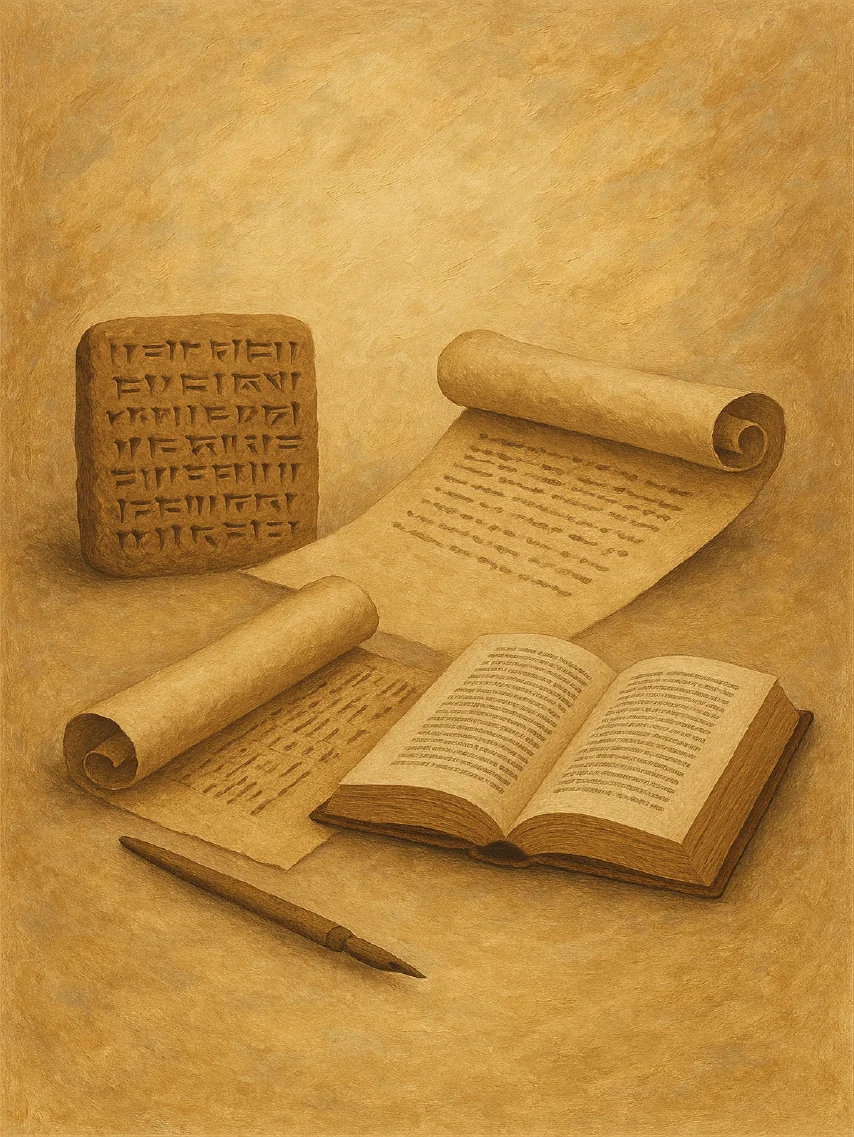
The book has traveled a long journey through the ages in terms of its physical form and industries, starting with clay tablets, writing on leather, and papyrus. The book industries have developed into what we are witnessing now of the rapid transformation towards moving from the world of printing on paper to the world of the electronic book. Our journey here with the book will be limited to the stage of printing and the paper book.
Historical Glimpse
There is a semi-agreement that China may have been the source of the first paper book. This perception stems from the fact that China is the first home of paper in the form we know, and from there its industry moved via the Arabs to Baghdad, the capital of the Islamic state at the time, where this industry expanded and developed greatly. From Baghdad, this industry moved to North Africa, then to Andalusia, and from there to Europe. Since the dawn of history, the Egyptian book was in the form of a roll of papyrus (a plant that grew on the banks of the Nile River and in the Delta marshes). The roll was divided into columns of short lines, and the book was divided into sections resembling pages. If it was to be read, the roll was spread out until the writing appeared. The oldest papyrus roll dates back to 2400 BC, although it is established that papyrus was used in writing before this date.
At the same time that papyrus was a basic material for writing, the civilization of China flourished in another location, where wooden tablets were used in writing, which were carved with a pointed instrument, and later written on with ink using a thin pen. Then the Chinese used silk, and they wrote on it with special pens. Silk was distinguished by many of the qualities of papyrus, especially in terms of its flexibility and the brightness of its surface, although it was more expensive.
Clay Tablets
The Assyrians and Babylonians used clay tablets, and the writing characters were carved on the tablets while they were wet using a tool, then these tablets were placed in ovens to gain hardness. The most famous library in Assyria is the library of King Ashurbanipal, who ordered that a classified copy of texts derived from all city and temple records be placed in it, thus making his capital a major center for Assyrian sciences.
Wax-covered Tablets
This is another type of writing material that differs from the clay tablets written on by the Sumerians and Babylonians and the papyrus written on by the Egyptians. This type of writing was known in Phoenicia, which is the area between Tyre and Sidon on the Lebanese coast. Before using wooden tablets, it was necessary to find a practical way to write on them, because the ink used by the Egyptians could be removed from the surface of the papyrus with a wet rag, making it easy to correct mistakes. If necessary, the entire surface could be cleaned and reused.
The Book in the Greek and Roman Era
Papyrus scrolls began to appear in Greece in the seventh century BC, and the largest number of discovered papyri date back to the third century BC due to the flourishing of civilization among the Greeks settled in Egypt, and the establishment of Ptolemy I of his powerful kingdom in the Nile Valley and giving Alexandria, his new capital, a superior position by establishing the greatest libraries of the ancient era, which is the Great Library of Alexandria. It included two groups: the large group in the King's Palace, and the small group next to the Serapeum Temple. The purpose of establishing this library was to collect all Greek literature in a collection of the best copies, arrange them, and comment on them. Since its inception, the library has been managed by people characterized by broad culture and abundant knowledge. The Greek book was in the form of a cylinder with a diameter of 5 to 6 cm when the papyrus scroll was folded to make it easy to hold. The scroll was no more than ten meters long and no more than thirty cm wide.
Wooden Tablets Among the Romans
Two methods were used: the first was writing the letters directly on the wood with a pen and ink, in which case the wood was painted with a white material to make the writing appear clearly. The second method was the Phoenician method itself using wax-covered wooden tablets. Several tablets were often tied with a string passing through holes, so the tablets connected in this way looked very much like a book. Parchment was also used for writing, and the Pergamum Library was credited with spreading its use. It was customary to use the skins of sheep, calves, and ats. These skins, after being completely cleaned, were placed in lime water to remove fatty substances, then dried and rubbed with chalk powder and then polished with a polishing stone, after which the skin became suitable for writing. Parchment was expensive, not because livestock was unavailable, but because the process of producing parchment was long and required great skill, and there was a grade for the quality of the parchment; the higher it was, the more expensive.
After the spread of parchment in bookmaking, it occurred to humans to make parchment into the shape that the tablets had. This progress was achieved in the early days of the Roman Empire, and the shape of the flat leather book was called (the codex). Most of these codices were written from several quires, each containing a specific number of leaves. The codex was similar in its organization to the scrolls, so that the delay in placing the title until the end of the text moved in the early ages from the scrolls to the codices. The use of the title at the beginning of the book was not popularized until the beginning of the fifth century. The means that predecessors found for producing multiple copies was using seals or making more than one copy by hand, but this means did not fulfill the increasing need for the book. Students were multiplying, costs were high, time was wasted in limited work, and the wait almost discouraged people from knowledge.
The Profession of Copying (Waraqa)
This profession flourished greatly in the Abbasid era due to the abundance of authorship, so the industry of the stationers came to produce more than one copy of a single book for benefit. Stationers' shops spread out of concern for and care for the book. The stationer was the one who copied books and added comprehensiveness to it to be a term for the book industry in all its branches. One of the oldest known by this attribution was Allan al-Sha'ubi al-Warraq, who used to copy in the House of Wisdom in Baghdad. There are many terms that denote this craft, including the writer, the scribe, the editor, the bookbinder, the dictation scribe, and other names that denote book production and publishing. It may be a shortcoming to say that stationers were just publishers, as some mention that their shops took the place of schools, libraries, and publishing houses. Their shops were a meeting place for scholars, as most stationers were scientifically cultured, participating with scholars and jurists in their research, reading, and authorship.
The Book After the Invention of Printing
While engraving on surfaces of various materials was the means of writing, there were various types of knowledge and culture. But there were no books, because the written word still lacked a basic and important characteristic of the writer in his current sense, which is the ability to move. Just as writing enabled the word to conquer time, the book enabled it to reach others and conquer space. There is no doubt that the various light and thin materials that - thirty centuries a - gave the book its different names. But the eleventh century AD brought new attempts, as the Chinese Bi Sheng found a way to make individual characters from clay used after firing. Then another attempt succeeded in Regensburg, Germany, and a third attempt in Seoul, Korea, in 1409 AD, which ended with the establishment of a vernment printing press with individual wooden characters.
These efforts were serious attempts on the road, continued by Johannes Gutenberg in the middle of the fifteenth century. He was able to cast metal characters in large quantities arranged in consecutive lines, forming page after page. The book industry was only strengthened after the emergence of printing. The credit for the appearance of the first printed document in Europe es to the year 1452 AD when Gutenberg was able to develop printing. During the subsequent years, this industry moved from printing religious books to printing books needed by ordinary people. The period following Gutenberg witnessed a great development of this industry and a huge growth in the number and titles of printed books. The emergence of universities in Europe during the twelfth and thirteenth centuries increased pressure on copyists and was the direct reason that pushed Gutenberg to invent printing, as many believe. While religious events witnessed by Europe during the fifteenth and sixteenth centuries, the appearance of relatively cheap paperback books, the establishment of book clubs, and the development of lending services in public libraries contributed to an increase in the number of printed book titles and the number of copies printed per title at the same time. All of this led to the transformation of the book into a media outlet instead of just a tool used for religious needs.
Printing went through three successive types: 1- Letterpress Printing: It is clear from observing the lines in a fingertip. If we pass a pen nib lightly over it and then press it onto a piece of paper, we would find the shape of the fingerprint printed on it. 2- Intaglio Printing: It is the exact opposite of the previous one. The ink is located low in channels representing the required writing or image. Printing occurs by scraping off the excess liquid ink from the surface representing the non-printing parts, then the paper is pressed so the liquid ink moves to it from the channels representing the drawing. 3- Planographic Printing: Here, the parts of the drawing are completely level with the background of the character. The ink rollers pass over them and yet pick them up. This method adopts the theory of fat repulsion. The clean background moistened with water does not accept ink, while the greasy parts of the drawing pick it up. This method was one of the most common at the time, and printing opened the way for the book to progress in two directions: it became possible to transfer or copy a long original quickly and easily after the appearance of the industry of extracting several copies by printing from one book. Printing caused a major revolution in the world of books. It became possible to transport numbers of these copies to any place; in other words, the written word became transported in large numbers and published with amazing speed. Thus, the picture changed completely. After the book appeared in a single copy in ancient times, situations changed, and today it has become common to print thousands and millions of copies of a book in one edition. This was accompanied by the establishment of a new industry, the publishing industry. This great change in book publishing has reached dimensions that allow what happened to be described as a revolution in the publishing industry.
In this field, we must mention the great progress in production methods and distribution methods for the increasing number of readers. Thus, the book faces a major change process to become one of the most important media means in our era. There is no doubt that books have become today the easiest and most effective way to spread thought and information of various kinds, because the written word is now transported in large numbers and at amazing speed. This idea of diffusion is considered the key that guides us in following everything related to the book, rather it is the basic axis around which any study to develop the book is built. Through the book, we can understand the problems of the current era in the field of intellectual creation, publishing, distribution, reading, and writing. There is a truth that must be emphasized at the beginning of this talk, which is that despite the multiplicity of means of knowledge transfer and cultural dissemination in this era, thanks to progress and modern technology, the book remains the basic, constant tool for learning and the primary, established means for culture. However, the reality of contemporary life confirms at the same time the growing of a new and strong phenomenon in this field, which is that the book is no longer the sole means of education and culture. Modern technology has been able, in a brilliant way, to invent new means with a tremendous capacity to transfer ideas and spread knowledge, meaning other media outlets. These different means perform their task relying on the spoken word or the visual image or both together, and thus they share with the written word its task usually performed through the book, magazine, or newspaper.
References:
1. Muhammad, Muhammad Sayyid, Book Industry and Publishing: Cairo, Dar Al-Maaref, 1988.
2. Smith, Datus C., The Book Industry from Author to Publisher, Cairo.
3. Al-Sufi, Abd al-Latif, Glimpses of the History of Books and Libraries: Damascus, Dar Tlas, 1987.
4. Mofaku, Muhammad, Writing, Books and Libraries among Ancient Civilizations in the Middle East: Arab Heritage Journal, Issue 31, 1988. p. 129.
5. Dahl, Svend, History of the Book from Ancient Times to the Present: Cairo, National Publishing Foundation, 1958.
6. Nofal, Yusuf Hassan, The Arab Library and the Book Industry, Cairo 1997.
7. Al-Jubouri, Yahya Wahib, The Book in Islamic Civilization: Beirut, Dar al-Gharb al-Islami, 1998.
8. Pedersen, Johannes, The Arabic Book from its Inception until the Era of Printing: Damascus, Al-Ahali, 1989.
9. Al-Namla, Ali bin Ibrahim, Stationers and the Most Famous Scribes: Riyadh, King Fahd National Library, 1995.
10. Razouqi, Naeema Hassan, Knowledge Transfer between the Book and the Internet: Riyadh, Author. pp. 65-70.