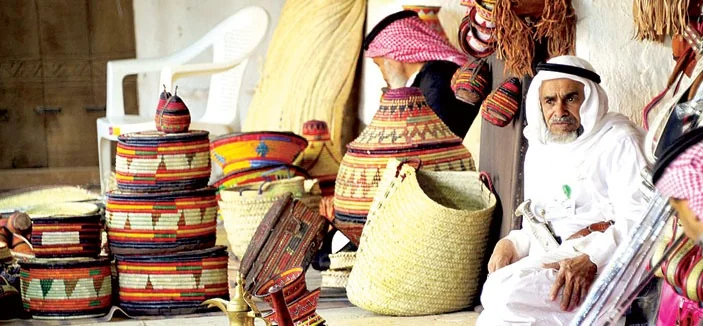
Most notably the pottery industry, carpentry, blacksmithing and tanning. The hand makes, the heritage records, and life expands in the Saudi traditional crafts and professions
Professions and handcrafts vary according to the environment and place, and according to what is produced in it. The professions of rural and desert societies differ from those of the city and its crafts. Professions in the Kingdom have diversified greatly according to its regions and its social and economic environments. Each region of the Kingdom is characterized by its professions and crafts according to the raw materials produced in it and according to the community''s customs and traditions that require the presence of certain professions and crafts such as the manufacture of fashion or textiles or jewelry or bakery products or leather or blacksmithing or carpentry, according to what the person coexists with of what has daily life necessity.
Among the regions famous for their professions is the Makkah region, as it is a vast region with diverse social and economic environments. It has urban cities of a commercial nature, villages of an agricultural nature, and others of a marine nature, and this type of diversity was reflected - without doubt - on the nature of the prevailing professions and crafts in the region. Among the professions widespread since ancient times in the Makkah region: making beads (subha), watering, tawafa, and distilling roses, especially in the city of Taif, which was famous for growing roses in the areas of Al Hada and Ash Shifa.
There are also professions: grocery (samana), fluffing (nadafa) or upholstery, sewing, and baking, which are common professions in the cities of the Makkah region and include making cakes, rusk (shabboura) and shareek, which are types of bread, as well as herbalism (attara), hair cutting, carpentry, money exchange, blacksmithing and copper smithing, and ldsmithing. There are well-known streets for ldsmiths and making traditional jewelry such as: anklets (khalkhal), rashrash, and banajer. There are other industries and crafts that are completely linked to the environment and have their long history in the Kingdom and are present in almost all regions, such as: the pottery industry which is considered one of the oldest crafts ever, from which all vessels are made from pottery like cups, plates and others like jars and pottery vases, as well as the wicker industry (khoos), one of the handcrafts widespread very greatly in the Kingdom due to the spread of palm trees.
Among the crafts present in the Kingdom: the mat craft (haseer) which specializes in making mats and they are manufactured in the form of rectangular mats spread on the floor of houses and mosques. The mat is also made of scales sewn together then the edge of the mat is folded and sewn with a rope made of reeds. Al-Ahsa region among other regions is famous for this craft due to the availability of its raw material which is the natural reed plant (asal) and the owner of this craft is called Al-Midad. Among the crafts also (blacksmithing) and among its most prominent tools are the bellows (kir), the anvil (sindan) and the hammer. Among the most important products of this craft are pots, trays, plates and many tools and supplies used in various fields. The weaving craft (hiyaka) or the art of Sadu is also one of the popular traditional industries and relies on the raw materials of the local environment and the skill of the weaver. The weaver is a folk artist who is od at dealing with woolen threads and weaving them using a simple factory called (mihak) and produces hair houses and a number of types of mattresses and rugs and some covering covers in the house and bags used for storing grains, exit bags, ropes, camel harnesses and bridles.
Making coffee pots (Al-Dillal) is one of the old crafts that entered the Kingdom and the artisans in the beginning of their work in this field used to whiten and polish them or what is called (rab al-dillal) then its industry developed and spread in the north of the Kingdom and despite its different types, they are all similar in shape and style of industry. Among the most famous are Baghdadi, Homsi, Ruslan dallah, Najdi, Hayli, Hasawi and Southern. Among the craft professions also is (tanning/leatherworking) which is an old folk craft dealing with skins with simple tools such as scissors, knives, awls (makhariz) and scrapers (majathib). The tanner produces a number of tools such as sandals, water skins (qirab), and samlan special for laban, fat containers (akak), rifle cases, belts and buckets (ghuroob). As for the primary material for the tanner, it is the skins they bring from different regions. Among the old professions that were common throughout the Kingdom and especially Makkah is the profession of watering called (suqya) and includes the waterers specialized in watering pilgrims or what is called (Al-Zamazema) and their function is watering the pilgrims and visitors of the Mosque from Zamzam water or delivering it to their homes. The waterers also carry out the transport of water from its sources and delivering it to the houses for a specific fee. The waterers transport the water in special (skins) from...