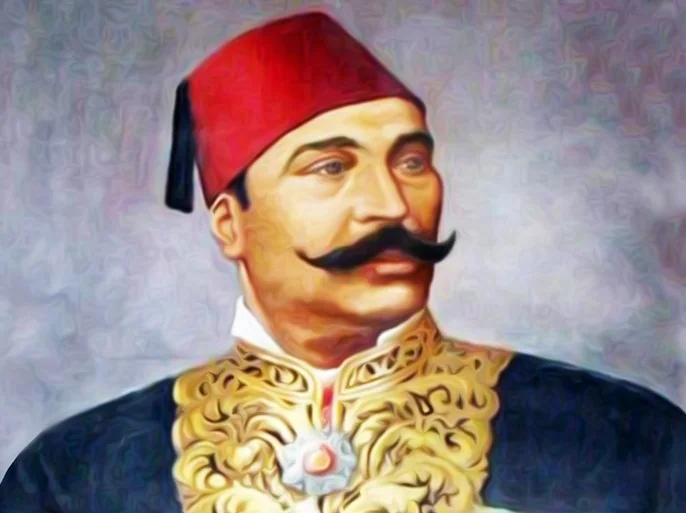
Poet Ibrahim Al-Ahdab Al-Tarabulsi: Is he the true pioneer of the Poetic Revival school?
Abdullah Al-Samti
Priority has its importance in the field of literary and cultural historiography. Regarding Arabic poetry, ancient and modern, there are still some issues and questions that have not been finally settled regarding the aesthetic formation of the Arabic poem, the creative ranking of Arab poets, and what relates to issues of influence, being influenced, and poetic plagiarism, as well as the historical priority of the emergence of a poetic form or a literary trend.
Because in Arab culture we often take generalities and seek to rest the mind from resolving dilemmas, and we accept in one way or another general information that rests the mind and does not completely rest the intellect, we have accepted in contemporary poetry - as an example - that the pioneers of the Poetic Revival school are: Mahmoud Sami Al-Baroudi, Ismail Sabry, Ahmed Shawqi and Hafez Ibrahim, without a true look at the previous poetic product, and without verifying even the hierarchy of these poets and others with other marginalized poets such as: Abdullah Fikri, Nasif Al-Yaziji, then Jamil Sidqi Al-Zahawi, Maarouf Al-Rusafi, and after them Muhammad Mahdi Al-Jawahiri.
Along with these names that are always brought up frequently and with pride when mentioning the leadership of contemporary Arabic poetry and the Poetic Revival school, a Lebanese poet is mentioned in passing, who is (Ibrahim Al-Ahdab Al-Tarabulsi) (1826-1891 AD). No focus is placed on his poetic product or his poetic aesthetics, even though he wrote more than (80,000 verses) and issued three poetic collections. In fact, it is amazing that he authored (20) novels, besides his literary books, maqamas, and diverse intellectual books, which amount to (25) books.
What concerns us here is poetry, and his writing of a distinguished poem that is no less in formation, creativity, and imagery than the poems of the poet Mahmoud Sami Al-Baroudi (Donla, Sudan, October 6, 1839 - Cairo, December 12, 1904), which makes the issue of Al-Baroudi's absolute leadership of the Revival school a leadership that needs reconsidering, and doubt in its repetition in various contexts of critical books concerned with the history of Arabic literature and poetry. Ibrahim Al-Ahdab is a competent poet who brought about a great shift in the levels of the vertical poem at that time. In fact, some of his poems, such as the Hamziyya which begins with:
What do the poets say in your praise?
And your highness, Al-Zahraa raises its origin
And d has praised you with that which
Has honored the Two Weights with praise from it
It certainly influenced the poet Ahmed Shawqi, and perhaps he opposed it, imitated it, or it passed by him while he was writing his Hamziyya influenced by Imam Al-Busiri and the poems of Al-Mutanabbi.
Reconsidering such a matter is very important for the history of literature, and in other matters that are still pending, such as the issue of the leadership of free verse and the issue of the leadership of the prose poem, its terms and concepts.
In order to show future generations the honest and correct picture of our literary and cultural history in general in a systematic, organized and effective manner.
I have reviewed a rare copy of Ibrahim Al-Ahdab's diwan and found in it everything that qualifies him for poetic leadership: solid construction, beautiful imagery, an eloquent and grand style, and attention to bright and glowing poetic language.
This is his biography excerpted from some pages on ogle from the Hindawi Foundation, Wikipedia, and the Poets Gate:
Ibrahim bin Ali Al-Ahdab Al-Tarabulsi was born in 1826 AD, in the city of Tripoli in Lebanon. He came from a family that respected knowledge, which encouraged him to obtain sciences and memorize the Holy Quran when he was not more than nine years old. He studied at the "Saqraqiya School" and the "Tawashiya School". When Ibrahim Al-Ahdab reached twenty-two years of age, he worked in teaching and his reputation spread and he gained great fame. He also traveled to the capital of the Caliphate at that time, "Astana", where he met a number of its scholars, and recited a poem praising Sultan "Abdul Hamid Khan". Then his fame grew and its resonance reached "Said Jumblatt", the ruler of the "Chouf" district; so he entrusted him in 1852 AD to be his advisor in legal issues and rulings, and perhaps he also took over teaching his children. However, the political conditions did not enable him to settle there permanently; because of the fires of internal strife that broke out following the disputes that arose between the "Druze" and the "Maronites" in 1860 AD. He returned to "Tripoli", then was appointed a deputy in the "Sharia Court" and was promoted to "Chief Clerk" of the court. In 1872 AD he traveled to Egypt and met many of its scholars. Finally, he was appointed a member of the "Education Branch" in 1888 AD.
He took over the editing of the newspaper (Thamarat Al-Funun), then was elected a member of the Education Council in Beirut, and held many Sultanate ranks. He was quick-witted, organizing the poem in one session. Among his works are (Fara'id al-La'al fi Majma' al-Amthal), (Kashf al-Arab 'an Sirr al-Adab), (Ta'hil al-Gharib), (Fara'id al-Atwaq) maqamas in ethics, and (Ninety Maqamas) in the style of Al-Hariri's maqamas, and (Kashf al-Ma'ani wal-Bayan 'an Rasa'il Badi' al-Zaman). He has about twenty novels and three poetry collections, one of which is (Al-Nafh al-Miski). What he composed is estimated at eighty thousand verses. Ibrahim Al-Ahdab Al-Tarabulsi died in Beirut in 1891 AD.